What Is a Special Illustration Rare in Pokemon TCG and Why Are They Worth So Much?
Walk into any local card shop in 2026 and the same disappointed sigh follows every booster crack: "Just another ex, no SIR." The Special Illustration Rare has become the dominant chase tier of the Scarlet & Violet era, with single cards trading from $80 to over $400 in PSA 10 condition. But the term itself confuses new collectors. SIRs aren't the same as Hyper Rares. They aren't the same as Illustration Rares (IRs). They aren't the rarest cards in the set, technically. Yet they consistently anchor the secondary market for every modern release. This guide explains what SIRs actually are, why they command such pricing, and which ones are worth chasing in 2026.
Key Takeaways
- A Special Illustration Rare (SIR) is a full-art alternate-artwork variant of an ex card, introduced with Scarlet & Violet (March 2023) and identified by the gold "SIR" stamp and unique illustration.
- SIR pull rates range from roughly 1 in 90 packs for common SIRs to 1 in 540+ packs for chase SIRs like Stellar Crown's Terapagos ex SIR.
- Top modern SIRs (Charizard ex SV151 #199, Umbreon ex Prismatic Evolutions, Pikachu ex Surging Sparks) trade $200-400 in PSA 10 condition.
- SIRs differ from Illustration Rares (IRs) in that SIRs feature ex Pokemon while IRs feature non-ex Pokemon, with different card numbering ranges and pull frequencies.
- The artwork-specific nature of SIRs makes them harder to reprint than standard ex cards, which underpins their long-term scarcity pricing.

What Is a Special Illustration Rare in Pokemon TCG?
A Special Illustration Rare, abbreviated SIR, is a full-art alternate-artwork variant of an ex Pokemon card introduced with the Scarlet & Violet base set in March 2023. Each SIR features a unique illustration showing the Pokemon in a scene or with its trainer, distinct from the standard ex card artwork in the same set. SIRs are identified by the "SIR" stamp on the card, the full-bleed artwork extending to the card edges, and card numbers above the official set total (for example, card 199/165 in SV151 indicates the SIR variant beyond the base 165-card numbered set).
SIRs replaced the older Alternate Art (Alt Art) category from the Sword & Shield era. The mechanics are similar: a sought-after pull featuring storytelling artwork rather than competitive utility. The presentation evolved with new foil patterns and tighter pull rates, and the SIR designation now anchors collector demand for almost every Scarlet & Violet era release.
The defining feature of an SIR is artwork uniqueness. The same Pokemon will have a standard ex card with one piece of artwork and an SIR with completely different artwork by a different illustrator, often showing the Pokemon in habitat or interacting with a human character. This is why SIRs feel like collectibles rather than gameplay tools: the visual storytelling is the entire point.
How SIRs Differ from Illustration Rares (IRs) and Hyper Rares
The Scarlet & Violet rarity tier system has confused new collectors since launch, and the SIR/IR distinction is where most people get lost. The cards look similar, both are full-art, both feature unique illustrations, but they are not the same product.
| Rarity | Pokemon Type | Pull Rate | Card Number | Stamp |
|---|---|---|---|---|
| Illustration Rare (IR) | Non-ex Pokemon | ~1 in 12 packs | Above set total | "IR" |
| Special Illustration Rare (SIR) | ex Pokemon | ~1 in 90-540 packs | Above IRs | "SIR" |
| Hyper Rare | Various (gold border) | ~1 in 100-200 packs | Highest in set | "HR" (gold) |
| Ultra Rare (ex) | ex Pokemon | ~1 in 4-6 packs | Within set total | None |
The cleanest way to spot the difference is the Pokemon featured. SIRs always feature ex Pokemon (look for "ex" after the Pokemon's name on the card). IRs always feature non-ex Pokemon. Both have full-bleed alternate artwork, but the Pokemon type and the pull rate diverge sharply.
The other common confusion is SIRs versus Hyper Rares. Hyper Rares feature gold borders and metallic foil treatment across the entire card, including the artwork. SIRs feature standard borderless full-art with regular foil. Hyper Rares pull at slightly different rates than SIRs and target a different collector aesthetic, though some collectors chase both as set completion goals.
Why Do SIRs Command Such High Prices?
SIR market pricing isn't arbitrary. Five structural factors compound to drive valuations from 5x to 50x the standard ex variant of the same Pokemon.
Pull rate scarcity. SIRs are among the rarest pulls in any modern set. The Stellar Crown Terapagos ex SIR pulls at approximately 1 in 540 packs based on TCGplayer Infinite's tracked data, and even more common SIRs sit at 1 in 90-150 packs. Compare this to ultra rare ex cards at 1 in 4-6 packs and the supply differential is enormous.
Artwork-specific demand. Each SIR has unique illustrator-driven artwork that cannot be replicated by reprints. Even if The Pokemon Company prints a promotional ex card with the same Pokemon, it will not have the same artwork, and serious collectors care about the specific illustration. This insulates SIRs from the reprint risk that haunts standard ex cards.
Mainline mascot concentration. The most expensive SIRs feature mainline characters: Charizard, Pikachu, Eeveelutions, Mewtwo, Mew. These Pokemon have permanent demand floors that secondary characters never reach. The Charizard ex SIR from SV151 trades around $234 in PSA 10 condition based on TCGplayer market data, while equivalent SIRs of less iconic Pokemon trade at half or less.
Grading attrition. The full-bleed artwork on SIRs makes edge whitening and surface damage easier to spot during grading. PSA 10 yields on SIRs run roughly 25-35% based on PSA Population Report data, lower than the 40-50% gem rate on standard modern cards. This means PSA 10 supply is structurally constrained even as raw supply grows.
Cross-market arbitrage. Many SIRs have Japanese parallel cards trading in active Japanese markets, which creates buy-side pressure across borders. Asian buyer demand for English-language modern slabs surged after 2024, adding a buyer pool that didn't exist when modern was last "hot" in 2021.

The Most Valuable SIRs in 2026
Not all SIRs are created equal. The market has clear tiers, and understanding which SIRs anchor their respective sets helps both buyers and sellers price the rest of the market.
The Charizard ex SIR 199/165 from Scarlet & Violet 151 sits as the blue chip modern SIR, trading roughly $234 in PSA 10 condition with a thinner pop than collectors realize. The Charizard ex SIR 223/197 from Obsidian Flames runs $220-300 in PSA 10 with stronger recent appreciation, up roughly 14% over the past 30 days per PriceCharting.
The Umbreon ex 161/131 from Prismatic Evolutions became the most-graded modern Pokemon card in history, with 14,276 total PSA submissions and 4,418 PSA 10 copies. Despite the high pop, the mainline Eeveelution mascot demand keeps prices elevated. The Pikachu ex SIR 238 from the same set has 7,374 PSA 10 copies and trades at approximately $268 raw.
The contrarian value plays in 2026 are not these blue chips. They are low-attention Illustration Rares with sub-500 PSA 10 populations from sets that didn't generate hype at release. Squirtle IR from Prismatic Evolutions, with roughly 112 confirmed PSA 10 copies, represents one of the scarcest chase pulls in modern relative to its collector appeal. We covered this contrarian framework in detail in our modern chase card investment guide.
Are SIRs Worth Buying or Pulling Yourself?
The buy-versus-pull math depends on which SIR you're after. For SIRs trading under $100 in PSA 10, ripping packs to chase them rarely makes financial sense. A Booster Box at $144 yields 36 packs, and at 1 in 150 pull odds for a specific SIR, you'd expect to open four boxes ($576) to hit one copy on average. Buying a graded copy at $80 is the rational choice. The full sealed product math is in our ETB vs Booster Box ROI breakdown.
For SIRs trading above $250 in PSA 10, the calculus shifts. Pack opening becomes a lottery ticket where the upside scales with the chase card's price floor. Most collectors who break even or profit from sealed product opening are doing it on sets with multiple high-value SIRs (Charizard SV151, Umbreon Prismatic Evolutions) rather than sets with one flagship SIR and bulk filler.
The most rational approach for serious collectors is hybrid: rip a single Booster Box per major release for the experience and chance hits, and buy graded copies of the SIRs you actually want for your collection. This caps downside on the opening side and guarantees you end up with the cards you care about.
How to Protect SIRs After You Pull or Buy Them
The full-bleed artwork that makes SIRs valuable also makes them vulnerable. The borderless edges show whitening damage immediately, and the foil surface scratches more easily than standard cards. PSA 10 yields drop from 35% to under 20% on SIRs that get casually handled for a year before grading.
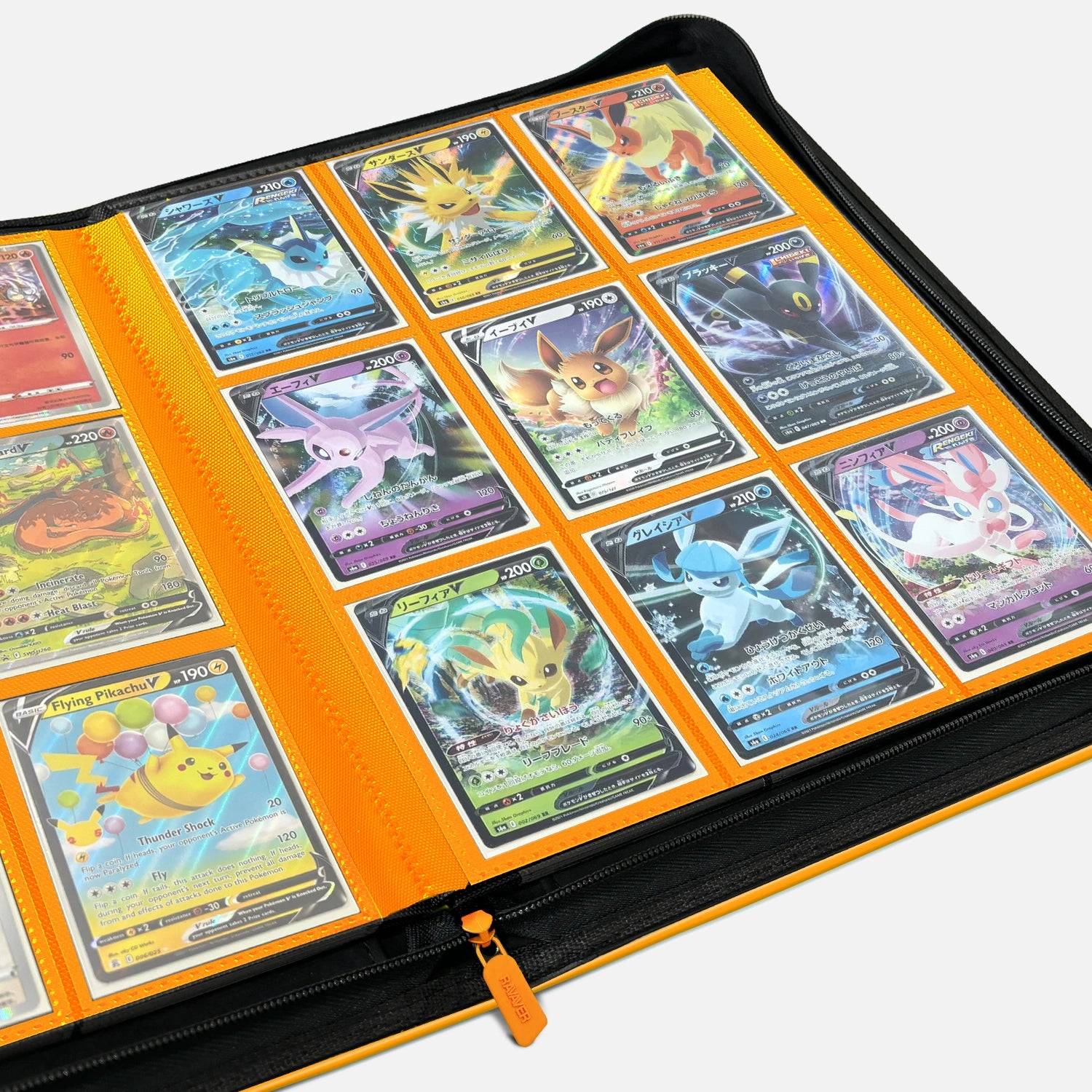
Raw SIRs intended for grading should go directly from pack to penny sleeve to top loader, then to a card binder with side-loading sleeves to prevent slide-in edge contact. Buying a side-loaded toploader binder with custom artwork is the storage standard most serious collectors converge on for chase pulls. We've covered the broader card protection workflow in our complete protection guide.
Frequently Asked Questions
What does SIR stand for in Pokemon TCG?
SIR stands for Special Illustration Rare. It is the rarity designation for full-art alternate-artwork ex cards introduced with the Scarlet & Violet base set in March 2023. The card features unique illustration distinct from the standard ex variant, plus the "SIR" stamp on the card face.
What is the difference between an SIR and an IR?
The SIR (Special Illustration Rare) features ex Pokemon and pulls at roughly 1 in 90 to 1 in 540 packs, while the IR (Illustration Rare) features non-ex Pokemon and pulls at roughly 1 in 12 packs. Both have full-bleed alternate artwork, but SIRs are significantly rarer and more valuable on average.
How rare is a Special Illustration Rare?
SIR pull rates vary by set and specific card. Common SIRs pull at approximately 1 in 90-150 packs, while chase SIRs like the Stellar Crown Terapagos ex SIR pull at roughly 1 in 540 packs. SIR rates have measurably tightened since Surging Sparks (November 2024) compared to earlier 2023 sets.
Are SIRs a good investment?
SIRs of mainline mascot Pokemon (Charizard, Pikachu, Eeveelutions) with PSA 10 populations under 1,000 have historically outperformed broader Pokemon market averages over 24-36 month holds. SIRs of secondary characters or competitive-only Pokemon underperform. The investable subset is roughly 5-10% of all SIRs released, not the entire category.
What is the most expensive SIR in 2026?
The Charizard ex SIR 199/165 from SV151 leads modern SIR pricing at approximately $234 in PSA 10 condition. Several vintage-ported Charizard SIRs, the Umbreon ex from Prismatic Evolutions, and select Eeveelution SIRs trade in similar $200-400 ranges. Specific record sales for low-pop graded copies have exceeded $500.
Can SIRs be reprinted?
SIRs are technically reprintable, but the unique illustrator artwork creates significant scarcity protection. Even when The Pokemon Company prints a promotional ex card of the same Pokemon, the artwork differs, which preserves the original SIR's value. This is the structural reason SIRs hold value better than standard ex cards over multi-year holds.
Your Next Step
If you've pulled an SIR worth grading, get it sleeved and into a top loader before another week of edge wear costs you a half-grade at PSA. If you're considering buying SIRs as collection pieces or investments, focus on sub-1,000 PSA 10 populations of mainline mascot Pokemon and skip everything else. Most collectors who lose money on modern Pokemon are buying hype SIRs at peak rather than waiting for the supply trough at month 12-18.
Sources:
- PSA, Population Report, retrieved 2026-05-07, https://www.psacard.com/pop
- TCGplayer Infinite, Stellar Crown Pull Rates, retrieved 2026-05-07, link
- PriceCharting, Charizard ex 223 Obsidian Flames Price History, retrieved 2026-05-07, link