PSA grades roughly 90,000 cards a day in 2026, six times the daily throughput it ran in 2021. That capacity expansion changed the grading calculus completely. Wait times collapsed from 12 months to weeks for many tiers. Premiums on PSA 10 versus PSA 9 narrowed for some chase cards as supply caught up with demand. CGC kept undercutting on price. BGS shifted toward dual-grade and subgrade strategies as collectors stopped paying flat 10s. The right grading choice in 2026 depends on math most comparison articles refuse to do.
Key Takeaways
- Pokemon grading ROI is grade premium minus all-in cost minus depreciation risk, not turnaround time and price tier alone.
- PSA scaled from approximately 15,000 cards graded daily in 2021 to approximately 90,000 in 2026, dramatically improving turnaround across service levels (PSA, February 2026).
- PSA February 2026 pricing update consolidated TCG Bulk and Value Bulk into a single Collectors Club service, raising the entry bar for low-value submissions.
- CGC and BGS make sense for specific card categories where their grading style commands market premiums, not as default PSA alternatives.
- Grading a card raw-worth under $80 rarely produces positive ROI in 2026 across any of the three services after fees, shipping, and insurance.

What is the actual ROI formula for grading a Pokemon card?
The right ROI formula has four terms, not two. Most comparisons stop at price and turnaround. Real grading ROI is: (sale price at expected grade) minus (grading service cost) minus (round-trip shipping with insurance) minus (probability-weighted depreciation if the grade lands below target). The last term is what separates profitable submissions from losing ones.
Here is the formula in operation. A card valued at $200 raw, expected to grade 9 with 60% probability and 10 with 35% probability, sent to PSA at the $40 service level. The 9 sells at $300 and the 10 sells at $700. The expected sale value is (0.35 × $700) + (0.60 × $300) + (0.05 × $180) = $245 + $180 + $9 = $434. Subtract $40 grading, $30 round-trip insured shipping, and the expected profit is $364, before considering submission management time. Net ROI on the $200 card is roughly 80%, which is a real win.
Now the same card with weaker centering, expected to grade 9 at 75% and 8 at 20%. PSA 8 sells at $220, barely above raw. Expected sale becomes (0.05 × $700) + (0.75 × $300) + (0.20 × $220) = $35 + $225 + $44 = $304. Subtract grading and shipping and you net $234. Still positive but the math gets thin fast on borderline cards. Below an expected 90% probability of hitting at least the second-best grade, most submissions stop being profitable.
The threshold question: what raw value justifies grading at all?
For 2026 PSA pricing, the rough breakeven raw value sits around $80 for cards likely to grade 9 or 10 with high confidence. Below $80 raw, the grading cost plus shipping eats the upside even on a successful 10. CGC and BGS shift this threshold by $10-20 in either direction depending on category and current market premium for their slabs. Cards under $50 raw should rarely be graded except for sentimental keep-only purposes.
How does PSA stack up in 2026?
PSA remains the dominant Pokemon grading service by population and by realized auction comps. PSA's February 2026 pricing update kept service tier structure intact for most submitters but consolidated bulk-tier eligibility behind a Collectors Club membership, effectively raising the floor for casual graders. The Value, Regular, Express, and Super Express tiers still exist with current turnaround estimates published on the PSA submission updates page.
The PSA premium is real for Pokemon. PSA 10 versus raw multiples on common chase cards from Evolving Skies, Lost Origin, and Crown Zenith routinely hit 4-8x in 2026 sale comps. PSA 9 multiples hit 1.5-2.5x raw. CGC 10 and BGS 9.5 trade at narrower premiums, typically 2-4x raw on the same cards, because the buyer pool prefers PSA slabs at resale.
The capacity expansion changed PSA's tier strategy. With 90,000 cards a day flowing through PSA grading rooms in 2026, the bottleneck shifted from grading capacity to submission processing and quality consistency. The trade-off most submitters notice is that PSA's modern grading consistency varies more than it did during the slow-throughput era. Borderline 9-or-10 cards now require more submitter judgment.
When PSA is the obvious choice
Default PSA for English-language modern Pokemon cards above $80 raw with strong centering, surfaces, and edges. Default PSA for vintage Wizards-era Pokemon (1999-2003), where the resale premium for PSA over alternatives is largest. Default PSA for any card you intend to consign through PWCC, Goldin, or Heritage, since their auction infrastructure is calibrated to PSA-graded comps.
Where does CGC make sense for Pokemon?
CGC entered Pokemon grading aggressively after 2020. Their pitch was lower price, faster turnaround, and pristine slab presentation. CGC succeeded in capturing market share for Japanese-language cards, where their global footprint and slab clarity earned a niche. For Japanese Pokemon submissions, CGC and BGS often close the price gap with PSA at resale, sometimes exceeding it for specific Japanese chase cards.
CGC also makes sense for cards where the slab presentation matters more than the resale liquidity. Display collectors, set registry builders within CGC's own registry system, and submitters in regions where CGC has faster international logistics use CGC consistently and rationally.
The market gap is real on English modern. A CGC 10 of a Mew ex SIR will typically sell for 60-75% of what the equivalent PSA 10 sells for in 2026. That gap closed slightly during 2024-2025 as PSA backlog pushed casual submitters to alternatives, but the structural preference reasserted as PSA capacity expanded.
When CGC is the right call
Choose CGC for Japanese Pokemon submissions where the resale premium gap with PSA is narrowest. Choose CGC for cards where you want a clean perfect-grade slab for personal display rather than maximum resale value. Choose CGC when PSA Value-tier wait times spike beyond your timeline and the card needs to ship before a known auction window. The CGC Black Label Perfect 10 designation also commands a small premium above their regular 10 grade for buyers who chase the absolute-grade aesthetic.

Where does BGS still earn its premium?
BGS occupies the smallest market share for Pokemon in 2026 but earns specific premiums in two scenarios. First, vintage Pokemon with subgrades that disclose a true Pristine 10 or Black Label 10 (all four subgrades at 10) command extreme premiums above PSA 10 equivalents. Second, BGS dual-grade for autographed memorabilia carries weight in the Pokemon-adjacent collectibles market.
For non-Pristine BGS grades, the math gets harder. A BGS 9.5 typically sells at 70-85% of a PSA 10 on the same modern card. The BGS 9 sells closer to a PSA 9. The full subgrade disclosure that BGS provides cuts both ways: a 9.5 with disclosed weak centering becomes harder to sell than an opaque PSA 9.
BGS also slows down submitters who are not pursuing pristine-tier outcomes. The grading cost runs slightly higher than CGC and slightly lower than PSA Express. The slab is heavier and harder to display. The math only works when the card has clear pristine potential.
Real 2026 comp examples that flip the standard advice
Three scenarios where the conventional wisdom breaks down:
Scenario 1: Modern English chase card with mild centering issue. Pikachu ex Special Illustration Rare from Surging Sparks, raw $250, mild left-edge offset. PSA likely grades 8 with 50% probability, 9 with 40%. PSA 9 sells around $400, PSA 8 around $290. Expected PSA payoff: (0.40 × $400) + (0.50 × $290) + (0.10 × $230) = $328 net of grading. CGC likely grades 9 at 50%, 9.5 at 30%, with the centering more forgiving. CGC 9 sells $280, CGC 9.5 sells $360. Expected CGC payoff: (0.30 × $360) + (0.50 × $280) + (0.20 × $230) = $294. The PSA expected value still wins, but the variance on PSA is wider. Risk-adjusted, the gap narrows enough that submitter risk tolerance becomes the deciding variable.
Scenario 2: Japanese promo card. A Japanese promotional Pikachu Illustrator print, raw value $1,800. PSA premium for Japanese grading exists but compresses to roughly 1.4-1.6x of CGC equivalent. Grading service cost similar at this value tier. CGC grades faster on average for Japanese submissions. The right answer is usually CGC unless the buyer pool is specifically PSA-anchored, like an English-market consignment auction.
Scenario 3: Vintage Wizards card with pristine potential. 1999 Base Set Holographic Charizard, raw $1,500 with pack-fresh appearance. Triple-graded path: send to BGS first, hope for Pristine 10. If it grades a flat BGS 9.5 with mid-grade subgrades, the resale gap to PSA 10 is wide enough that crossing to PSA after the BGS result is sometimes the optimal move. BGS Pristine 10 of vintage Charizard exceeds PSA 10 comp by 30-60% in 2026 auctions. Submitters who chase that ceiling accept the variance.
[REDDIT VOICE] The Pokemon grading community pattern in 2026 is consistent: PSA is the default unless the submitter has a specific reason to deviate, and "specific reason" usually means Japanese cards, BGS pristine pursuit, or a CGC display preference. Submitters who chase price arbitrage by sending mass volume to whichever service is cheapest that month tend to underperform submitters who pick a service per card.
The hidden cost most ROI models skip
Submission management time. Packing 10 cards for grading takes 90 minutes when done correctly with semi-rigid holders, top loaders, sleeves, and form completion. Round-trip insured shipping requires post-office time and tracking management. Receiving and re-photographing graded cards for sale listings takes another hour per slab. Across a 10-card submission, you are committing 6-8 hours of focused work.
If your effective hourly rate is $50, that submission carries $300-400 of opportunity cost in your time. The grading ROI math has to clear that hurdle on top of cash costs. For high-volume submitters, this argues for either fully systematizing the workflow or restricting submissions to cards where the upside justifies the time investment. For occasional submitters, this argues for higher per-card thresholds before grading.
Frequently Asked Questions
How much does PSA grading cost in 2026?
PSA's February 2026 pricing update kept tiered service levels with Value, Regular, Express, and Super Express options. Exact pricing varies by declared value of the card. The Bulk tier consolidated under Value Bulk, requiring Collectors Club membership. Most modern submitters operate at the Value or Regular tiers, which currently price in the $25-75 per card range depending on declared value and service speed.
Is CGC cheaper than PSA for Pokemon?
CGC has historically priced below PSA at equivalent service tiers, sometimes by 25-40% per card. The price advantage exists. The resale market discount for CGC slabs versus PSA slabs on equivalent English Pokemon cards typically exceeds the grading cost savings, which is why CGC pricing alone rarely tips the ROI math toward CGC for English market resale.
Why do PSA 10 cards sell for so much more than PSA 9?
The PSA 10 premium reflects a combination of perceived perfection, set registry demand, and the fact that PSA 10 populations stay relatively scarce on premium chase cards even after capacity expansion. The buyer pool for set registries and high-end collectors specifically targets 10s. Population reports from PSA's pop database show that for many modern chase cards, PSA 10s represent under 30% of total submissions, which sustains the premium.
Should I cross my CGC slabs to PSA?
PSA offers a crossover service that grades cards still in CGC or BGS slabs and re-encapsulates them into PSA holders if the grade meets your threshold. Cross only when the price gap between your current grade and the equivalent PSA grade exceeds the crossover cost plus shipping plus the risk that the new grade lands lower than the original. For modern chase cards with $200+ premium gaps, crossover often makes sense. For midrange cards, the math rarely works.
What about subgrades on BGS slabs?
BGS subgrades disclose centering, edges, corners, and surface scores individually. The disclosure is double-edged. A BGS 9.5 with all 9.5 subgrades and one 10 sells at a premium. A BGS 9.5 with a centering 8 trades at a discount because buyers can see the weakness. PSA's opaque grading hides those individual scores. For pristine-tier vintage cards, BGS subgrades amplify upside. For midrange cards, opacity favors the seller.
How long does PSA grading take in 2026?
Turnaround estimates depend on tier and current submission volume. PSA's published estimates for 2026 run from a few business days at the Super Express tier to several weeks at the Value tier. The capacity expansion to 90,000 cards graded daily collapsed the multi-month wait times that defined the 2021-2022 backlog. PSA explicitly notes that turnaround estimates can change rapidly without notice when submission volume spikes.
Are there any cards where I should not grade at all?
Yes. Cards under $80 raw rarely produce positive ROI after fees. Cards with visible printing defects, off-center tolerance issues, or surface scratches grade lower than expected and lose the grading bet. Heavily-played vintage cards typically grade 4-6 and trade at minimal premium to raw. Cards held for emotional or sentimental value alone do not need a grade to satisfy that purpose.
Build your grading decision rule this month
Pull every card in your collection currently sitting in a top loader you intended to grade. For each, write the raw price, the expected grade with probability, and the resale premium for that grade across PSA, CGC, and BGS. Apply the four-term ROI formula. Anything that comes in below 30% expected return after costs and time goes back into the binder ungraded. Anything between 30% and 100% goes to the right service per the criteria above. Anything above 100% expected return is high-conviction and probably belongs at PSA at the most appropriate tier.
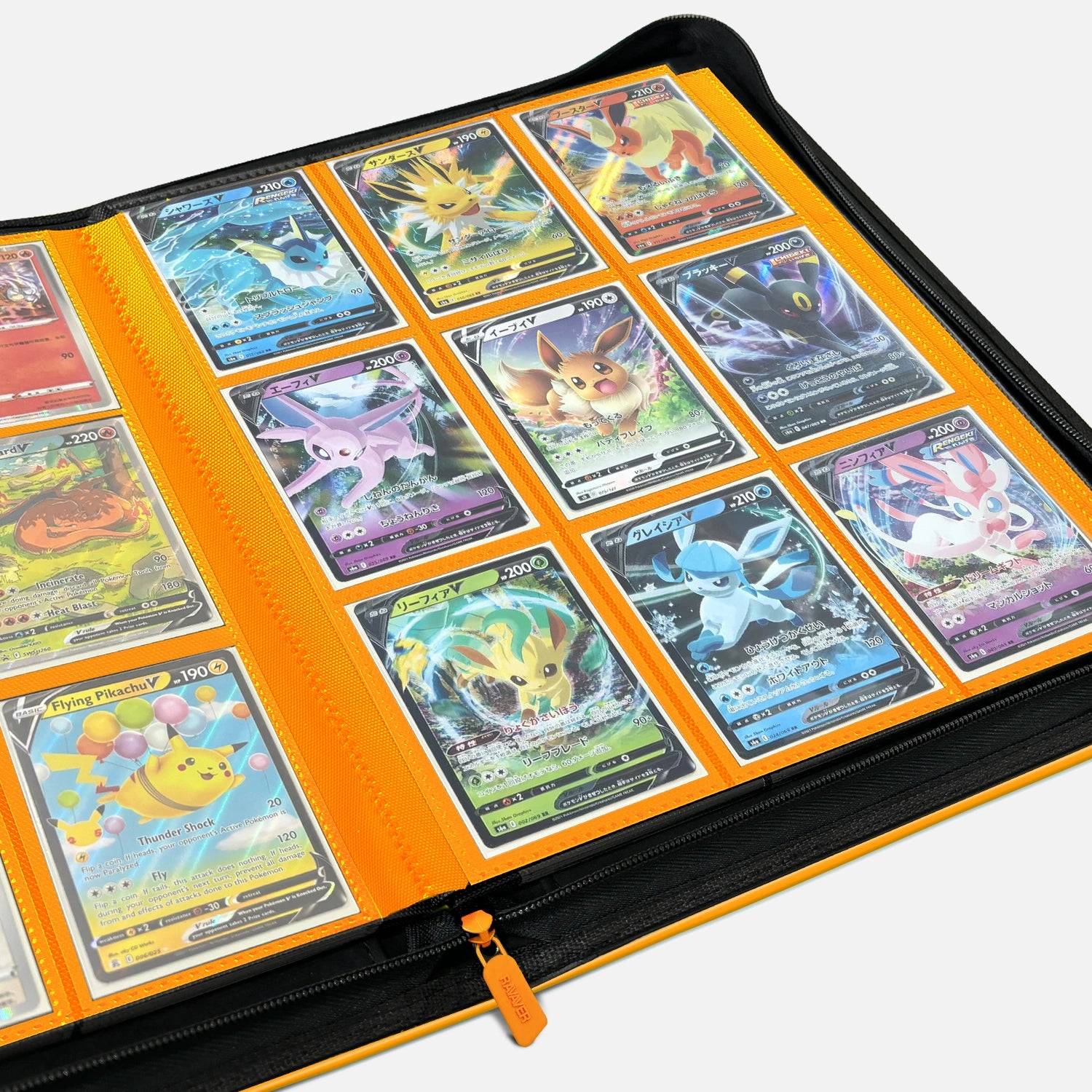
Storage matters between submission and resale. Graded slabs need rigid storage that protects the slab itself, separate from the soft toploader and binder ecosystem you used pre-grading. A dedicated Ravaver toploader binder handles the pre-grading inventory while graded slabs live in slab boxes or graded card binders sized for the larger slab dimensions.
Sources:
- PSA, Grading Services Update February 2026, retrieved 2026-05-05, https://www.psacard.com/articles/articleview/15663/grading-services-update-february-2026
- PSA, Pricing and Estimated Turnaround Time Updates, retrieved 2026-05-05, https://www.psacard.com/info/submission-updates
- PSA, Updates to Estimated Turnaround Times, retrieved 2026-05-05, https://www.psacard.com/articles/articleview/15625/updates-to-estimated-turnaround-times
- PSA, Official Trading Card Grading Service, retrieved 2026-05-05, https://www.psacard.com/services/tradingcardgrading
- Beckett, Trading Card Grading Service Levels Pricing Turnaround Times, retrieved 2026-05-05, https://www.beckett.com/grading-pricing-turnaroundtimes