Every grading guide on the internet tells you which cards to grade. Almost none tell you which cards to leave raw, even though that decision saves master set builders more money each year than any submission optimization. After running grading EV math on thousands of master set candidates, the same seven categories of cards repeatedly fail the test. Submitting them is the most common $200 mistake new master set collectors make. Here is the list, with the math behind each one.
Key Takeaways
- Reverse holos, modern commons and uncommons, recently reprinted cards, and damaged cards almost always fail grading EV — the post-slab market value doesn't cover the submission cost.
- Mid-tier modern holos in the $3 to $10 raw range often look gradable but rarely clear positive EV after the true-cost calculation.
- Cards intended for binder display lose option value when slabbed — even high-value ones, if your master set plan is a display showpiece rather than a liquidation track.
- The PSA 9 trap: cards likely to grade 9 rather than 10 are often worse than raw market value after fees, because PSA 9 premiums on modern cards run only 1.0 to 1.3x raw.

1. Reverse holos from any modern set
Reverse holos are the single most common grading mistake. The math is brutal: a Scarlet & Violet reverse holo trades at $0.25 to $1 raw and a PSA 10 reverse holo of the same card trades at $6 to $12. The headline ratio looks like a 6x to 12x lift, which sounds tempting. The absolute dollars do not work. A $0.50 reverse holo graded for $25 to $37 in true cost and sold at $9 PSA 10 nets a loss after the 13.5 percent eBay fee.
The only exception is reverse holos from sets with crossover alt-art rarity or extreme print scarcity. Outside those edge cases, leave every reverse holo in the binder.
2. Commons and uncommons (yes, even "perfect" ones)
The argument for grading commons is always the same: "a PSA 10 common from Base Set sells for $80." That's true for Base Set, sometimes. For modern commons, PSA 10 prices cluster at $4 to $8 against $0.10 to $0.50 raw. The submission cost alone exceeds the resale, before you account for shipping, supplies, or the opportunity cost of the slot in your Value Bulk submission.
The exception worth noting: modern starter Pokemon commons from rookie-card-style sets (a McDonald's promo of a debut Pokemon, for example) can occasionally hold value. Check sold listings before submitting any common. Default answer is no.
3. Cards from the year's heaviest-reprinted set
Reprint exposure is the underdiscussed killer of grading EV. The pattern: a card hits PSA 10 at $80 in year one of its release. The card gets reprinted in a special expansion, a Pokemon Center exclusive, or a McDonald's promo. PSA 10 price drops to $30 to $50 within 12 months. Anyone who graded at the year-one price ate a 40 to 60 percent capital loss on the slab.
Veteran collectors track reprint risk by looking at whether a card is from a set that Pokemon's print-management cycle suggests will get reprinted, whether the card features a top-tier Pokemon (Charizard, Pikachu, Mew, Eevee — these get reprinted more), and whether there are public statements about upcoming special products. When risk is high, leave the card raw and watch the market.
4. Cards with any visible centering issue (the PSA 9 trap)
This is the trap that catches collectors with okay-but-not-mint cards. The card looks clean, but factory centering is 60/40 left to right. Submit it and PSA grades it a 9 rather than a 10. PSA 9 prices on modern cards run 1.0 to 1.3x raw, meaning the slab cost wiped out the modest premium. The card is now worth roughly what it was raw, minus the $25 to $37 you paid to grade it.
The honest filter: if you have to squint to decide whether the centering is 50/50 or 55/45, the answer is the card grades 9. Modern PSA standards are strict on centering. Leave borderline candidates raw.
5. Damaged cards "because they might still grade 8"
PSA 8 prices on modern cards trade below raw market for most cards, because buyers prefer ungraded mint copies they can re-grade themselves. Submitting a card with visible edge wear, surface scratches, or print defects in the hope of a PSA 8 is almost always a net-negative move. The slab cost exceeds the premium delta.
Vintage cards flip this. A Base Set Charizard in genuine PSA 7 condition sells well into the $1,000+ range, so even mid-grade vintage submissions can clear the math. For modern, PSA 8 is the cutoff below which grading destroys value.
6. Cards you'll never realistically sell
This is the philosophical one. A slab is a liquidation tool. If a card is in your master set because it has personal significance — the first SIR you ever pulled, the chase your kid hit at her first prerelease — grading it adds zero value to you and roughly $30 of cost. The PSA 10 score is a number for buyers, not for you.
The honest test: would you ever list this card for sale at any price? If the answer is no, don't grade it. Display it raw in your binder where you can actually see the texture, foil pattern, and details that the slab will obscure behind a thick acrylic shell.
7. Cards from sets where the PSA premium has compressed below 5%
For some recent modern sets, the gap between PSA 10 prices and high-grade raw prices has compressed so far that grading no longer pays. A modern hyper rare trading at $40 raw and $45 PSA 10 doesn't justify the $30 true grading cost. The slab makes the card 12 percent more valuable and costs you 75 percent of its raw price to obtain.
Check sold listings before assuming any modern card carries a meaningful PSA premium. The 2025 to 2026 market has compressed modern premiums broadly, and many cards that earned their slab in 2022 no longer do.
The pattern across all 7 categories
Every card on this list shares one trait: the absolute dollar gap between raw and PSA 10 prices does not cover the true cost of grading. That is the only test that matters. Percentage lifts can look attractive on cheap cards (a $0.50 to $9 reverse holo is an 18x lift) and still produce a net loss after fees. Veteran master set builders trained themselves to evaluate gradability in absolute dollars only.
| Card type | Typical raw $ | Typical PSA 10 $ | Net after $30 true cost |
|---|---|---|---|
| Modern reverse holo | $0.50 | $9 | -$23.21 |
| Modern common | $0.30 | $6 | -$25.19 |
| Reprinted modern holo (post-reprint) | $8 | $25 | -$16.38 |
| PSA 9 trap (60/40 centered) | $20 | $26 (sells at PSA 9 price) | -$27.51 |
| Compressed-premium modern hyper rare | $40 | $45 | -$31.07 |
The negative numbers are not theoretical. Every one of them represents a category of submission I've seen master set builders make in the past two years, usually because they followed a generic "grade your collection" guide that didn't sort by EV.

What to do with the cards on this list
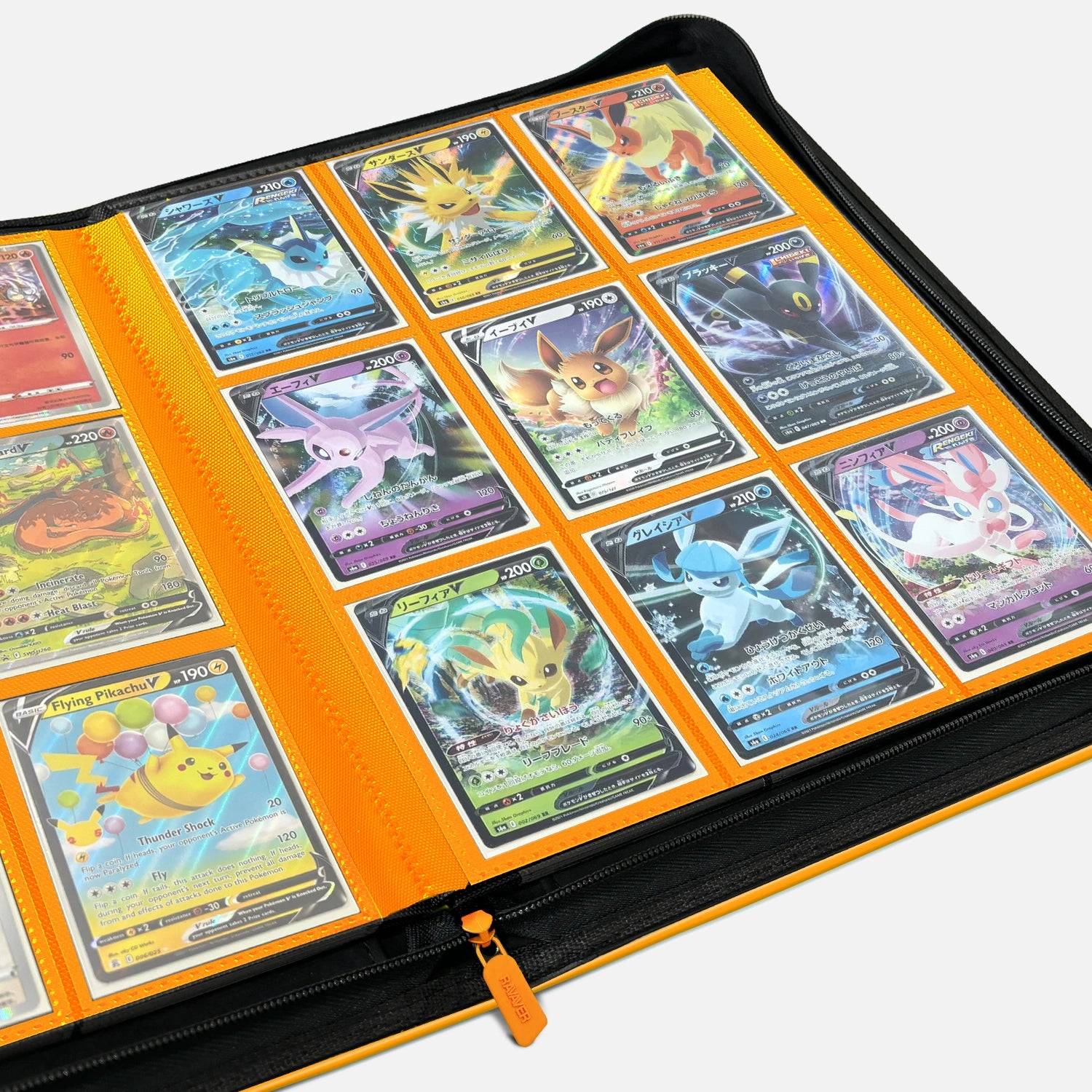
The 60 to 70 percent of your master set that doesn't pass grading EV needs a home. The home is a proper binder. Storage upgrades from a generic 9-pocket to a premium toploader-compatible binder cost a fraction of one PSA submission, and they protect the entire ungraded portion of the set in a single object you can actually hand to a friend at trade night. Ravaver's toploader-friendly binders are designed for exactly this slot in the master set workflow.
Storage is the lever most collectors underweight. A $60 binder protecting 200 ungraded master set cards earns its keep across decades. Grading the same 200 cards would cost $5,000 to $7,000 and produce a worse outcome on every dimension except the slab aesthetic.
Frequently Asked Questions
What's the most common grading mistake master set collectors make?
Submitting reverse holos and commons "to round out the bulk minimum." The math on these categories is reliably negative — a $0.50 reverse holo graded for $30 true cost and sold at $9 PSA 10 nets a $23 loss after eBay fees. Bulk minimums should be filled with positive-EV cards or held for the next batch.
Should I grade my Base Set commons?
Generally no. Vintage commons in PSA 10 from Base Set sometimes hit $30 to $80, but the population for clean Base Set commons is large and rising, and the per-card true grading cost ($30 to $40) is a meaningful percentage of the projected sale. Reserve vintage grading for holos and key cards.
How do I tell if a card is centered well enough for PSA 10?
Hold the card vertically against a hard light source. Measure the white border on the left versus the right at the front. A 55/45 ratio is usually a PSA 10 candidate; 60/40 is usually a PSA 9. Modern Pokemon centering tolerance is strict, and PSA's published standards reflect that.
What if my modern hyper rare has a small surface scratch?
Almost certainly not worth grading. A surface scratch caps the card at PSA 7 to 8, which on modern cards trades below raw mint copy prices. The exception is if the card is extremely scarce and any third-party authentication adds resale confidence — but check sold listings first.
Is grading reverse holos ever worth it?
For modern sets, almost never. For vintage WOTC reverse holos (which technically didn't exist) or for special edition crossovers like Pokemon Center exclusives where the reverse pattern is part of the rarity, the math can flip. Default assumption: leave reverse holos raw.
Actionable next step
Go through your last completed grading submission and identify any cards from these seven categories. Calculate the net EV after the $30 to $37 true cost. If the total is negative, you have a data point for next time. The collectors who consistently profit from grading aren't the ones who submit the most cards — they're the ones who submit fewer, better cards. For the framework that gets you to that filter, see our When to Grade Cards from Your Pokemon Master Set pillar and the True-Cost Worksheet for the per-card cost numbers.
Sources:
- PSA, Grading Standards, retrieved 2026-05-20, psacard.com/gradingstandards
- PSA, Population Report, retrieved 2026-05-20, psacard.com/pop
- PSA, Pricing and Estimated Turnaround Time Updates, retrieved 2026-05-20, psacard.com/info/submission-updates