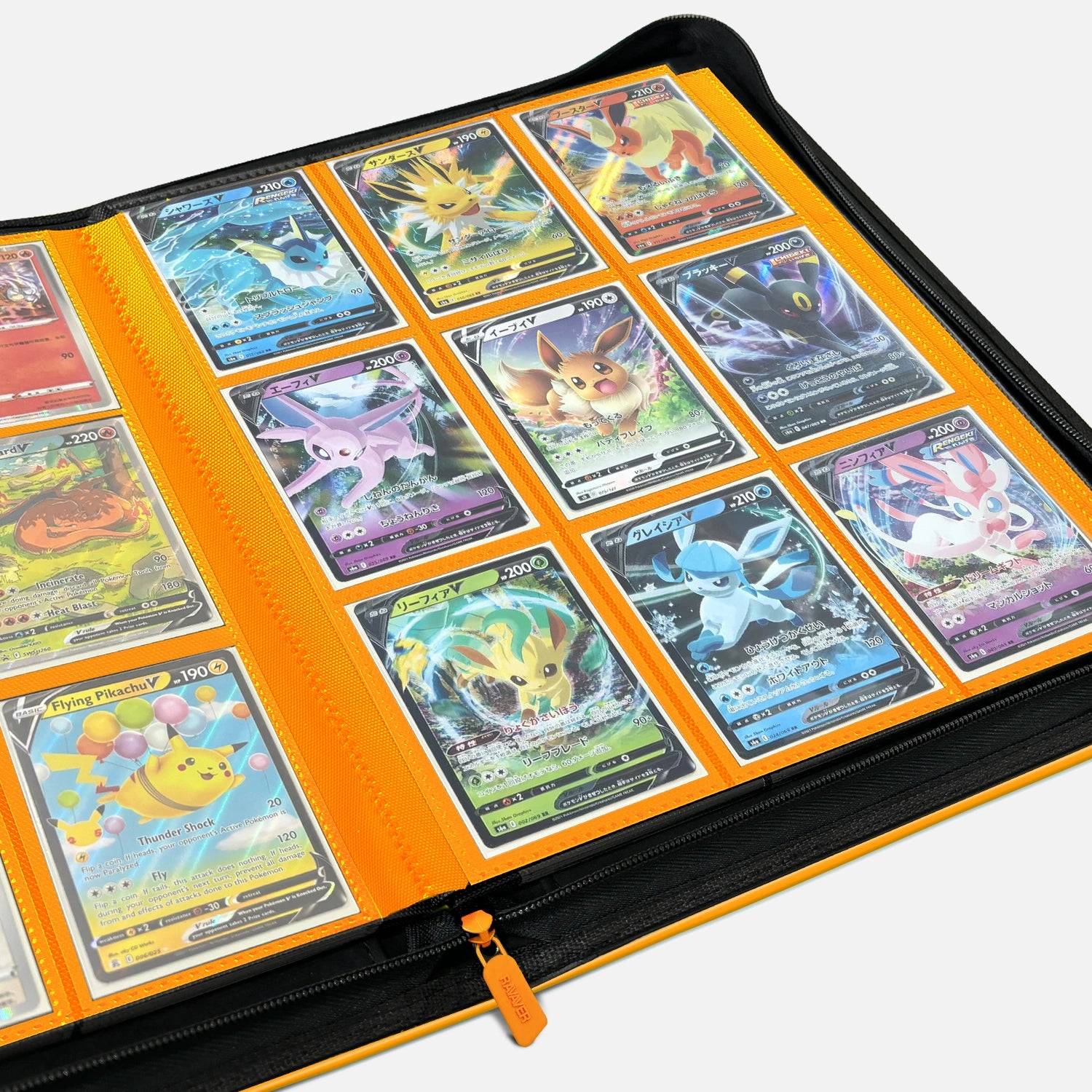
A finished Pokemon master set crosses a threshold most collectors don't realize until it's already gone wrong. The week your set hits $10,000 in replacement value is the week your homeowners policy stopped covering it. The standard policy cap on collectibles, in most U.S. states, is somewhere between $1,000 and $2,500 total, with individual item caps as low as $250. A single graded Charizard ex SIR can blow past those limits on its own, and the cards your master set is built around are usually exactly the ones the insurance company won't pay out on without a scheduled rider or a dedicated policy.
This is the workflow I walk new collectors through after they ask, "do I actually need to insure these?" The answer for most finished master sets is yes, and the steps below take a Saturday afternoon plus about $100–$200 a year. Compared to losing a $15,000 collection to a kitchen fire that wasn't your fault, the math works out.
Key Takeaways
- Standard homeowners policies cap collectibles coverage at $1,000–$2,500 in most states. Most finished master sets exceed that, especially when graded chase cards are included.
- Specialty insurers (Collectibles Insurance Services, American Collectors Insurance, Hugh Wood under Risk Strategies) cover Pokemon collections specifically, with premiums of $0.65–$1.50 per $100 covered annually.
- Insurance underwriters want documentation: itemized inventory, photos, purchase receipts, grading certificates. The week you finish the set is the week to do this.
- Storage decisions affect premiums. Cards in a bank deposit box drop premiums 20–35% versus home storage.

Step 1: Calculate your replacement value
Insurance is priced on replacement value, not what you paid. A 1st Edition Base Set Charizard you bought in 2018 for $400 might be a $12,000 PSA 9 today. A Scarlet & Violet SIR you pulled out of a $50 booster box can be worth $1,500 on the secondary market. Insurance underwriters care about replacement value because that's what they'd have to pay you if the card was lost.
The right way to value a master set for insurance:
- Pull recent comp sales for each high-value card from TCGplayer, eBay sold listings, and PWCC auction archives. Use the average of the last 5–10 sales in the same grade.
- For graded cards, look up the PSA Population Report to confirm grade and sample size. Lower population grades sometimes carry premiums.
- For raw cards over $50, value at the high end of the near-mint range from recent TCGplayer sales.
- For bulk and supplementary cards, use a conservative blanket value ($1–$3 per card depending on set age).
- Sum the total. That's your declared insurance value.
Don't inflate this number. Underwriters check, and inflated declarations get policies cancelled or claims denied. Don't underestimate either — if you declare $5,000 on a $15,000 collection and lose it, you get $5,000.
Step 2: Decide between a homeowners rider and a dedicated policy
The two paths most master set owners take, by collection value:
| Collection value | Recommended path | Typical annual cost |
|---|---|---|
| Under $2,500 | Existing homeowners policy is probably enough | Already covered |
| $2,500–$10,000 | Scheduled rider on homeowners or renters policy | $25–$80 added to existing premium |
| $10,000–$50,000 | Dedicated collectibles policy (CIS, American Collectors) | $100–$500 |
| $50,000+ | High-net-worth collectibles policy (Hugh Wood/Risk Strategies, Chubb) | $500–$2,500+ |
The scheduled rider path is the easiest for mid-tier master sets. You call your existing insurance agent, schedule the collection as a separate covered item, send them the inventory documentation, and they add a few dozen dollars to your annual premium. The dedicated policy path makes sense once you cross $10,000 because the specialty insurers underwrite Pokemon collections specifically and pay claims faster than general homeowners insurers do.
Step 3: Build your inventory documentation
Insurance underwriters want three things: an itemized list, photographs of high-value items, and proof of value (receipts or comp sales). The standard package for a master set looks like this:
- Spreadsheet inventory: Card name, set, condition or grade, certification number for graded cards, replacement value, purchase date and price if known. One row per card. A master set tracker spreadsheet works for this exactly.
- Photographs: One front-and-back photo per graded card. One overview photo per binder page for raws. Lighting should be even, background neutral, card filling most of the frame. iPhone or Android camera in well-lit room is sufficient.
- Proof of value: PSA/CGC/BGS grading certificates downloaded as PDFs, eBay or TCGplayer purchase receipts for cards bought online, comp sales screenshots for cards bought in person or through trades.
- Storage location documentation: A note describing where the cards are stored (home safe, bank deposit box, climate-controlled closet) and any security features (alarm system, fire suppression, dehumidifier monitoring).
Save all of this in two separate cloud locations (Google Drive plus iCloud, Dropbox plus OneDrive). If your house burns down, the documentation can't be in the house.
Step 4: Choose an insurer and get quotes from at least two
The three Pokemon-friendly insurers most master set collectors end up at:
- Collectibles Insurance Services: The volume player for trading card collections. Minimum policy around $2,500 declared value. Annual premiums roughly $0.65–$1.00 per $100 covered. Pays claims relatively fast, accepts photographic documentation, has a Pokemon-specific landing page.
- American Collectors Insurance: Comparable to CIS, slightly different underwriting. Worth getting a quote from both because pricing can vary 20–30% depending on your state and storage situation.
- Hugh Wood / Risk Strategies: Higher minimums (typically $25,000+), serves higher-net-worth collectors. As of March 2024 operates under Risk Strategies.
Get quotes from at least two. The conversation typically goes: you fill out an online form with your declared value, storage location, and a description of the collection, they respond within 1–3 business days with a quote and a list of any additional documentation they need, and you make the decision.
Step 5: Set up annual review and revaluation
The mistake most collectors make after buying a policy is forgetting about it. Pokemon TCG values move — sometimes up 20% in a year (post-Scarlet & Violet launch periods), sometimes down 30% (post-bubble corrections). A policy declared at $15,000 in 2024 might be covering a collection that's actually worth $25,000 in 2026. If something happens, the payout is $15,000, not $25,000.
The annual review takes about an hour:
- Pull current comp sales for the top 10–20 cards in the collection.
- Update the spreadsheet inventory.
- Add any new cards acquired or graded in the past year.
- Compare new total to currently declared value.
- If value has moved more than 15%, call the insurer and adjust the policy.
Most insurers adjust mid-policy without re-issuing. The premium just shifts pro-rata to the new declared value.
Frequently Asked Questions
Does homeowners insurance cover Pokemon cards?
Partially, with caps. Most U.S. homeowners and renters policies include personal property coverage that covers Pokemon cards as part of household contents, but with category limits. The standard cap on "collectibles, jewelry, fine art" categories is $1,000–$2,500 total, with individual item caps as low as $250–$500. A finished master set with graded chase cards almost always exceeds those caps. The fix is either a scheduled rider that increases the coverage limit for that specific category, or a dedicated collectibles policy.
How much does it cost to insure a Pokemon master set?
Roughly $0.65–$1.50 per $100 of declared replacement value annually, depending on the insurer, your state, and your storage situation. A $15,000 master set typically costs $100–$200 per year to insure with a specialty insurer. A scheduled rider on existing homeowners insurance is cheaper, usually $25–$80 added to your existing premium for collections under $10,000.
What documentation do insurance companies require?
An itemized inventory spreadsheet (card name, set, condition or grade, value), photographs of each high-value card front and back, proof of value (grading certificates, purchase receipts, or comp sales screenshots), and a note describing where the cards are stored. Insurers want this upfront for the policy, then again whenever you file a claim. Save everything in two separate cloud locations.
Does collectibles insurance cover cards in transit?
Most specialty policies do cover cards in transit, including when shipped to PSA, CGC, or BGS for grading. Coverage typically includes theft, loss, and damage during shipping with a tracked carrier (USPS, UPS, FedEx). Read the specific policy carefully because limits vary — some cap in-transit coverage at $10,000 per shipment regardless of declared total policy value. For high-value submissions, use registered mail and the carrier's own declared value coverage as additional layers.
Will insurance cover Pokemon cards in a safety deposit box?
Yes, and the premium is usually lower than home storage. Safety deposit boxes at FDIC-insured banks are considered low-risk locations by collectibles insurers, and many policies offer 20–35% discounts for vault-stored cards. The downside is access — you can only retrieve cards during bank hours, which is fine for grails but inconvenient for cards you'd display.
How often should I update my insurance policy?
Annually at minimum, plus any time the collection's value changes by more than 15%. Pokemon TCG values are volatile enough that a policy declared two years ago is probably mis-priced today. The annual review takes about an hour: pull current comp sales for top cards, update the inventory, compare to declared value, call the insurer if it's drifted significantly.
Are sealed Pokemon products insurable?
Yes, but valuation is the tricky part. Sealed booster boxes, ETBs, and bundles can be insured under the same collectibles policy as singles, but you need to declare them at current sealed-market value (not retail). Sealed Base Set boxes from 1999 are worth $400,000+ today; sealed Scarlet & Violet boxes are worth $200. Use eBay sold listings and Heritage Auctions archives for sealed product valuations specifically.
What to do this week
If your master set is finished and worth more than $5,000, start the documentation today. Open a spreadsheet, list every card, photograph the top 20–30. Aim to finish in one weekend. Once the inventory is in place, get quotes from Collectibles Insurance Services and American Collectors Insurance the following week. Most collectors who do this say the only regret is not doing it sooner. The cards you've spent two years finishing into a properly stored master set are worth $100–$200 a year to protect.
Sources:
- Collectibles Insurance Services, "Pokemon Card Insurance," retrieved 2026-05-21, https://collectinsure.com/pokemon-insurance/
- American Collectors Insurance, "Pokemon Card Collection Protection," retrieved 2026-05-21, https://americancollectors.com/pokemon-card-collection-protection/
- Risk Strategies, "Acquires North American Operations of HWI," press release, retrieved 2026-05-21, https://www.risk-strategies.com/press-releases-risk-strategies-acquires-north-american-operations-of-h.w.-international-b.v