A friend handed me a Charizard last month and asked the question every collector dreads: is this real? The card looked clean, the holo shimmered, the back had the right blue swirl. It took the texture test and a digital scale to give him an honest answer. With non-sports trading card spending up 350% between 2020 and 2025 (per Goldin/CNBC reporting), counterfeiters have caught up fast. The "super fakes" rolling out of overseas print shops in 2025 and 2026 now pass casual inspection that used to be foolproof.
So here are the nine tests I actually run before buying any card over $20. Some take five seconds, some need a scale or a loupe, and not one of them is perfect on its own. Run them as a stack and you'll catch the overwhelming majority of fakes.
Key Takeaways
- Real Pokémon cards weigh 1.7–1.8g and measure roughly 0.31–0.32mm thick, a tolerance digital scales catch instantly.
- The texture test (running a fingernail across the surface) is ranked by r/PokemonTCG collectors as the most reliable single check.
- The light test still catches mid-tier fakes but newer "super fakes" sometimes pass it, so it can't be your only check.
- For any card worth $100+, professional grading from PSA, BGS, or CGC is the only way to be 100% sure.
Why fake Pokémon cards exploded in 2025 and 2026
Pokémon's 30th anniversary on February 27, 2026 reignited demand for vintage and anniversary sets, and prices climbed across both sealed product and singles. Counterfeiters follow money. According to TCGplayer's March 2026 price trend reports, spikes on Base Set Charizard, Trainer Gallery hits, and Special Illustration Rares pulled new buyers into the market — many of them parents and casual fans without the muscle memory to spot a print error or a wrong holo pattern.
The 2026 fakes are different from the 2018 fakes. They're heavier than older counterfeits, the cardstock has improved, and some now include a printed black layer that mimics the dark line you see on edge inspection. The light test alone won't save you on these. That's why this list runs nine checks deep.
Test 1: The light test
Hold the card flat against a phone flashlight or bright bulb in a darkened room. Real cards have a thin black layer sandwiched between the front and back cardstock. Light should not pass through clearly. If you can read the back through the front, or see your fingers glowing pink behind the card, you're holding a fake.
The catch: 2026's super fakes have started adding a black middle layer of their own. So this is a first-pass screen, not a final verdict. If a card fails the light test, walk away. If it passes, keep testing.
Test 2: The texture test
Drag a fingernail across the front surface of the card. A real Pokémon card feels like running your nail across a vinyl record — fine etched grooves, a slight rasp, a sound. Fakes feel smooth, glossy, or waxy. Some printed counterfeits stamp a texture pattern that looks right under glass but the surface is flat, so your nail just slides.
Reddit's r/PokemonTCG community ranks the texture test as the single most reliable check for sealed singles. It's also the test most likely to catch a "super fake" that passed the light test, because reproducing actual etched cardstock at scale is genuinely hard.
Test 3: Weight on a digital scale
Pull a kitchen-grade digital scale that reads to 0.01g. Real Pokémon cards weigh 1.70 to 1.80 grams. Most fakes land outside this window — too light because the cardstock skips a layer, or surprisingly heavy because the counterfeiter overcompensated. A 1.62g card or a 1.94g card is a hard no.
Stack five known-real cards from your collection on the scale to calibrate your eye. Then weigh the suspect card. If it lands more than 0.05g off the cluster, treat it as fake until proven otherwise.
Test 4: Thickness with a caliper or micrometer
Real cards measure roughly 0.31–0.32mm thick. A digital caliper from a hardware store costs $15 and pays for itself the first time you avoid a $200 mistake. Measure at three points (top, middle, bottom). If thickness varies by more than 0.02mm across the card, that's a print quality issue counterfeiters consistently miss.
Test 5: Font and accent marks
Pull up the card on the official Pokémon TCG database or a high-resolution scan from PokeBeach or TCGplayer. Compare the é in "Pokémon" — fakes routinely lose the accent or shrink it. HP numbers, attack damage, and the energy symbol shapes — counterfeits have slightly thicker strokes or off-kilter spacing. The set symbol and rarity icon in the bottom corner — this is one of the highest-error zones on counterfeits because each set has a unique symbol the printer has to recreate exactly.
Test 6: The back swirl pattern
Flip the card. The blue back has a swirling pattern around the central Pokéball. On real cards, the swirl is crisp, the blue is consistent, and the yellow Pokéball has clean edges. Fakes show muddy color blends, blurred swirl detail, or a Pokéball that looks slightly off-yellow (often too orange or too pale).
The dead giveaway: real cards have a tiny strip of solid color along one edge of the back, where the cardstock layers meet. Fakes either omit this or get the color wrong.
Test 7: The rip test (last resort, on cards you don't care about)
If a card is suspect and worth less than $5, you can rip it. Real Pokémon cards tear in three layers — front print, black middle, back print. Fakes usually rip into one or two layers, with no visible black sandwich. The middle-layer color also matters: real cards show a deep matte black, while many fakes use a dark grey or even a purple-ish tone.
Don't rip cards worth keeping. This is for sanity-checking a sketchy bulk lot or a $2 single you suspect.
Test 8: Holographic pattern under tilt
Tilt the card slowly under a desk lamp or window light. Real holo cards (especially modern Mega ex and SIR foils) show complex shifting rainbow patterns with depth — colors move and bend differently across the artwork. Fakes display flat foil, uniform shimmer, or a holographic effect that "pixelates" at certain angles.
This is harder to fake than texture because the foil layering is a multi-pass print process. Counterfeiters cut corners here more than anywhere else on the card.
Test 9: Set printer details and edition mark
Real cards include tiny printer marks: the copyright line at the bottom (year, Nintendo/Creatures/GAME FREAK credits), the set abbreviation, the card number formatting (e.g., 6/102 vs 006/102), and the holographic Wizards of the Coast or The Pokémon Company watermark on certain sets. Each detail varies by era. A 1999 Base Set card should say "© 1995, 96, 98, 99 Nintendo, Creatures, GAME FREAK." A 2026 Mega Evolution set has different copyright text.
If the copyright info is missing, smudged, or matches the wrong era for the set, you're holding a counterfeit.
What to do when a card is worth more than the test stack can verify
For cards worth $100 or more, no DIY check stack is enough. Send it to PSA, BGS, or CGC. Grading services authenticate before they grade — fakes get rejected with a note, and the fee is a fraction of what you'd lose buying a counterfeit Charizard. PSA's 2025 Population Report logged authentication of millions of submissions, and counterfeits get kicked out at the prep stage long before the grading bench.
A second-best option: buy from sellers who themselves source from grading services or established card shops. eBay's Authenticity Guarantee program handles cards over $250 and is genuinely good — they reject fakes at the inspection stage before the card ever reaches you.
How to actually store cards once you've confirmed they're real
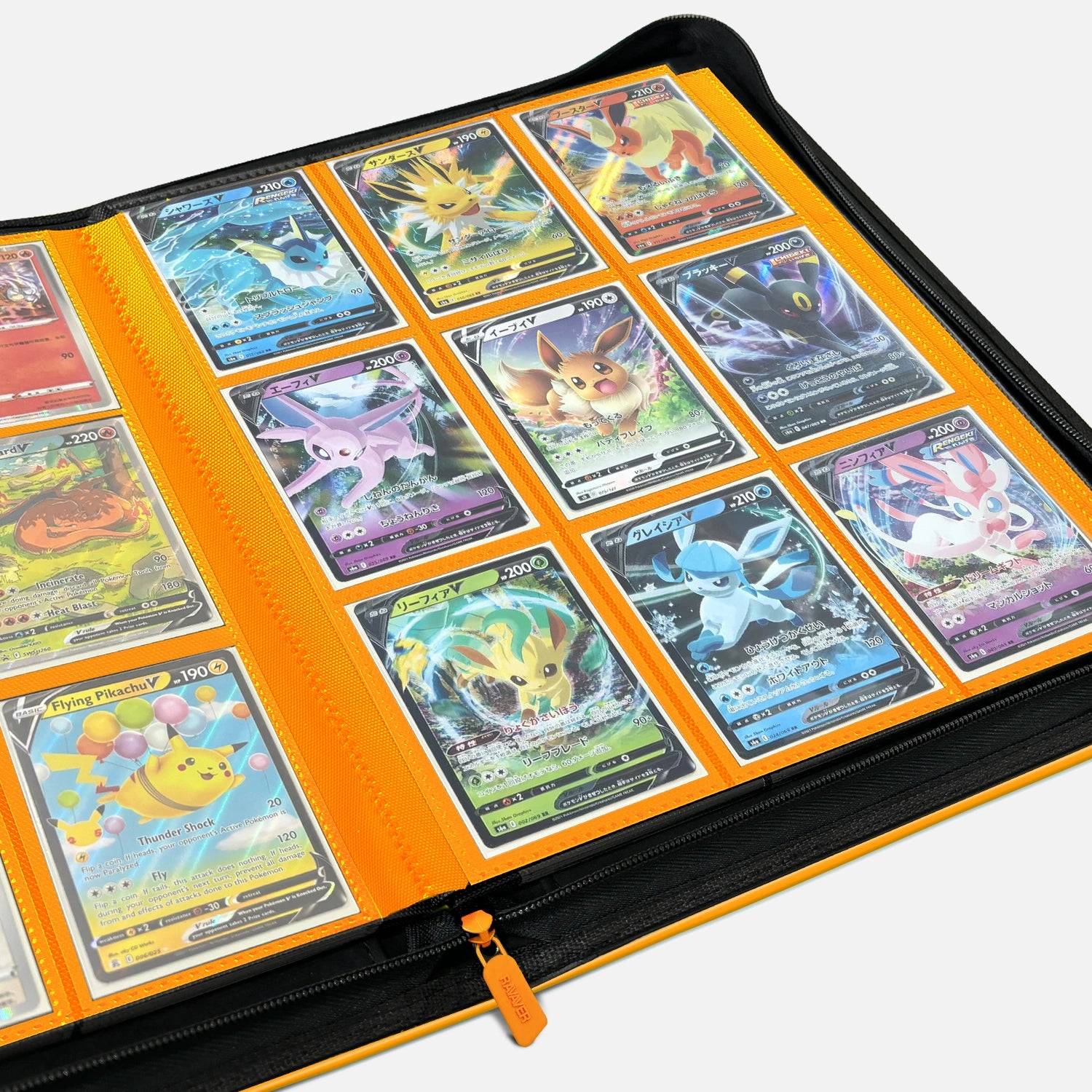
Authentication is step one. Step two is making sure your real cards stay in the condition that justified buying them in the first place. For raw cards under $50, premium binder sleeves and a side-loading binder protect against bending, edge whitening, and surface scratches. For cards in the $50–$300 range, toploaders or a dedicated toploader binder give rigid protection without the cost of grading. For graded slabs, archival storage boxes with desiccant matter more than people think — heat and humidity damage labels and slabs over years.
The point of running nine tests is to know what you have. The point of storage is to keep it that way.
When in doubt, walk away
If a deal feels off — the price is too good, the seller has no history, the photos are stock images, the card "passes" four tests but fails on weight or texture — don't buy. The Pokémon collecting market is bigger than ever. Another Charizard will come along. The one in front of you isn't worth your $400 if you're guessing.
Run the nine tests. Trust the stack, not any single check. And for anything you actually care about long-term, get it graded.
Sources:
- TCGplayer, Price Trends: Pokémon Cards Climbing in Price 03/03/2026, retrieved 2026-05-03
- CNBC, Logan Paul Pokémon Card Auction Coverage, retrieved 2026-05-03
- Pokémon Support, Did I Purchase Fake or Counterfeit Cards, retrieved 2026-05-03
- Card Chill, How to Spot Fake Pokémon Cards Advanced Authentication Guide April 2026, retrieved 2026-05-03