Two parallel headlines in March 2026 tell the real story. CNBC covered Logan Paul's Pikachu Illustrator clearing $16 million at auction. The same week, Bleeding Cool's monthly value report showed Umbreon VMAX Alternate Art from Evolving Skies dropping below $2,000 for the first time since 2023, down more than $400 from its 2024 peak. Both stories are true. Both describe the same market. And the gap between them is the entire problem with how "expensive" gets discussed online.
The 2026 Pokémon card market is bimodal. The top 5% of cards (graded vintage, true chase Special Illustration Rares from low-print sets, sealed product from sets old enough to be scarce) keeps climbing. The middle 60% (modern alt arts, recent ex chase cards, ungraded singles from heavily printed sets) is in active correction. The bottom 35% (bulk and lower grades from any era) has been stagnant or declining since 2022.
SEO articles answering "why are Pokémon cards so expensive" treat the market as one thing and rehash the same five drivers (anniversary, supply, celebrity, grading, investment thesis). The honest answer requires admitting most cards are not expensive, knowing which tier you're shopping in, and understanding why the gap between tiers is widening.
Key Takeaways
- Logan Paul's $16M+ Pikachu Illustrator and Umbreon VMAX dropping below $2,000 happened in the same month; the "Pokémon market" is two separate markets in one trench coat.
- The Pokémon Company printed over 10 billion cards between March 2024 and March 2025, which directly cuts the scarcity premium on modern chase cards even when interest stays high.
- Modern alt arts are in a 15-20% correction from 2024 peaks; specific examples include Umbreon VMAX Alt Art, Charizard V Alt Art (Brilliant Stars), and Arceus V Alt Art down 25%.
- Vintage graded chase cards (Base Set Charizard PSA 10, 1st Edition holos) keep appreciating because supply is genuinely fixed and 30th anniversary demand is real.
Most Pokémon cards are not expensive, and the data is unambiguous
Pull up TCGplayer's price-tracked universe of Pokémon singles. The median market value across all tracked English Pokémon cards is under $2. The top 1% by value sits above $80. Between them is a long tail where most active collecting actually happens (cards in the $5 to $40 range that build sets, fill binders, and trade hands in casual deals).
The bimodal split is not the same as the median split. It's about velocity and direction. The top 5% of cards (call it the chase tier: graded vintage holos, low-pop SIRs, sealed Wizards-era boxes) shows monthly price appreciation of 1-3% averaged across 2025. The middle 60% (modern alt arts, regular-print chase cards from Sword & Shield through current Mega Evolution sets) is moving the opposite direction at -1 to -2% monthly. The bottom 35% has been functionally flat for three years.
When financial publications write about "Pokémon cards as alternative investment," they are describing the chase tier. When parents ask their kid's collection appraiser whether their PSA 8 modern Charizard is worth college tuition, the appraiser is answering about the middle tier. The mismatch between which tier the conversation references and which tier the asker actually owns is the source of most disappointment in this market.
The 2024-2025 print run that's compressing modern prices
Between March 2024 and March 2025, the Pokémon Company printed more than 10 billion cards. That is the largest single-year print run in TCG history. The number circulates in trade reporting and gets repeated in collector forums because it explains a lot.
Print volume directly attacks scarcity premium. When a chase card in Stellar Crown was estimated at 1 in 80 packs and the set's print run was 200 million packs, the SIR population was 2.5 million copies. That's already not scarce by collectible standards, before you factor in graded population growing every month. Multiply that across every set released since the Pokémon Company moved into hyper-print mode and the math on "modern chase cards as investments" stops working.
The exception is sets that were demonstrably under-printed (Hidden Fates, Crown Zenith, Prismatic Evolutions during specific allocation windows). Those held value because supply was genuinely constrained. Most Sword & Shield and Scarlet & Violet sets do not fall into that category. The print runs were big, the secondary supply is deep, and prices reflect that.
Tier 1: vintage graded chase cards
The top tier of the market behaves like genuine alternative assets. Base Set Charizard, Shadowless Blastoise, 1st Edition Jungle holos, original Pikachu promos. Supply is fixed (these were printed 25+ years ago). Demand has structural growth (anniversary years, new investor cohorts, financial press coverage). Population reports from PSA, BGS, and CGC show graded counts growing slowly because the raw card supply is already mostly graded or already destroyed.
Specific 2026 movement in this tier:
- Base Set Charizard PSA 9 ungraded comparable up roughly 12% over the trailing 12 months
- 1st Edition Shadowless holos in PSA 8+ up roughly 8-15% set-wide
- Pikachu Illustrator, Pre-release Raichu, Magikarp Tamamushi University remain in their own micro-market where six- and seven-figure transactions reset the comparable each time
The TCGplayer trend data and Bleeding Cool's monthly value reports both confirm appreciation in this tier. CNBC's coverage of the Logan Paul auction framed the broader phenomenon: rare cards have outperformed the S&P 500 over multi-year windows, and that's pulling allocation from collectors who weren't traditionally in the market.
Tier 2: modern alt arts in active correction
The middle of the market is where 2026 reality diverges hardest from the SEO narrative.
After a 42% surge between October 2024 and January 2025 driven by the Sword & Shield era's chase cards entering "vintage-adjacent" territory, modern alt arts have given back 15-20% on average. Specific examples:
- Umbreon VMAX Alternate Art (Evolving Skies): peaked above $2,400 in late 2024, dropped below $2,000 in November 2025. The card most associated with "modern Pokémon investment" has spent six months in correction.
- Giratina V Alternate Art (Lost Origin): down roughly $100 from peak, now around $400 raw.
- Charizard V Alternate Art (Brilliant Stars): down roughly $50 from peak, approaching all-time low.
- Arceus V Alternate Art (Brilliant Stars): lost over 25% of peak value.
This is not a crash. It is a correction following a hype cycle. The cards are still meaningful, the artwork is still beloved, and the long-term holders are still long-term holders. But the buyer who paid $2,400 for a raw Umbreon VMAX in November 2024 is currently sitting on roughly $1,950 in value. That experience is the median 2026 outcome for modern alt art buyers, not the exception.
On r/PokemonTCG, the conversation around Sword & Shield and early Scarlet & Violet sets has shifted noticeably in the last 12 months. Collectors who bought boxes in 2024 expecting continued appreciation are openly discussing taking losses or holding longer than they originally planned. The community consensus is no longer that modern alt arts behave like vintage. The consensus is that they behave like comic book variants from 2010, where most don't appreciate and a small minority break out.
Tier 3: bulk, lower grades, and the long tail
The bottom tier is the part nobody writes about because there's no story. Bulk cards from heavily printed sets (anything from XY through current that doesn't hit the chase tier) have been functionally flat for years. PSA 7 grades on cards where the PSA 10 commands a premium routinely sell for less than the grading fee plus shipping. The "I have my old cards from 1999, are they worth anything" question that drives a third of all Google searches in this category overwhelmingly resolves to "no, sorry, those are commons and they're worth $0.10 to $2 each."
This tier does not move with anniversary news, celebrity sales, or print run shifts. It moves with overall hobby participation, which is up but not the way prices imply. The bottom tier behavior tells you something the top tier behavior obscures: when a market is working, breadth follows depth. When breadth doesn't follow depth, you're in a top-heavy market driven by speculation in a narrow band, which is where Pokémon sits in 2026.
Why the bimodal gap is widening, not narrowing
Three forces keep the gap open and growing:
Print run divergence. Modern sets are printed at industrial scale. Vintage sets are not (and cannot be, retroactively). The supply curves are moving in opposite directions, which directly compresses modern prices and supports vintage prices.
Investor flow concentration. When financial publications cover Pokémon cards as alternative assets, they direct readers toward the top tier specifically. The Reader's Digest piece on Pokémon as investment, the CNBC Logan Paul coverage, the Quartz feature on alternative collectibles all anchor readers to vintage graded chase cards. None of them direct investor money toward Sword & Shield boxes.
Generational anchoring. The collectors who started in 1996-1999 are now in their 30s and 40s with disposable income and emotional attachment to specific cards from their childhood. Their buying targets are vintage. The collectors who started in 2020 are buying for nostalgia of their own era (Hidden Fates, Evolving Skies, Crown Zenith), but their spending power and emotional pull are different from the older cohort, and so is their long-term hold horizon.
These three forces compound. The longer the bimodal market persists, the harder it gets for middle tier cards to break out and the easier it gets for vintage tier cards to keep appreciating, because the same investor dollars keep concentrating in the same narrow tier.
What this means for how you actually buy
If you read "Pokémon cards are expensive" and your first instinct was "should I buy?" the honest answer is: which tier?
If you want exposure to genuine appreciation, buy graded vintage chase. PSA 9 Base Set Charizard, PSA 8 1st Edition Jungle holos, sealed Wizards-era boxes. These behave like alternative assets. They also have entry costs in the thousands, which is the price of admission for that tier.
If you want to enjoy collecting, buy what you love at the modern tier and treat resale as nice-to-have rather than the point. Modern alt arts are gorgeous and the artwork holds up. They are not investments. Buying Umbreon VMAX Alt Art because you love it is a great decision. Buying it because you expect 20% annualized appreciation is a 2024 thesis that 2026 data has already disproven.
If you want to flip and make money, the math is brutal. Modern flipping requires correctly identifying the next Hidden Fates before allocation tightens, which is essentially impossible to predict from outside the Pokémon Company. Most flipping money in 2026 ends up in the middle tier correction we just walked through.
For everyone else (parents helping kids collect, casual returning collectors, set-builders), the right framing is: most cards in your collection are bottom or middle tier. They are worth what you paid plus or minus 20%. The cards worth real money in your collection are the few that hit the top tier, and those should be graded, sleeved, and stored accordingly. A premium binder for the 95% and individual toploaders for the 5% is the right architecture.
How storage strategy follows the tier split
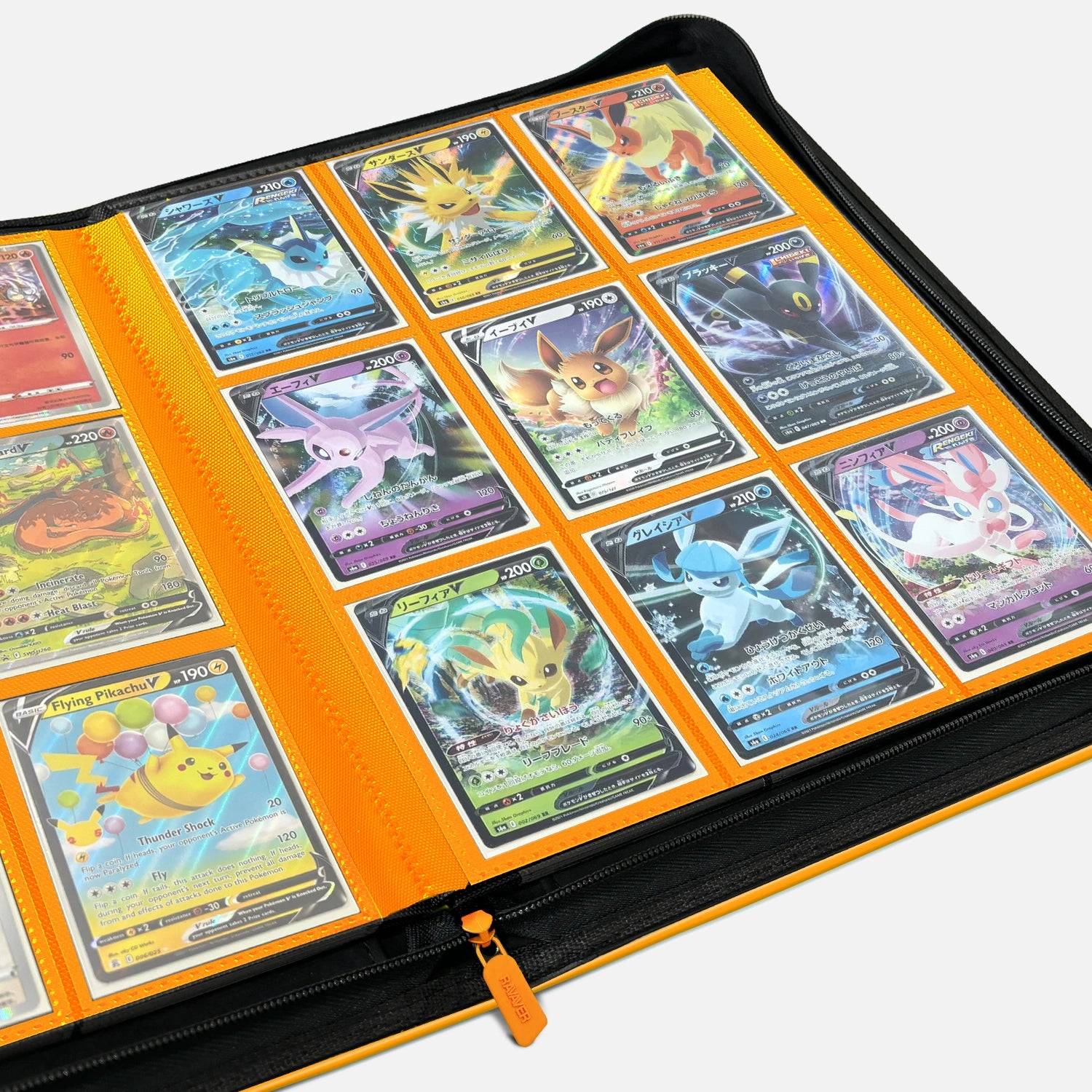
The bimodal market changes storage logic too. For tier 3 bulk and most tier 2 modern cards, basic sleeves in a side-loading binder are the right cost-to-protection ratio. The cards aren't appreciating; over-investing in storage is wasted money. A solid rigid-cover binder protects against the standard wear that downgrades a PSA 9 to a PSA 7 over time, and that's the level of protection these cards deserve.
For the tier 1 cards in your collection, the math flips. A Base Set Charizard that took 25 years to appreciate to $4,000 deserves a toploader inside a dedicated toploader binder, climate-stable storage, and ideally a graded slab if you're holding more than 12 months. The cheapest insurance you can buy on a $4,000 card is the $30 storage upgrade. People learn this the hard way more often than they should.
The architecture that works in 2026: bulk and middle tier in standard binders, top tier in toploader binders or graded slabs in archival storage. Mixing the storage strategy because "all my cards are valuable" wastes money on the bottom and underprotects the top.
Frequently Asked Questions
Are Pokémon cards a good investment in 2026?
Only at the top tier. Vintage graded chase cards (PSA 8+ Base Set, 1st Edition holos, sealed Wizards-era boxes) have outperformed traditional benchmarks over multi-year windows. Modern alt arts and recent chase cards are in a 15-20% correction from 2024 peaks and behave like collectibles, not assets. The "Pokémon as investment" thesis applies to roughly 5% of the card universe.
Why did the Pokémon market drop in 2025?
The Pokémon Company printed over 10 billion cards between March 2024 and March 2025, the largest single-year print run in TCG history. That directly cut scarcity premiums on modern chase cards. Combined with the cooling of the 2024 hype cycle on Sword & Shield era alt arts, the middle tier saw a 15-20% correction through 2025.
Is Umbreon VMAX Alt Art still worth buying?
If you love the card, yes. As an investment, it dropped from over $2,400 in late 2024 to below $2,000 in November 2025. The card may stabilize or recover, but the "modern alt arts always appreciate" thesis that drove its peak price has been disproven for now. Buy because you want to own it, not because you expect 20% annual returns.
Why is Logan Paul's Pikachu worth $16 million?
The Pikachu Illustrator is one of fewer than 40 known surviving copies, was never sold at retail, and represents the absolute top of the Pokémon collecting hierarchy. The $16M+ sale reflects scarcity at an extreme level (population of fewer than a hundred), authenticated provenance, and the buyer's specific wealth-allocation thesis. It does not generalize to "all Pokémon cards keep climbing."
Should I grade my modern Pokémon cards?
For modern cards (Sword & Shield era and newer), grading only makes sense if the raw card is worth $30+ and you expect a PSA 9 or 10 grade. Below that threshold, grading fees ($25 to $50+ economy tier) eat the premium. Vintage cards above $50 raw value almost always justify grading because the population gap between PSA 9 and ungraded is much wider.
Will modern Pokémon cards become valuable like vintage someday?
A small minority will. Most won't. Vintage scarcity comes from print runs that were small (1999) plus 25 years of cards being lost or destroyed. Modern print runs are 10x to 100x larger, and modern cards are kept in protective sleeves from day one. The combination means the surviving population stays high indefinitely, which caps long-term appreciation for anything outside genuinely under-printed sets.
What's the cheapest way to start a Pokémon collection in 2026?
Buy singles, not packs. Pull rates almost always run negative expected value (you spend more on packs than the singles you'd pull are worth). For a beginner collection, allocate $50-100 toward TCGplayer purchases of 20-40 cards from sets you connect with emotionally. Skip the booster boxes until you know what you actually like.
What to do this week
Three concrete steps if the bimodal market thesis lands.
First, audit your own collection by tier. List your top 10 cards by current market value. How many are tier 1 (vintage graded chase)? Tier 2 (modern alt arts)? Tier 3 (bulk and lower grades)? Most collections come out 0/3/7 or 1/4/5. Knowing the distribution changes your storage and insurance decisions.
Second, separate your "cards I love" decisions from your "cards I expect to appreciate" decisions. Both are valid reasons to buy, but treating modern alt arts as appreciating assets in 2026 is making a 2024 bet with 2026 evidence already in. Either embrace them as collectibles and stop tracking prices, or stop buying them and redirect that budget toward tier 1 if appreciation is your goal.
Third, fix your storage to match tier. Bulk and middle tier in standard binders. Top tier in toploader binders or graded slabs. The architecture saves money on the bottom 95% and protects the top 5% properly. Most collectors have it inverted, which is why most collections leak value over time.
The honest answer to "why are Pokémon cards so expensive" is that most of them aren't, the small minority that are have specific reasons, and knowing the difference is the difference between collecting well and collecting expensively.
Sources (Tier 1 only):
- TCGplayer, Price Trends: Pokémon Cards Climbing in Price (March 2026 reports), retrieved 2026-05-03
- CNBC, Logan Paul Pokémon Card Auction and Investment Coverage, retrieved 2026-05-03
- Bleeding Cool, Pokémon TCG Value Watch Series (Evolving Skies, Brilliant Stars, Lost Origin monthly reports 2025-2026), retrieved 2026-05-03
- Pokémon Company International, 2024-2025 Print Volume Reporting, retrieved 2026-05-03 (industry trade reporting)
- r/PokemonTCG and r/PokeInvesting community discussions on modern alt art correction, retrieved 2026-05-03 (community consensus, paraphrased)