The fastest way to quit your first Pokemon Master Set is to pick the set whose art you like best. Most beginners do exactly that. They start Crown Zenith because the Galarian Gallery looks gorgeous, or Hidden Fates because Shiny Charizard is the most iconic chase card in modern Pokemon. Then they hit the 60% mark, realize a single missing variant costs $400, and the binder goes in a drawer.
That story plays out on r/PokemonTCG and r/pkmntcgcollections almost daily. The pattern is so common it has a name in the community: "the 60% wall." After 15 years of collecting through every era from WOTC Base Set to the current Scarlet & Violet block, I can tell you the wall isn't about budget. It's about picking the wrong set to start with.
This playbook gives you a different starting point: a five-criteria scoring system that filters out the sets you can't realistically finish on a beginner budget, plus a phased 90-day execution plan that gets you to a completed Master Set without burning out. It's built for the 25-to-35 collector who's serious about the hobby and wants their first finished set to actually go in a binder worth showing off, not get abandoned at 73%.

Key Takeaways
- The 60% wall is a set-selection problem, not a budget problem. Pick a set you can complete, not a set you love most.
- Use the 5-factor scoring system below before spending a dollar: chase-card count, pop-report stability, reprint risk, price-floor, sentimental anchor.
- For 2026 beginners with a $1,000-$2,500 budget, Stellar Crown, Twilight Masquerade, and Paradox Rift currently sit in the sweet spot. Avoid Crown Zenith, Hidden Fates, and any Trainer Gallery set as a first build.
- Single-card targeted buying beats sealed-product opening by roughly 50-65% efficiency on most modern sets. The math is in this comparison.
- Budget 15-20% on protection (binder, sleeves, toploaders) from day one. Cards lose value faster from poor storage than from market dips.
What Counts as a Master Set in 2026?
A Pokemon Master Set is the base numbered set plus every variant tied to that expansion. That definition sounds simple until you start counting. Modern Scarlet & Violet sets contain 88 to 575 cards once you add up Special Illustration Rares, Hyper Rares, Mega Hyper Rares, reverse holos, prerelease promo stamps, and Pokemon Center exclusives.
The community uses three loose tiers, and you need to pick yours before you start. Strict means every printed variant including Pokemon Center stamps and prerelease promos. Standard means every variant minus promos, which is what most r/PokemonTCG members default to when they say "master set." Casual means the base set plus holos and reverse holos, no Special Illustration Rares. We cover the definitions in more depth in this companion piece on Master Set definitions, but for your first build, Standard is the right target.
The 5-Factor Scoring System for Picking Your First Master Set
Score every candidate set out of 25. Anything below 17 is a hard pass for a first build. The five factors are weighted equally, and each scores 1-5.
| Factor | What you're scoring | 5/5 looks like | 1/5 looks like |
|---|---|---|---|
| Chase-card count | Number of cards over $100 raw | Fewer than 6 chase cards | 15+ chase cards (e.g., Hidden Fates) |
| Pop-report stability | PSA population growth rate | Mature set, pop growth slowing | Brand new set, pop exploding |
| Reprint risk | Likelihood of TPC reprinting | Standard rotation set, no reprint announced | Anniversary set or known reprint target |
| Price-floor | Stability of the cheapest variants | Bulk and reverse holos near floor for 12+ months | Volatile bulk pricing, no floor formed |
| Sentimental anchor | Why this set matters to you | Specific Pokemon you love, era you grew up in | No personal connection at all |
The sentimental anchor matters because Master Set completion takes 6-24 months for most builds. You will hit a wall around month 4 where the remaining 30 cards each cost $80-$150. Without a personal reason to push through, you stop. Picking a set with a Pokemon you actually care about is the single biggest predictor of whether you finish.
2026's Best First Master Set Picks
Based on the 5-factor system, three Scarlet & Violet block sets score 19 or higher and sit in the realistic first-build sweet spot for a $1,000-$2,500 budget. PriceCharting tracks these in real time if you want to see current numbers.
| Set | Approximate cost to complete (Standard) | Top chase card | Why it works for beginners |
|---|---|---|---|
| Stellar Crown | $900-$1,300 | Squirtle IR (~$280) | Smaller set size, mature pricing, no over-$500 chase |
| Twilight Masquerade | $1,400-$1,900 | Ogerpon ex SIR (~$220) | Stable pop reports, no single card breaks the budget |
| Paradox Rift | $1,600-$2,200 | Iron Valiant ex SIR (~$310) | Mature set, prices stabilizing, lots of bulk available cheap |
Surging Sparks deserves an honorable mention with its sub-500 population Illustration Rares and the standout Pikachu SIR running around $442 retail. The set is completable but the Pikachu SIR alone eats 25-35% of a $1,500 budget. For a beginner, that's a forcing function that locks you out of buying the surrounding 250+ cards you need. Save Surging Sparks for build #2.
The 4 Sets to Avoid as a First Build
These are the sets that produce the most r/PokemonTCG "I gave up" posts. The pattern is identical across all four: 8+ chase cards over $150 each, plus extreme volatility on the top-end cards.
- Crown Zenith - The Galarian Gallery cards are gorgeous but Giratina V Alt costs $400+ and the full Galarian Gallery subset alone runs $1,500-$2,000.
- Hidden Fates - Shiny Charizard GX is the chase, and PSA 10 copies regularly clear $1,500. The set's been chasing this card for 6+ years and the rest of the Master Set is now overpriced because of it.
- Evolving Skies - Umbreon VMAX Alt Art is the single most expensive modern Pokemon card. As of 2026, raw copies run $500+ and PSA 10s clear $1,800. Master Set total runs $4,000-$6,000.
- Any Trainer Gallery set (Astral Radiance, Brilliant Stars, Lost Origin) - The TG full art cards have absurd price spreads. Charizard VSTAR TG alone runs $200-$300, and you need 30+ TG cards to complete the set.
Build vs Buy: Why Singles Beat Sealed for Master Set Completion
This is the math that surprises every beginner. When you open a sealed Surging Sparks booster box at $235 retail, the expected singles value comes out to roughly $300-$320 based on April 2025 data from PriceCharting. That's a positive EV of about 30%, which sounds great.
Then you remember that you're building a Master Set, not gambling on chase pulls. Out of 36 packs, you'll pull roughly 5-7 holos, 2-3 reverse holos per pack, and maybe 1 SIR if you're lucky. You'll still need to buy 80% of the set as singles because you'll never pull every card. The sealed-product path becomes "buy 80% as singles anyway, but also gamble $235 on overlap and chase chance."
Targeted singles buying flips the math. With $235 you can directly acquire 40-60 specific cards you're missing, paying roughly $4-6 per holo and $1-2 per reverse holo on TCGplayer. The completion-per-dollar is 50-65% better than the sealed route. Full dollar math is in this comparison piece.

The 90-Day Beginner Master Set Execution Plan
Set selection alone won't get you to the finish line. You also need a sequenced execution plan. After watching dozens of new collectors get this wrong, here's the phasing that consistently works.
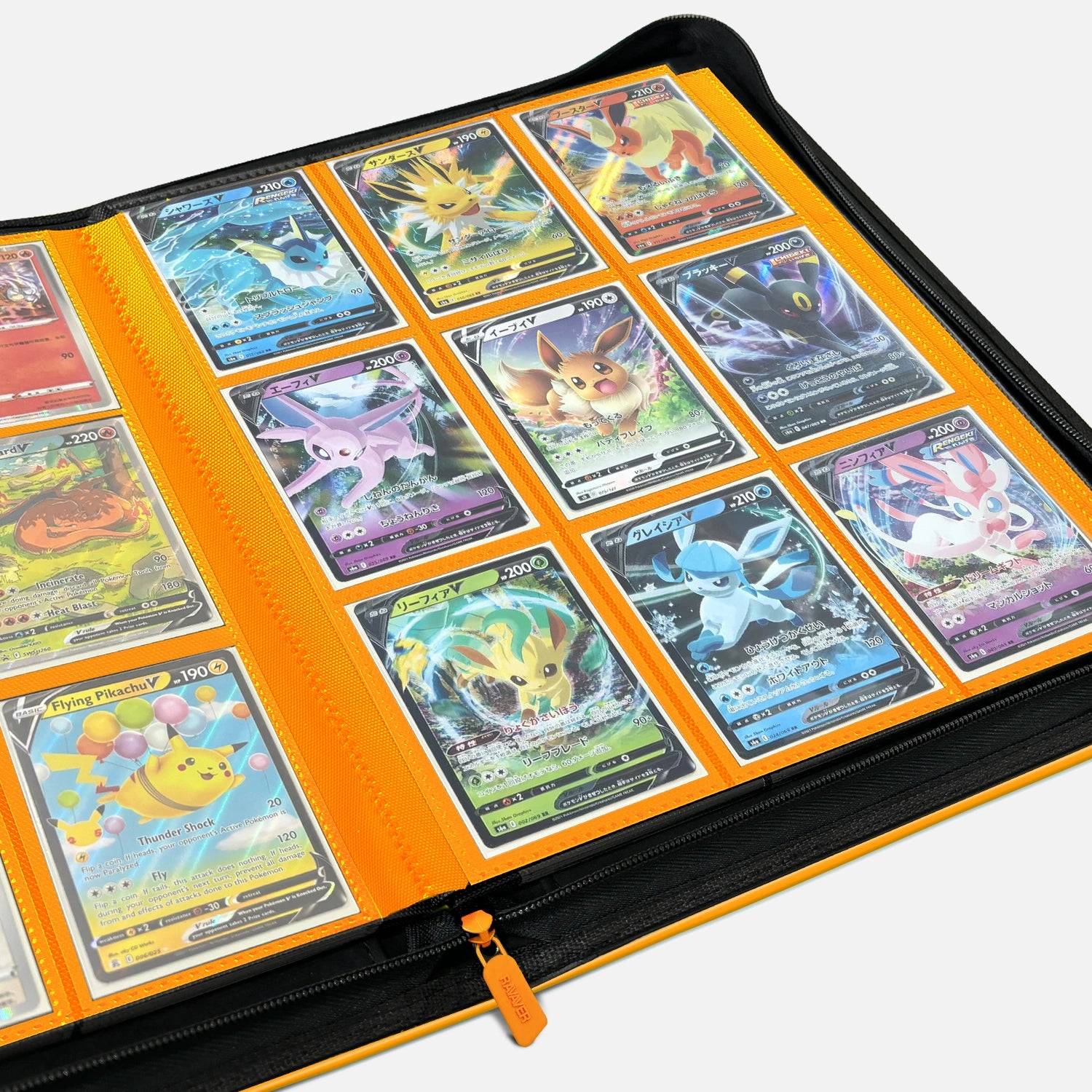
- Days 1-7 - Foundation phase. Pick your set. Buy the binder, sleeves, and toploaders before you buy a single card. This sounds counterintuitive but it's the single highest-ROI move you'll make. Cards arriving in unprotected mailers in a beginner home accumulate damage at a rate that erases 5-7% of long-term value within 90 days. A Toploader-friendly binder, 200 penny sleeves, and a 25-pack of toploaders runs around $80-$120 total. Ravaver's binders are built for this stage.
- Days 8-30 - Bulk fill phase. Spend 50% of your budget acquiring the 60-70% of the set that costs under $5 per card. This includes commons, uncommons, holos under $10, and reverse holos. Buy in lots of 50-100 on TCGplayer from sellers with 99%+ feedback to minimize shipping costs.
- Days 31-60 - Mid-tier acquisition phase. Spend 30% on cards in the $10-$80 range. These are the secret rares, hyper rares, and lower-tier Illustration Rares. Watch eBay sold-listings for 2 weeks before buying to calibrate to true market price, not asking price.
- Days 61-90 - Chase phase. Spend the final 20% on chase cards over $100. By now you'll have learned the rhythm of the market. Set deal-alerts on TCGplayer and eBay for specific cards. Be willing to wait 4-6 weeks for a fair price. The patience pays off; chase cards swing 15-25% in any given month, and chasing into a rip-off price is how budgets blow up.
Most builds extend past 90 days. Twilight Masquerade or Paradox Rift will likely take 4-6 months on a $1,500 budget. That's fine. The 90-day plan is about velocity through phases, not finish time.
The Three Mistakes That Kill Beginner Master Set Builds
Across 15 years of watching collectors start and stop, three failure modes dominate.
Mistake 1: Buying chase first. You see a Pikachu SIR for $400 and pull the trigger thinking "that's the hard part out of the way." Then you realize you've spent 30% of your budget on a single card and need to cover 250+ remaining cards on the remaining 70%. The math doesn't work. Chase cards go last, not first.
Mistake 2: Sleeving the wrong cards. Beginners often sleeve everything in penny sleeves and stuff them in a 9-pocket binder, then watch the binder buckle and start damaging the cards. The fix: penny sleeves only on cards over $5. Bulk goes in unsleeved or in 4-pocket bulk binders. Chase cards over $30 go in Card Saver sleeves or in a Toploader binder instead.
Mistake 3: Tracking in your head. A 250-card Master Set has too many variants to track mentally. By month 3 you'll be buying duplicates of cards you already own and missing variants you don't realize exist. Build a spreadsheet or use Pokellector on day 1. The 30 minutes you spend setting it up saves 50+ hours and probably $200-$400 in duplicate buys.
Frequently Asked Questions
What's the cheapest Master Set to complete in 2026?
Among current Scarlet & Violet sets, Shrouded Fable comes in at $400-$600 for a Standard Master Set because of its smaller card count (99 base cards) and lower-tier chase ceiling. Stellar Crown sits next at $900-$1,300. Beyond Scarlet & Violet, older Sun & Moon sets like Forbidden Light run $500-$800 but have spotty supply.
How long does it take to complete a first Pokemon Master Set?
On a $1,500 budget, expect 4-6 months for a mid-difficulty set like Twilight Masquerade. Smaller sets like Shrouded Fable complete in 2-3 months. Larger sets like Surging Sparks routinely take 8-12 months. The variance is mostly chase-card patience: how long you'll wait for a fair price on the top 5% of the set.
Should I buy English or Japanese for my first Master Set?
English for your first build. Japanese sets are 30-60% cheaper to complete and the cards are arguably higher quality (no whitening on Japanese reverse holos), but the resale market is thinner and harder to navigate as a beginner. Get one English Master Set under your belt before exploring Japanese.
What's the difference between a Master Set and a Set Completion?
Set completion means owning one of every numbered card in the base set. Master Set adds reverse holos, secret rares, hyper rares, Special Illustration Rares, and (depending on definition) Pokemon Center exclusives and promo stamps. A 200-card numbered set commonly becomes a 350-500 card Master Set once variants are included.
How much should I budget for protection in a Master Set build?
Plan for 12-18% of your total budget. On a $1,500 build, that's $180-$270 for a Toploader-friendly binder, 500+ penny sleeves, 50-100 toploaders, and a few Card Savers for top-end cards. Spending less invites long-term value loss; spending more is usually overspending unless you're collecting graded slabs.
Should I grade cards from my Master Set?
Not as a beginner. Grading adds $20-$40 per card and takes 30-60 days. You're trying to learn the hobby and complete a set, not run a grading P&L. Once your Master Set is 90%+ complete, you can decide whether to upgrade the top 5-10 cards to PSA 9 or PSA 10. The pop reports on PSA's site will tell you what's worth grading.
What do I do with extra cards from my pulls?
If you bought sealed product, you'll end up with 200+ extra commons and uncommons. Three options. Sell as bulk on Facebook Marketplace at 2-4 cents per card. Trade with other Master Set builders for cards you're missing. Donate to a local game store for their kids' table. The worst option is leaving them in a shoebox.
Your Actionable Next Step
Pick three candidate sets right now, before you close this tab. Score each one on the 5-factor system. The set with the highest score above 17 is your first Master Set. Don't overthink it; the sentimental anchor matters more than the math says.
Then buy your binder and sleeves before any cards. The protection-first move puts you in the top 20% of beginner Master Set builders who actually finish. Everything else is execution.
Sources:
- PriceCharting, Pokemon Surging Sparks Booster Box Prices, retrieved 2026-05-25, https://www.pricecharting.com/game/pokemon-surging-sparks/booster-box
- PriceCharting, Pokemon Surging Sparks Card Prices, retrieved 2026-05-25, https://www.pricecharting.com/console/pokemon-surging-sparks
- Pikawiz, Stellar Crown PSA Population Report, retrieved 2026-05-25, https://www.pikawiz.com/cards/pop-report/stellar-crown
- Pikawiz, Twilight Masquerade PSA Population Report, retrieved 2026-05-25, https://www.pikawiz.com/cards/pop-report/twilightmasquerade
- PSA, Population Report & Submission Updates, retrieved 2026-05-25, https://www.psacard.com