Walk into a card show today and ask twenty collectors which modern Pokemon set they're chasing as a master set. Eighteen will say Prismatic Evolutions. Two will say something defensible. The eighteen are about to spend four to six thousand dollars chasing a finite pool of 32 Special Illustration Rares where most of the total cost is locked into the last three cards. They picked the set because of the art on Umbreon, not because it's the right set for their budget, their patience level, or their time horizon. That's the mistake this guide exists to stop you from making.
I've been collecting Pokemon TCG since 2010. I've completed three master sets, abandoned two, and watched dozens of friends do the same. The collectors who finish are the ones who score the candidate sets before they start buying — not the ones who fall in love with a single chase card and back into a $5,000 commitment.
Key Takeaways
- The five factors that decide whether a master set is realistically completable are: pool size, chase concentration, booster availability, SIR distribution, and reprint exposure.
- Prismatic Evolutions has the worst chase concentration ratio of any modern set — pulling a specific SIR sits at roughly 1 in 1,440 packs according to PokéBeach's pull rate analysis.
- Scarlet & Violet 151 looks completable on paper but carries the highest reprint exposure of any set on this list.
- For most collectors with a $1,500–$2,500 budget, Ascended Heroes is the strongest 2026 pick — even though it's not the most popular one.
- The right set depends on whether you're collecting to hold for 10+ years, collecting to flip in 18 months, or collecting because you love the visual identity of one specific Pokemon.

What does it actually mean to complete a master set in 2026?
A master set is every single card from a single Pokemon TCG expansion — every common, uncommon, reverse holo, holo rare, Pokemon ex, Special Illustration Rare, Illustration Rare, Hyper Rare gold, and any promo or galaxy holo variant printed for that set. The exact line of what counts gets argued in collector circles, but the working definition most veterans use is: one copy of every numbered card, plus every parallel printing released for that set during its sales window. Our full master set definition guide walks through the edge cases.
Five candidate sets dominate the 2026 master set conversation: Scarlet & Violet 151 (the nostalgia anchor), Surging Sparks (the chase-card monster), Prismatic Evolutions (the art set), Ascended Heroes (the new Mega Evolution flagship), and Perfect Order (the early-2026 release). Each scores differently across the five factors below. None of them is universally the right pick.
The five factors that actually determine completability
Whether a master set is realistically achievable for a given collector comes down to five measurable factors. Most collectors evaluate sets on one or two of these — usually "do I like the art" and "how much does the cheapest sealed box cost" — and ignore the other three. That's how people end up two years and four thousand dollars into a set with one card left to find.
| Factor | What it measures | Why it matters |
|---|---|---|
| 1. Pool size | Total unique cards in the master set (main + secret rares) | Bigger pool = more singles to track, but also more chances for cheap commons to round out the set |
| 2. Chase concentration | What percentage of total set value lives in the top 3 cards | If 70%+ of value is in three cards, you're really buying three singles, not a set |
| 3. Booster availability | Sealed box price stability over the last 6 months | In-print sets give you live pulls; out-of-print sets force you to singles markets |
| 4. SIR distribution | Number of SIRs / Illustration Rares relative to set size | Determines how many "art moments" the binder has and where the difficulty curve lives |
| 5. Reprint exposure | Risk that TPCi reprints chase cards in a future set | Reprint risk crashes single prices and rewards patience over urgency |
Pool size sets the floor on how much time the project takes. Chase concentration sets the ceiling on cost. Booster availability decides whether you can rip your way to most of the set or have to fish in singles markets. SIR distribution shapes what the finished binder actually looks like when you flip through it. Reprint exposure decides whether the cards you bought hold their value while you're still completing the set. Our 6-step master set budget worksheet turns these five factors into a dollar figure you can plan against.
Factor 1: How big is the master set pool?
Pool size is the most obvious factor and the easiest one to look up. Bigger doesn't automatically mean harder — Scarlet & Violet base set has 258 cards according to TCGplayer's set listing, and the bulk of that pool is cheap commons and uncommons. The difficulty lives at the top of the rarity stack, not the bottom.
| Set | Total cards (master) | SIRs | Hyper Rares (gold) |
|---|---|---|---|
| Scarlet & Violet 151 | ~207 | 9 | 4 |
| Surging Sparks | ~252 | 14 | 9 |
| Prismatic Evolutions | ~180 | 32 | 2 |
| Ascended Heroes (ME2.5) | ~290 | 13 | ~10 (est.) |
| Perfect Order (ME03) | ~120 | ~10 (est.) | ~6 (est.) |
Two patterns jump out of this table. Prismatic Evolutions has a small total pool but the densest SIR concentration in modern TCG history — 32 SIRs in roughly 180 cards is unprecedented. Ascended Heroes is the opposite: a 290+ card monster with a manageable SIR count and 13 Mega Pokemon ex spread across the rarity stack. The Reddit consensus on Ascended Heroes since the January 30 release has been "the master set is heavy but each individual card is gettable" — which is the opposite of how collectors describe Prismatic.
Factor 2: Where is the chase concentrated?
Chase concentration is the single most underweighted factor in master set picking. It measures what percentage of the total set's market value lives in the top three or four cards. A set with a 70%+ chase concentration is functionally a set of three expensive cards plus a long tail of cheap fluff. A set with chase concentration under 50% has its value spread across the binder, which means more affordable progress and fewer terrifying invoices at the end.
Surging Sparks is the modern archetype of high chase concentration. Pikachu ex SIR alone accounts for roughly 35–40% of the entire master set's secondary market value. Add in the next two chase cards and you're past 60%. That means most of a Surging Sparks master set is achievable for under a thousand dollars — and the last 40% of the budget goes into one card. Prismatic Evolutions has a softer chase concentration distribution because the 32 SIRs spread value more evenly, but pulling any specific SIR is brutal: PokéBeach's pull rate breakdown puts the odds of pulling a specific named SIR at roughly 1 in 1,440 packs. You will be buying singles. Many of them.
The Reddit collector community talks about this trade-off constantly, framed as "do you want one expensive cliff or a long expensive grind." Surging Sparks is the cliff. Prismatic is the grind. Most people don't know which one suits them until they're three months into one of them and already committed.
Factor 3: Booster box availability and price stability
If a set is still in print, you can rip boxes for live pulls and have a realistic shot at filling 70–80% of the master set from sealed product alone. Once the set goes out of print, sealed boxes become collectibles in their own right, prices drift up, and you're forced to buy singles for the entire rest of the project. That changes the math by a multiplier of two or three.
As of May 2026, the Mega Evolution era sets — Ascended Heroes, Perfect Order, and the freshly released Chaos Rising — are all in print and widely available at MSRP or close to it. Scarlet & Violet 151 is in the strange middle zone where official reprints exist but pre-reprint boxes are climbing. Surging Sparks is largely out of print at retail and is now a singles-market completion. Prismatic Evolutions was a special set with limited print runs and was scalped hard at launch; in-print box premiums sit at 40–60% above MSRP depending on the week.
Active collectors who enjoy ripping packs as part of the hobby should weight this factor heavily. If pulling cards is half the fun, an out-of-print master set robs you of that half. Our comparison of master set vs regular set vs reverse holo paths covers how this trade-off changes the project's character.

Factor 4: SIR and Illustration Rare distribution
This factor is about what the finished binder looks like, not just what it costs. SIRs and Illustration Rares are the visual payoff of a master set — the cards that make a binder worth pulling out at a trade table. A set with 32 SIRs has 32 wow-moments when you flip through it. A set with 9 SIRs has 9. Both can be beautiful master sets. They're just different kinds of objects.
Prismatic Evolutions wins this factor decisively. 32 SIRs is the most ever printed in a modern set, and the art direction was unified around a single theme (Eeveelutions plus Sylveon-line evolutions). When the binder is done, it looks like a small museum exhibit. The cost of that aesthetic outcome is the brutal chase concentration covered in Factor 2.
Ascended Heroes takes a different approach. 13 Mega Pokemon ex form the visual spine of the set, supported by roughly 13 SIRs and Tera Pokemon ex variants. The finished binder reads as a Mega Evolution showcase — fewer art moments per page, but more thematic coherence with the Legends Z-A storyline. For a collector who cares about a set telling a story rather than maximizing SIR density, this is a stronger pick.
Factor 5: Reprint and ETB drift exposure
Reprint exposure is the factor most collectors forget until they're already exposed to it. The Pokemon Company reprints sets, special sets, and specific high-demand cards on a roughly 18-month cycle when demand stays elevated. Scarlet & Violet 151 has been reprinted multiple times since release. Prismatic Evolutions has had one official reprint announced. Surging Sparks chase cards have been pulled into special collection releases that effectively reprint them at a different rarity.
Reprints crash single-card prices. If you completed a Surging Sparks master set in March 2025 and TPCi reprinted Pikachu ex in a holiday tin in December 2025, your binder lost meaningful value overnight. Mega Evolution era sets carry lower reprint exposure for the obvious reason that they haven't been out long enough — but Ascended Heroes specifically is a 2.5 transition set, which historically has lower reprint risk than mainline sets in the same block.
My 2026 scorecard for the five candidate sets
Scoring each set on the five factors using a simple 1–5 scale (5 = best for completability), here's how the candidates stack up as of May 2026. This is a 15-year collector's working scorecard, not a published market consensus. Your weighting will shift the recommendation.
| Set | Pool size | Chase concentration | Booster availability | SIR distribution | Reprint exposure | Total |
|---|---|---|---|---|---|---|
| SV 151 | 4 | 3 | 3 | 2 | 1 | 13 |
| Surging Sparks | 3 | 1 | 2 | 3 | 2 | 11 |
| Prismatic Evolutions | 4 | 2 | 2 | 5 | 3 | 16 |
| Ascended Heroes | 3 | 4 | 5 | 4 | 5 | 21 |
| Perfect Order | 5 | 4 | 5 | 3 | 5 | 22 |
Perfect Order edges out Ascended Heroes on this scorecard mainly because its smaller 120-card pool makes the project tractable in 6–9 months instead of 12–18. Ascended Heroes is the more visually rewarding finish thanks to the 13 Mega Pokemon ex anchor. Prismatic Evolutions is the highest-status master set you can complete in 2026 — and also the most expensive one to attempt. Surging Sparks is the worst pick on this scorecard, which is the opposite of the conventional wisdom you'll hear at most card shops.
Three different recommendations for three different collectors
One scorecard doesn't fit every collector. Here are the three profiles I see most often and what I'd point each one toward.
- The first-time master set collector with $1,500–$2,500 to spend over 12 months: Ascended Heroes. The math is the friendliest, sealed product is in print, and the Mega Pokemon ex anchor cards are visually rewarding without being financially ruinous.
- The aesthetic-driven collector who wants the most visually impressive finished binder regardless of cost: Prismatic Evolutions. Budget $4,000–$6,000, expect 18+ months, and plan to buy at least 60% of the set in singles.
- The investor-collector building for a 5–10 year hold: Scarlet & Violet 151. Reprint exposure is real but nostalgia premium on original 151 art is structurally durable. Budget around $3,000 and prioritize PSA 10 graded copies of the chase cards over raw pulls.
If you're not sure which profile fits you, work through our full master set playbook before committing budget. Picking the wrong set isn't a fatal mistake, but switching mid-project is expensive and demoralizing.
Frequently Asked Questions
What is the easiest Pokemon master set to complete in 2026?
Perfect Order (ME03) is currently the easiest modern master set to complete because of its smaller 120-card pool, in-print availability at MSRP, and balanced chase concentration. A focused collector can realistically finish in 6–9 months on a $1,200–$1,800 budget. Ascended Heroes is the next easiest if you want a larger, more visually rewarding binder.
How much does it cost to complete a Prismatic Evolutions master set?
Prismatic Evolutions master sets are currently completing in the $4,000–$6,500 range as of May 2026, with most of the cost concentrated in the 32 SIRs and the chase Umbreon. A specific named SIR has a pull rate of roughly 1 in 1,440 packs, which means most collectors buy 60–80% of the set as singles.
Should I buy sealed booster boxes or singles to complete a master set?
For in-print sets, a hybrid approach works best: rip 4–6 boxes to capture the cheap-to-mid rarity tier through live pulls, then fill the remaining SIRs and chase cards through TCGplayer or a local card shop. For out-of-print sets, singles-first is more cost-effective because sealed product carries a collector premium that doesn't translate to pull value.
Which Pokemon set has the highest reprint risk in 2026?
Scarlet & Violet 151 carries the highest reprint exposure because TPCi has already reprinted it multiple times and the original 151 theme has structural commercial appeal that supports continued reprints. Surging Sparks chase cards have moderate reprint risk through special collection releases. Mega Evolution era sets carry low reprint exposure as of May 2026.
What is the difference between a master set and a regular set?
A regular set includes one copy of every numbered card from main set through secret rares. A master set extends that to include every reverse holo, every parallel printing, and every promo variant released within the set's sales window. Master sets are typically 2–3x the card count and 4–6x the cost of regular sets. Full comparison of the three completion paths covers the trade-offs.
Can I complete a master set entirely from booster boxes?
For most modern sets, no. Pull rates on Hyper Rare gold cards run roughly 1 in 180 packs and specific SIRs run 1 in 1,440 packs in sets like Prismatic Evolutions according to PokéBeach data. To pull every SIR from packs alone, you'd need to open thousands of packs — which costs far more than buying the singles outright.
Is Prismatic Evolutions a good first master set?
No. Prismatic Evolutions is one of the most expensive and most difficult sets to complete in modern TCG history, primarily because of the 32 SIR pool and the brutal specific-SIR pull rate. First-time master set collectors are better served by Ascended Heroes or Perfect Order, both of which offer cleaner math and more forgiving budgets.
What to do this week
Pick a candidate set this week and run it through the five-factor scorecard with your own weights. If the total comes in below 15 on a 25-point scale, the set isn't right for you regardless of how good the art looks. If it scores 18 or higher, start with one sealed box to confirm you actually enjoy the pull experience for that set before committing to the full project.
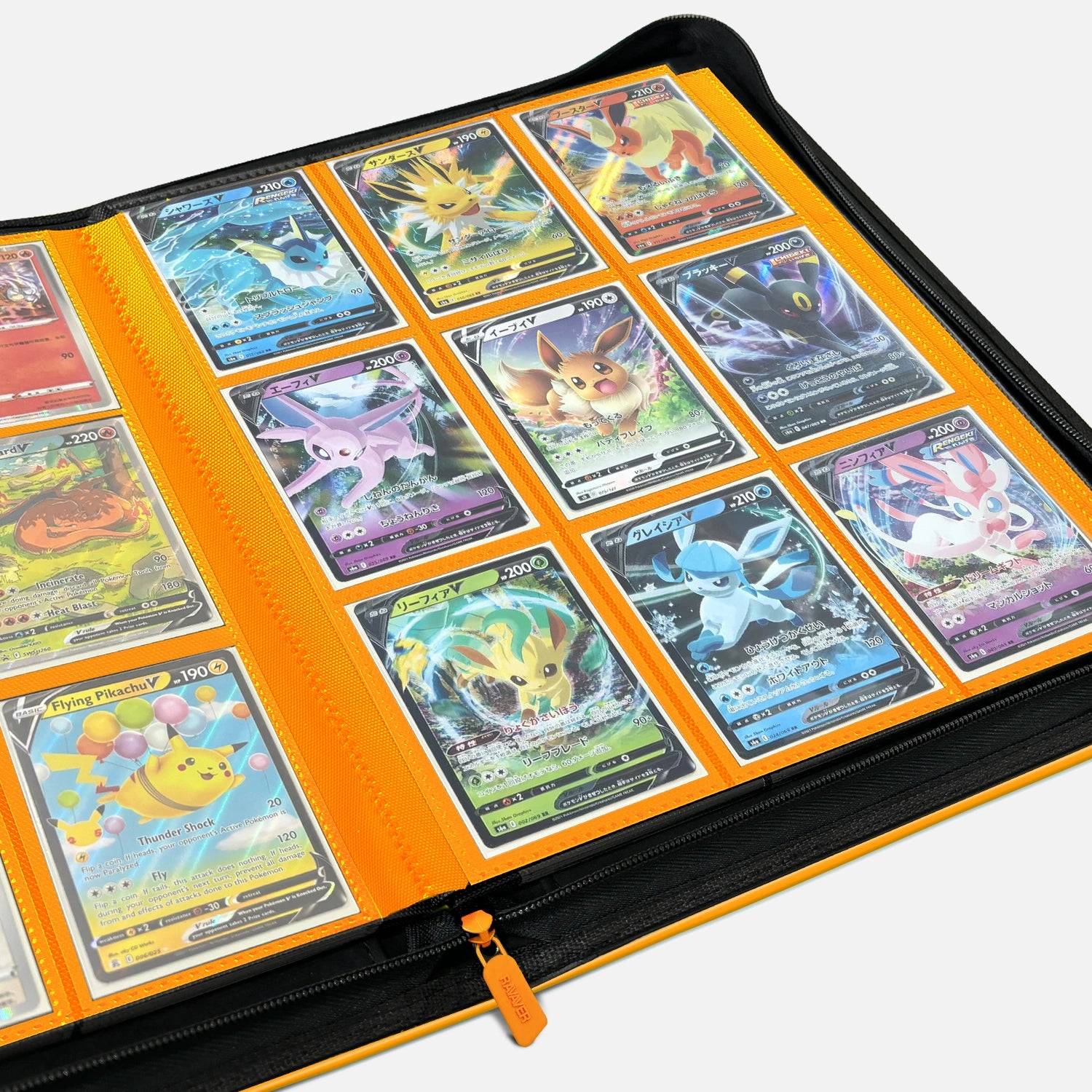
Once you've picked your set, store it properly from the first pack. A master set is a multi-year project — your binder needs to protect the cards for the entire duration, look good when you bring it to trade nights, and be flexible enough to hold both raw pulls and graded slabs. Ravaver's premium card binders are built for exactly this kind of multi-year collecting project.
Sources:
- PokéBeach, "Prismatic Evolutions Pull Rates Revealed," retrieved 2026-05-19, https://www.pokebeach.com/2025/01/prismatic-evolutions-pull-rates-revealed-special-illustration-rares-twice-as-easy-to-pull
- TCGplayer, "Scarlet & Violet Base Set Booster Box," retrieved 2026-05-19, https://www.tcgplayer.com/product/476452/pokemon-sv01-scarlet-and-violet-base-set-scarlet-and-violet-booster-box
- Athlon Sports, "Pokemon TCG Mega Evolution Perfect Order Release Preview," retrieved 2026-05-19, https://athlonsports.com/collectibles/pokemon-tcg-mega-evolution-perfect-order-release-preview-march-2026
- Cardshoplive, "Hit Rates for Pokemon TCG Scarlet & Violet," retrieved 2026-05-19, https://cardshoplive.com/pages/hit-rates-for-pokemon-tcg-scarlet-and-violet
- Bleeding Cool, "Pokemon TCG Has Two Releases Happening in April 2026," retrieved 2026-05-19, https://bleedingcool.com/games/pokemon-tcg-has-two-releases-happening-in-april-2026/