A 2024 estate sale in central Florida produced a stunning lesson in storage economics: a complete sealed run of 1999-2003 WOTC booster boxes that should have been worth $480,000+ sold for $215,000 because every box had been stored in a non-climate-controlled garage for 22 years. This guide is the storage companion to our vintage sealed booster box investment pillar, that pillar covers how sealed appreciates; this guide covers how to keep that appreciation from evaporating in storage.
The shrink wrap had partially fused to the cardboard, the box flaps had warped, and BBCE rejected six of the eight boxes for visible moisture damage. The investment had been made correctly. The storage had not.
This is a ranked breakdown of the seven storage mistakes that consistently destroy Pokemon card investment value, with the specific mechanism each one triggers and the corrective action that prevents it. Every mistake on this list has cost real collectors real money in the last 24 months.
Key Takeaways
- Humidity above 60% relative humidity for sustained periods causes the most expensive damage and is the single most common storage failure.
- UV exposure from window-adjacent storage degrades holographic foil and cardstock color in 18-30 months.
- Vertical stacking of sealed boxes causes weight-induced flap deformation that BBCE rejects.
- Temperature swings of more than 15F seasonally weaken factory shrink wrap and crack toploaders.
- The total cost of correct storage infrastructure runs $80-200 for collections under $50K, trivial compared to the value protected.
Mistake 1: Storing in Basements, Garages, or Attics
Basement, garage, and attic storage is the single most expensive mistake collectors make. These spaces have humidity ranges that swing from 30% to 80%+ across seasons, temperature variations exceeding 40F annually, and concentrated UV exposure if any windows are present. Cardboard is hygroscopic, which means it actively absorbs ambient moisture, swelling and warping cardstock and disrupting factory shrink wrap seals over 18-30 months.
What it costs: A vintage WOTC sealed box with visible moisture damage loses 35-55 percent of its market value and typically fails BBCE authentication, which compounds the loss by removing the certification premium. On a $20,000 box, that is a $7,000-11,000 hit before factoring in BBCE rejection.
Fix: Move all sealed product and graded singles to interior closet space, never against an exterior wall. Interior closets in HVAC-controlled homes hold 45-58% relative humidity and 67-72F year-round without intervention. The cost: zero, plus relocation labor.
Mistake 2: Skipping Hygrometer Monitoring
Most collectors who store cards in proper interior closet space still fail to verify the actual humidity in that closet. HVAC systems vary by region, season, and house age. A closet that runs 50% RH in winter can climb to 65% RH in summer if the homeowner reduces AC use during travel or vacation. Without monitoring, the damage is invisible until BBCE rejection or visible warping appears.
What it costs: Damage from undetected humidity excursions typically reduces sealed box value 15-30 percent and modern card condition by one PSA grade tier. On a $5,000 sealed box, that is $750-1,500 in value loss.
Fix: A digital hygrometer with min/max memory costs $12-18 on Amazon. Place one in each storage location. Check the readings monthly. If readings exceed 60% RH for more than a few hours, deploy silica gel canisters or a dehumidifier in the storage space. The total infrastructure cost: $15-50.

Mistake 3: Window-Adjacent Storage and UV Exposure
Pokemon cards stored within 4-6 feet of any window receive enough UV exposure to degrade holographic foil and fade cardstock color within 18-30 months. The damage is gradual, asymmetric (the side facing the window degrades faster), and often invisible until the card is graded and the back is compared to a reference. PSA grading accounts for color shift and surface degradation in the final grade.
What it costs: The PSA 10 to PSA 9 gap on modern Special Illustration Rares typically runs 2.5x to 4x in value (covered in detail in our PSA vs CGC vs BGS grading ROI guide). On a $1,800 PSA 10 candidate that drops to PSA 9, the loss is $1,000-1,300. For sealed product, UV exposure fades the box artwork itself, which counts toward condition grading at resale and can knock 10-20 percent off comp value even when the seal remains intact.
Fix: Store cards in fully enclosed cabinets, drawers, or interior closet shelving with no line-of-sight to any window. UV-blocking shelf liner is unnecessary if storage is enclosed. The cost: zero with proper placement.
Mistake 4: Vertical Stacking of Sealed Booster Boxes
Sealed booster boxes are not designed for long-term vertical stacking. The bottom box in a vertical stack of three or more bears the cumulative weight of everything above it for the duration of storage. Over 24-48 months, this causes flap deformation, flap-edge crushing, and visible stack lines on the cardboard. BBCE explicitly notes flap damage as a condition factor that can reduce certified condition grades or, in severe cases, prevent certification entirely.
What it costs: Visible flap damage on a vintage sealed box reduces resale value 12-25 percent, often without recourse. Even BBCE-certified boxes with documented flap damage trade at the lower end of comp ranges. On a $20,000 Jungle box, that is $2,400-5,000 in avoidable value loss.
Fix: Store sealed boxes either flat (lying on their largest face, which has no fold lines) or in single-tier upright orientation. If multi-tier storage is necessary due to space constraints, separate tiers with rigid plywood or acrylic shelves so no box bears weight from above. The cost: $20-60 for shelving inserts.
Mistake 5: Cardboard Banker Box Storage
Standard cardboard banker boxes from office supply stores are popular for trading card storage because they fit standard shoebox storage products neatly. They are also one of the worst storage choices possible. Cardboard banker boxes absorb ambient humidity, transmit it to the contents, provide zero pest protection, and typically have inadequate structural rigidity once they have absorbed any moisture themselves.
What it costs: Long-term cardboard storage produces compounding damage: warped sleeves, foxed card surfaces, and in extreme cases, mold colonization on cards that touched a damp banker box wall. Restoration is impossible. Affected cards lose 50-90 percent of value depending on damage severity.
Fix: Replace all cardboard banker boxes with airtight plastic tubs (Sterilite, Iris, or Rubbermaid Roughneck lines all work). Look for tubs with rubber-gasketed lids rather than friction-fit lids. Cost: $12-25 per tub for the gasket-sealed versions.
Mistake 6: Inadequate Sleeves and Toploaders for Long-Term Storage
The soft sleeve plus penny sleeve plus toploader stack remains the standard for card protection, but specific product choices within that stack matter enormously for long-term storage. Generic non-Ultra-Pro toploaders from Amazon often crack within 3-5 years of normal handling and cause edge damage to the cards inside. Cheap penny sleeves yellow and stick to card surfaces over time. Soft sleeves that are PVC-based release plasticizers that fog card surfaces.
What it costs: A modern Special Illustration Rare in a degraded toploader can suffer surface scratching, edge scuffing, and corner whitening that drops PSA grading by one or two tiers. On a $2,500 PSA 10 candidate, dropping to PSA 8 over storage time costs $1,500-1,900.
Fix: Use Ultra Pro Premium toploaders (the gold-rim line) or comparable PSA-approved products for long-term storage. Use PVC-free, PET-based penny sleeves and soft sleeves. Replace sleeves and toploaders every 5-7 years for cards intended for eventual grading. The cost: $0.50-1.20 per card for the protection stack, replaced periodically.

Mistake 7: Treating Insurance as Optional
The final mistake is the one that compounds all the others: not insuring high-value collections at appropriate replacement-cost coverage. Standard homeowners and renters policies almost universally cap collectibles coverage at $1,000-2,500 per category without a specific scheduled rider. A $50,000 sealed Pokemon collection sitting under a default homeowners policy is functionally uninsured against fire, theft, water damage, and natural disasters.
What it costs: Total loss without scheduled insurance can mean 100% loss with negligible recovery from the underlying policy. Reddit threads on r/PokeInvesting in 2024-2025 documented multiple cases where collectors lost five-figure and six-figure collections to house fires and received $1,000-2,500 against six-figure replacement costs.
Fix: Schedule a collectibles rider through Collectibles Insurance Services, Distinguished, or your existing homeowners carrier collectibles addendum. Premium runs 0.6-1.3% of declared value annually. On a $50,000 collection, that is $300-650 per year for full replacement-cost coverage. Collectibles Insurance Services publishes their rate structure transparently and accepts BBCE-certified declared values.
The Total Cost of Doing Storage Right
| Item | Cost | Frequency |
|---|---|---|
| Digital hygrometer (2 units) | $25-35 | One-time, replace battery annually |
| Silica gel canisters (4-pack) | $15-25 | Replace every 6 months |
| Sterilite gasket-sealed tubs (4) | $60-100 | One-time, decade+ lifespan |
| Ultra Pro Premium toploaders (100) | $30-45 | Every 5-7 years |
| Collectibles insurance ($25K declared) | $150-325/yr | Annual |
| Total first-year infrastructure | $280-530 | For a $25K collection |
For a $25,000 collection, $280-530 in first-year storage and insurance infrastructure is roughly 1.1-2.1 percent of declared value. That is a tiny fraction of the value protected.
Frequently Asked Questions
What is the ideal humidity for Pokemon card storage?
The ideal range for Pokemon card and sealed product storage is 45-55% relative humidity, held stable. Fluctuations between 40% and 60% are tolerable. Sustained humidity above 60% causes warping and shrink-wrap distortion within 18-24 months. Stability matters more than the exact target, a steady 55% is better than oscillating between 45% and 60%.
What temperature is best for Pokemon card storage?
Stable room temperature in the 65-72F range is ideal. Pokemon cards tolerate temperature better than humidity, but extreme swings (above 80F or below 50F) and rapid changes weaken factory shrink wrap on sealed product and can crack older toploaders.
Are silica gel packets enough to control humidity in a closet?
Silica gel packets provide modest humidity buffering but are not a substitute for environmental humidity control. A 50-100g silica gel canister inside an airtight tub will maintain stable humidity inside the tub even when ambient humidity fluctuates moderately. For collections in spaces with consistent humidity above 65%, silica gel alone is insufficient.
Should I rotate sealed boxes between storage and display?
For investment-purpose sealed product, no. Display environments expose cards to UV, temperature swings, dust, and handling damage that storage avoids. The collectors who maintain investment-grade collections typically keep investment-tier sealed boxes in storage permanently and use lower-value duplicate copies for display purposes.
How does storage affect PSA grading outcomes?
Storage quality directly affects PSA grading results. Cards stored in stable humidity and temperature with appropriate sleeves and toploaders typically grade one to two tiers higher than identically pulled cards stored in fluctuating conditions. The grading economic impact is significant: PSA 10 vs PSA 9 grading on modern Special Illustration Rares routinely produces 2.5x-4x value differences.
Is climate-controlled offsite storage worth the cost?
For collections valued above $30,000, offsite climate-controlled storage units at $35-65/month often make sense, both for environmental control and for risk concentration reasons (theft, fire, water damage at primary residence). Below $30,000, home storage in a properly equipped interior closet is usually adequate and more cost-effective.
Can I store sealed Pokemon and graded cards in the same tub?
Yes, with one caveat: graded slabs occupy enough vertical space that they should not be placed beneath sealed boxes in vertical orientation. The slabs themselves are well-protected, but if a tub has both sealed boxes and slabs, organize so slabs are on top or in separate compartments.
Actionable Next Step
Audit your current storage setup this weekend against this 7-point checklist. The most common failure pattern: items are stored in interior closets (good) but without hygrometer monitoring (mistake 2) and in original cardboard packaging (mistake 5). Both fixes can be completed for under $50 and 30 minutes of work. The value protected typically exceeds 200x the implementation cost.
If you discover your collection has been stored in a basement, garage, or attic for more than 12 months, BBCE-submit any sealed boxes valued above $3,000 in the next quarter to confirm authentication still passes. Use our 8-step authentication checklist for pre-submission inspection. Catching damage before resale is always cheaper than negotiating against unauthenticated comp prices later.
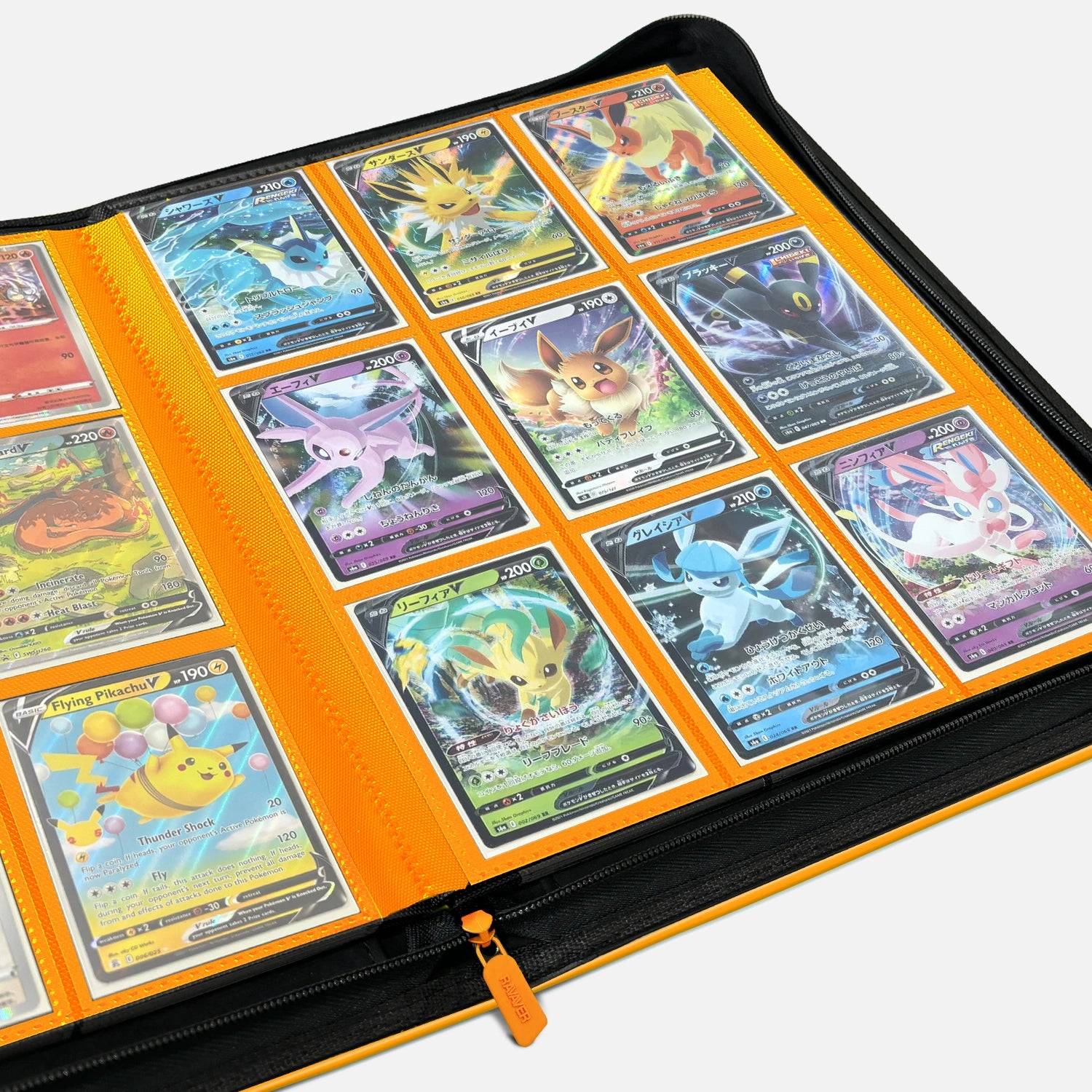
For graded singles workflow, our older complete card protection guide remains the foundation, and many collectors run their grading-pipeline singles through our custom card binders for binder-grade preservation between submissions.
Sources:
- Collectibles Insurance Services, Coverage and rate structure documentation, retrieved 2026-05-08
- PSA, Card grading standards and submission documentation, retrieved 2026-05-08
- TCGplayer, Sealed product storage best-practices content, retrieved 2026-05-08