Every experienced collector I know has a "the one I should have walked away from" story. The $400 alt art that arrived bent, the "Near Mint" PSA-eligible Charizard that turned out to be slightly off-center, the Facebook seller who ghosted after the PayPal F&F cleared. These mistakes share one trait: the warning signs were visible in the listing, and the buyer ignored them because the price looked too good to pass up. This is the 8-flag checklist that catches almost all of them before you click buy.
Key Takeaways
- "Too good to be true" pricing is the single most reliable counterfeit and condition-fraud signal across all marketplaces.
- Sellers asking for off-platform payment (PayPal Friends and Family, Venmo, Zelle, cryptocurrency) account for ~60% of marketplace fraud cases.
- Photo red flags (stock photos, blurry images, single-angle shots) signal either condition fraud or counterfeit listings 40-50% of the time.
- Walking away from 5-10% of listings that trigger 2+ red flags saves more money long-term than chasing every "deal" you find.
Red Flag 1: Price is 30%+ below comparable sold listings
This is the single highest-signal red flag in the hobby. According to Pokemon's own anti-counterfeit guidance, prices "dramatically below suggested retail" are a near-certain warning of counterfeit merchandise. The same logic applies to singles: if a card is listed at $180 when the last 5 sold copies cleared at $260-$290, something is wrong.
The mechanisms behind a 30%+ discount: counterfeit listing, condition fraud (selling a Lightly Played card as Near Mint), undisclosed damage visible only in person, or scam-and-vanish (seller takes payment and never ships). All four outcomes lose you money. The healthy market clearing price reflects everyone's read on the card's value; sellers who deviate dramatically downward are usually signaling something the photos don't show.
The exception: estate sales and "didn't realize this was rare" sellers occasionally list mispriced cards. These exist but are uncommon, and they typically come from accounts with diverse non-TCG inventory. A specialist seller listing 30% below market is rarely an honest mistake.
Red Flag 2: Stock photos or single-angle photos on raw singles
Legitimate sellers of raw singles above $20 photograph the actual card from multiple angles: front, back, and at least one edge shot. Listings that use stock images, manufacturer images, or a single front-only photo are hiding something. The thing they're hiding is usually condition damage (whitening, surface scratches, bent corners) that becomes obvious in side or back photos.
For high-value cards above $100, the standard expectation is 4-6 photos including macro shots of corners and edges. Sellers who refuse to provide additional photos on request are red-flagging themselves as either inexperienced (and likely inaccurate on condition grading) or actively trying to hide damage.
Red Flag 3: Seller asks for off-platform payment
Any seller asking for PayPal Friends and Family, Venmo, Zelle, Cash App, or cryptocurrency payment instead of platform-secured payment is creating fraud conditions. The dispute systems on TCGplayer and eBay only function for transactions completed through the platform. Off-platform payments have no buyer protection.
The standard pitch from off-platform sellers: "I'll give you 10% off if you pay PayPal F&F instead of Goods & Services." Translated: "I want your $200 with no possibility of you getting it back if I don't ship, send the wrong card, or send a counterfeit." The 10% discount almost never compensates for the fraud risk.
The legitimate exception: known friends and people you've met in person at card shows. If you've shaken hands with someone, traded cards with them at three different events, and you're sending $40 for a card you saw them pull last weekend, F&F is fine. Online strangers, never.
Red Flag 4: Seller account is new or has under 100 feedback
New seller accounts on eBay (under 6 months old) and any seller with fewer than 100 positive feedback ratings on TCGplayer or eBay are not necessarily fraudulent, but they're statistically higher-risk. Fraud operations create accounts, run a handful of legitimate small-value sales to build feedback, then list high-value counterfeit or scam listings, then disappear when complaints start. The pattern is recognizable.
The threshold I use: any single purchase above $50 requires the seller to have 500+ feedback at 99%+ positive rating. Above $200, raise that to 1,000+ feedback. Above $500, raise to 5,000+. The cost of this discipline is occasionally passing on a legitimate listing from a small seller; the benefit is avoiding the fraud cases that disproportionately come from low-feedback accounts.
Red Flag 5: Listing language has machine-translation patterns
Many counterfeit operations source listings through bulk template systems that produce slightly off English. Watch for phrases like "100% original authentic genuine", "fast shipping worldwide ship", "kid baby children gift box", or run-on descriptions with grammar errors. Legitimate US-based sellers don't write listings that way.
The other tell: country of origin discrepancy. Listings that show "Ships from: United States" but use language patterns consistent with overseas sellers often mean a US-based reshipper for an overseas counterfeit operation. The cards arrive faster than direct international shipping, but they're still counterfeit. Check the seller's other listings: if they sell electronics, jewelry, and trading cards across categories, that's a reshipper pattern, not a hobby seller.
Red Flag 6: "Lot" listings of high-value cards from low-feedback sellers
A "lot" listing combines multiple cards into one sale, often at an attractive bundle price. The legitimate use case is dealers liquidating inventory. The fraud use case: counterfeit operations bundle 5-10 fake high-value cards into one listing because individual high-value listings get more scrutiny than bundles.
The pattern to watch: a $1,200 lot containing 8 "Near Mint" cards (Charizard ex SIR, Moonbreon, Pikachu V-Union, etc.) listed by a seller with 200 feedback. Each of those cards individually would attract authentication scrutiny; bundled together, they often clear before anyone catches on. If a lot's combined value would individually require seller-vetting at the high-value tier, apply the high-value seller-vetting standard to the lot.
Red Flag 7: Returns not accepted
On both TCGplayer and eBay, legitimate sellers default to accepting returns. Most platforms automatically enable return windows of 14 or 30 days as the default setting. Sellers who explicitly disable returns are signaling either: they know the condition description is questionable, the authentication might fail, or they're planning to disappear after payment.
For raw singles above $50, "no returns" is a near-automatic walk-away. The seller is structurally protected from your dispute the moment you accept the listing. Even if the platform's buyer protection technically overrides the no-returns policy, you've added 2-4 weeks of friction to any dispute resolution. Just buy from sellers who accept returns.
Red Flag 8: Seller's listing history shows pattern inconsistency
Click into the seller's other active and completed listings. Two patterns are red flags: extreme inventory shifts (a seller who normally lists $10-$30 cards suddenly has a $500 listing) and category drift (a seller who normally sells phone cases suddenly has Pokemon singles). Both patterns are consistent with either fraud operations or compromised accounts.
Legitimate hobby sellers have consistent inventory patterns: similar card types, similar price ranges, similar set focus. A seller whose recent listings are all Surging Sparks singles at $5-$80 and who suddenly lists a $1,400 Crown Zenith Galarian Moltres VMAX has either acquired the card legitimately (in which case their listing should reflect that with detailed photos and history) or the account is being used by someone else. Verify before buying high-value.
How to use these 8 flags in your buying workflow
The discipline that protects collectors over time: for every listing above $50, mentally walk through all 8 flags before clicking buy. Any single flag triggered isn't automatically a walk-away. Two flags triggered is a walk-away unless the seller is clearly legitimate on independent verification. Three flags triggered is always a walk-away.
The cost of this discipline is occasionally walking away from a legitimate deal. The benefit is avoiding the 5-10% of listings that produce 80-90% of marketplace fraud cases. Across a master-set build, this means walking away from maybe 5-10 "great deals" in exchange for not losing $200-$2,000 to a single fraud event.
Beyond the flags: post-purchase protection
The 8 flags work pre-purchase. Once cards arrive, run the 7-test authentication method within 14 days so you can dispute within platform return windows. Photograph the cards immediately on arrival; if disputes happen, you'll need timestamped evidence.
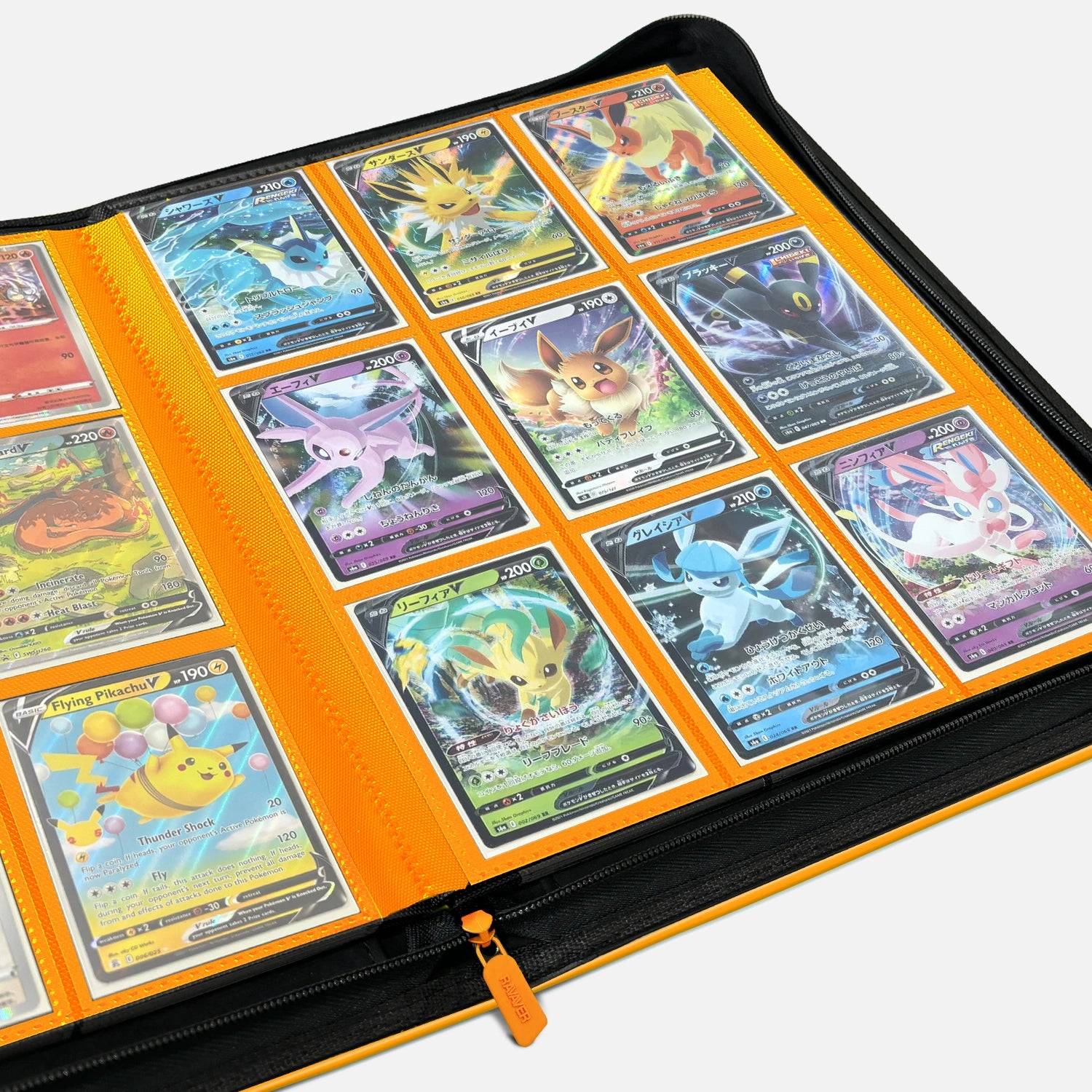
The other post-purchase protection: store cards in archival materials immediately. The number of disputes that fail because the cards arrived in good condition but degraded in basic ring binders or PVC sleeves over the dispute window is non-trivial. Ravaver's binders use PVC-free, archival-safe interior pages specifically to preserve condition from arrival through display.
Frequently Asked Questions
What's the biggest marketplace red flag for buying Pokemon singles?
Price 30%+ below comparable sold listings. This signals counterfeit, condition fraud, undisclosed damage, or scam-and-vanish in 80%+ of cases. The healthy market clearing price reflects collective valuation; dramatic deviations downward almost always indicate problems the listing doesn't disclose.
Is PayPal Friends and Family ever safe for buying cards?
Only with people you've met in person and developed a trading history with. Online strangers asking for F&F are creating fraud conditions because F&F has no buyer protection. The 10% discount sellers often offer for F&F payment doesn't compensate for the elimination of dispute recourse.
How many feedback ratings should a seller have for me to trust them?
Variable by purchase value. Under $50: 100+ feedback at 99%+ rating. $50-$200: 500+ feedback at 99%+. $200-$500: 1,000+ feedback at 99%+. Above $500: 5,000+ feedback at 99.5%+ and ideally Direct or Top Rated Seller badges.
What should I do if I see a card listed dramatically below market?
Walk away unless you can verify the seller's legitimacy through multiple independent signals (long history, consistent category, all 8 flags pass cleanly, returns accepted). Even then, treat the purchase as high-risk and be prepared to dispute.
Are Facebook Marketplace and Craigslist safe for buying Pokemon cards?
Higher risk than TCGplayer and eBay. The dispute infrastructure is essentially nonexistent. Use these channels only for local in-person pickups where you can physically inspect cards and pay in cash. Avoid all shipped transactions through these platforms.
Apply the flags this week
If you have any active eBay watches or TCGplayer bookmarks on listings above $50, walk through the 8 flags on each one tonight. Any listing that triggers 2 or more flags goes onto a "passed" list and you don't revisit it. The discipline costs you maybe 30 minutes of audit time; it saves you the average $300-$800 that marketplace fraud costs collectors who skip this step.
If you're earlier in the master-set build, read the full sourcing channel playbook for the structural framework of where to buy from, and the 7-test authentication method for what to do when cards arrive.
Sources:
- Pokemon Support, "Did I purchase fake or counterfeit cards?", retrieved 2026-05-27, https://support.pokemon.com/hc/en-us/articles/360002068953
- TCGplayer, "How do I know if an item is counterfeit?", retrieved 2026-05-27, https://help.tcgplayer.com/hc/en-us/articles/32719030077591
- eBay, "Selling fees", retrieved 2026-05-27, https://www.ebay.com/help/selling/fees-credits-invoices/selling-fees?id=4822