The hobby loses an estimated $5-$10 million annually to Pokemon counterfeit fraud, most of it concentrated on a handful of marketplace channels. The collectors who get hit are almost always the ones who applied one or two informal checks instead of a systematic authentication method. This is the 7-test authentication framework that catches 95%+ of modern counterfeits and most vintage forgeries, written for collectors who don't have grading lab equipment but want to stop overpaying for fakes.
Key Takeaways
- Counterfeit Pokemon cards almost always fail on at least 3 of 7 standard tests, even high-quality counterfeits.
- The single most reliable test is the layered-cardstock check: per Pokemon's own support documentation, genuine cards have a visible black layer sandwiched between the front and back faces, visible at the edge.
- The light test (holding the card up to a bright light to check opacity) catches roughly 60-70% of all counterfeits on its own.
- If you're buying graded slabs (PSA, BGS, CGC) from reputable sellers, you've delegated authentication to the grading company; for raw cards above $200, run all 7 tests within 14 days of arrival so you can dispute within platform return windows.
How widespread is the Pokemon counterfeit problem in 2026?
Counterfeit Pokemon cards have existed since the late 1990s, but the 2024-2026 wave is qualitatively different. Modern counterfeits, mostly sourced from overseas printing operations, can fool casual inspection. The cards have correct color tones, proper card backs, and increasingly accurate holographic patterns. What they can't yet replicate consistently is the structural cardstock that genuine Pokemon cards use, the precise font kerning on attack text, and the matte-vs-glossy contrast on holographic foils.
The risk concentration: ~80% of confirmed counterfeit cases in the hobby trace back to four channel patterns. Cheap "booster boxes" on AliExpress or Wish, raw singles from Facebook Marketplace sellers with under 50 friends, unauthenticated eBay singles under $50 from sellers with under 100 feedback, and "bundle deals" sold through Discord direct messages without escrow. If your purchase doesn't fit one of those patterns, your counterfeit risk is already low; if it does, the 7 tests below are non-negotiable.
The 7-test authentication method
Test 1: The light test
Hold the card up to a bright light source (a phone flashlight works). A genuine Pokemon card is largely opaque; you'll see only a faint silhouette of light through it. A counterfeit card lets noticeably more light through, often enough that you can read text from the other side of the card. According to Pokemon's own support guidance, counterfeit cards "are often easy to see through if you hold them up to a bright light".
This single test catches an estimated 60-70% of counterfeits on its own. Even well-funded counterfeit operations cut corners on cardstock thickness because thicker paper costs more and slows production lines. Always run this test first.
Test 2: The layered cardstock edge inspection
Look at the edge of the card under good lighting, ideally with a 10x magnifier or your phone camera's macro mode. A genuine Pokemon card is a three-layer construction: front face, black middle layer, back face. The black layer is visible at the edge as a thin dark stripe sandwiched between the two outer layers. Counterfeit cards typically use single-layer cardstock or two-layer construction without the dark middle, which is visible immediately at the edge.
The Pokemon Company's own anti-counterfeit guidance describes this as the highest-reliability test because the black middle layer requires specialized printing equipment that overseas counterfeit operations don't have access to. Cards that pass the light test but fail the edge inspection are almost certainly counterfeit.
Test 3: Side-by-side color comparison
Compare the suspect card to a known-genuine card from the same set or era. Look at the yellow border (modern cards), the energy symbol colors, and the HP number. Counterfeits typically show subtle color shifts: yellows that lean greenish, reds that lean orangey, blues that lean grayish. The difference is small but consistent across the card once you train your eye to see it.
If you don't have a known-genuine card from the same set, compare against the official high-resolution image on Bulbapedia. Most discrepancies are visible at side-by-side comparison even on a phone screen.
Test 4: Font kerning and text quality
Modern Pokemon cards use very specific fonts with precise kerning (the spacing between letters). Counterfeits often use close-but-not-identical fonts, and the kerning is slightly off, especially on energy cost symbols and attack damage numbers. Look closely at the attack text: counterfeit text often appears slightly blurry, has inconsistent letter spacing, or uses a slightly thicker/thinner font weight than genuine cards.
The HP value on the top right is the easiest tell. Genuine cards have consistent font weight and spacing between the HP digits. Counterfeits frequently have HP numbers that look slightly compressed or have inconsistent vertical alignment.
Test 5: Holographic pattern check
For holographic cards, the foil pattern is the second-hardest element for counterfeiters to replicate. Genuine holos have specific patterns depending on the card's rarity and era: cosmos pattern on standard holos, etched patterns on V cards, full-art textures on full arts and SIRs. Counterfeit holos often use generic "rainbow film" overlays that don't match the genuine pattern type for the card you're holding.
For modern SIRs and alt arts specifically, the holographic pattern should respond to changing light angles with the specific texture of the card's rarity tier. If the holo looks like generic rainbow film regardless of angle, the card is likely counterfeit.
Test 6: Weight and feel comparison
Genuine Pokemon cards weigh approximately 1.7-1.8 grams each. If you have a postal scale (or any kitchen scale with 0.1g precision), weigh the suspect card. Significant deviation (outside 1.5-2.0 grams) indicates counterfeit cardstock.
Without a scale, use the feel test: genuine cards have a slight stiffness and a smooth-but-not-slick finish. Counterfeits often feel either too flimsy (thin paper) or too slick (cheap coating). The texture of a genuine card surface should resist your fingernail slightly without feeling sticky or chalky.
Test 7: Back centering and print alignment
The card back has a consistent Pokeball image and Pokemon TCG logo. On genuine cards, the centering is reasonably tight (the inner blue circle is roughly centered on the card back, though minor variance is normal). On counterfeits, the print alignment is often noticeably off-center, with the Pokeball pushed toward one edge or the logo placement slightly tilted.
Run this test against a known-genuine card from the same era. Modern counterfeits have gotten better at back printing, but small alignment errors persist on roughly 30-40% of counterfeit cards.
What to do when you've identified a counterfeit
The 7-test method should be completed within 14 days of card delivery, because most platform return windows close after 14 or 30 days. The action sequence:
- Document with photos and video. Take photos of the failed tests (especially the light test and edge inspection) before initiating any dispute. Video of the light test held against a known-genuine card is especially persuasive in platform disputes.
- Contact the seller first. Many sellers will issue refunds immediately when presented with photo evidence rather than risk platform penalties. Skip this step only if the seller has a history of disputes.
- Open a platform dispute if needed. TCGplayer and eBay both have buyer protection for counterfeit items. File the dispute with your photo evidence and reference Pokemon's official authentication guidance.
- Do not ship the counterfeit back without instruction. Wait for the platform to instruct on return. In some cases, the platform will refund without requiring return, especially when the seller has a pattern of counterfeit listings.
- Report the seller to the platform. Both TCGplayer and eBay have seller-reporting systems for counterfeit goods. Reporting helps the platform remove repeat offenders.
How to avoid counterfeit risk in the first place
The 7-test method works as a recovery system. The better strategy is pre-purchase risk reduction: buy only from channels where counterfeit risk is structurally low. According to TCGplayer's authentication guidance, the platform's own marketplace has very low counterfeit incidence due to seller verification and dispute resolution; the same holds true for eBay sellers with 1,000+ feedback at 99%+ rating, and for PSA/BGS/CGC graded slabs regardless of channel.
The channels to avoid for raw singles: AliExpress, Wish, Temu, Facebook Marketplace from low-friend sellers, Discord DM "deals" without platform escrow, eBay sellers under 100 feedback, and any seller asking for PayPal Friends and Family or cryptocurrency payment. If you stick to TCGplayer marketplace and verified eBay sellers, your annual counterfeit exposure is likely under $0 even across hundreds of singles purchases.
The condition trap that mimics counterfeit
One nuance worth flagging: heavily played, water-damaged, or improperly stored genuine cards can fail some of the 7 tests, especially the weight test (water damage adds mass) and the holo pattern test (foil damage changes pattern appearance). Always check at least 5 of 7 tests before concluding counterfeit, and apply skepticism to weight-test failures alone.
This is also why binder choice matters for newly sourced singles. Genuine Near Mint cards stored in a basic PVC ring binder will fail authentication tests within 5-10 years as the PVC off-gases into the card surface. Storing your master set in archival-grade materials preserves authentication integrity along with the financial value.
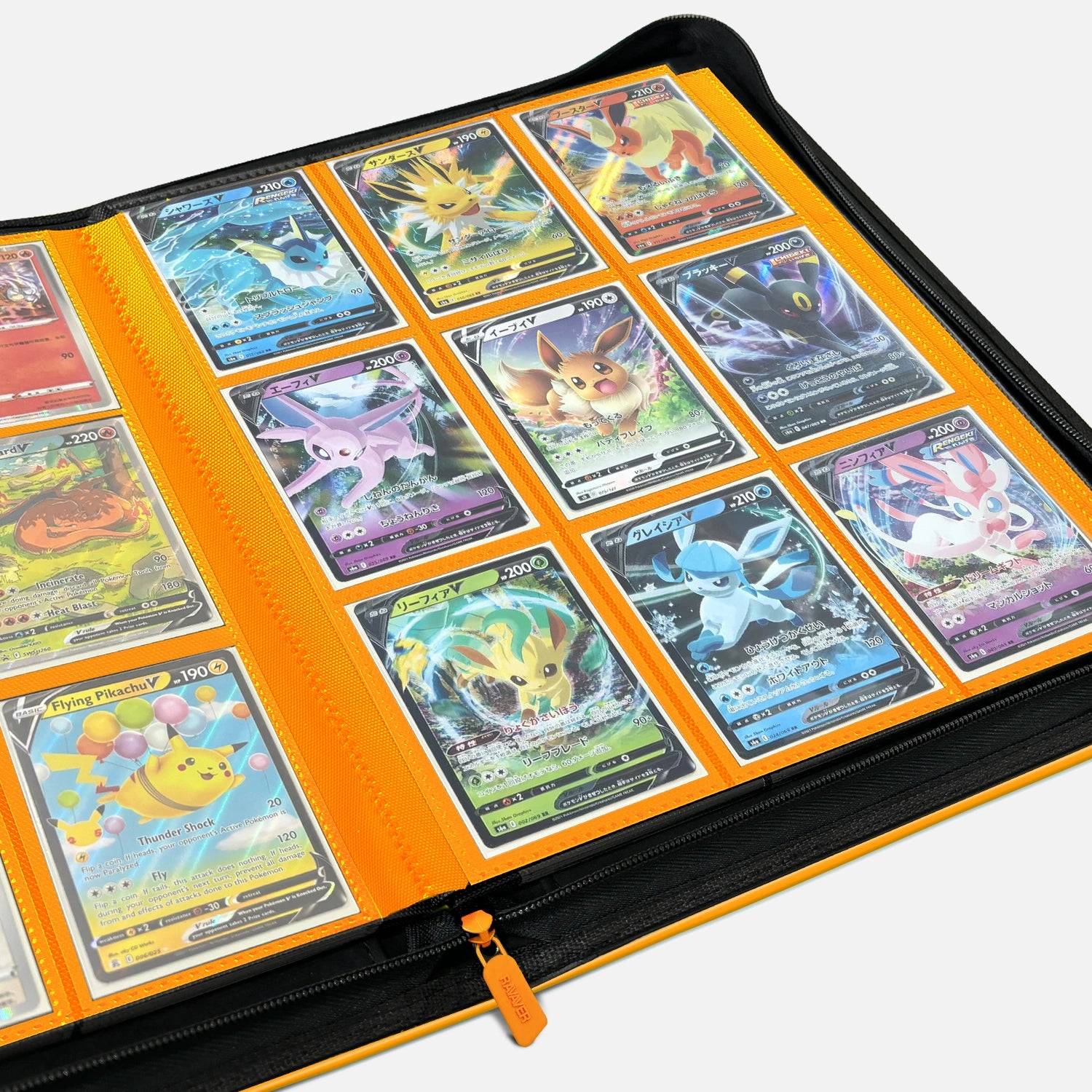
A Ravaver toploader binder uses PVC-free, archival-safe interior pages specifically so the cards you authenticated correctly today still test as genuine in 2036. It's not a counterfeit defense, but it is a preservation defense.
Frequently Asked Questions
What's the single most reliable test for spotting fake Pokemon cards?
The layered cardstock edge inspection. Genuine Pokemon cards are a three-layer construction with a visible black middle layer at the edges. Counterfeits typically use single-layer or two-layer cardstock that lacks this dark stripe. This test is the highest-reliability single check, recommended by both Pokemon's official support documentation and major grading companies.
Can professional grading companies tell if a card is counterfeit?
Yes. PSA, BGS, and CGC all authenticate cards as part of the grading process. Counterfeit cards submitted for grading are flagged and returned without a grade (and typically without a refund of submission fees). A PSA, BGS, or CGC slab is effectively guaranteed authentic.
Are counterfeit Pokemon cards illegal to own?
In the US, possession of counterfeit trademarked goods for personal use is generally not criminally prosecuted, but selling counterfeits is illegal under federal trademark law. Counterfeit cards have no resale value and cannot be ethically traded or sold to other collectors.
Are AliExpress and Wish Pokemon cards counterfeit?
Effectively all "cheap booster box" listings on AliExpress, Wish, and Temu are counterfeit. The wholesale price of legitimate Pokemon TCG booster product is set by The Pokemon Company and licensed distributors; nobody legitimately sells boxes 50-80% below retail.
What should I do if I accidentally sold a counterfeit card?
Contact the buyer immediately and issue a full refund regardless of return condition. Apologize, explain what happened, and offer to cover return shipping. Then run the 7-test method on every card in your collection to identify any other counterfeits.
Run the tests this week
If you've bought any raw singles above $50 in the past 30 days, run the 7-test method on them tonight. The window for platform dispute closes faster than most collectors realize, and the 30 minutes of testing pays for itself the first time you catch a counterfeit. For collectors building master sets, make the 7-test method a standard step in the unboxing workflow: light test, edge inspection, side-by-side color comparison, then into the binder.
If you haven't picked a binder yet, read the sourcing channel playbook for where to source authentic singles in the first place, and look at archival binders that preserve authentic cards in collectible condition for the long term.
Sources:
- Pokemon Support, "Did I purchase fake or counterfeit cards?", retrieved 2026-05-27, https://support.pokemon.com/hc/en-us/articles/360002068953
- TCGplayer, "How to Spot Fake Pokemon Cards", retrieved 2026-05-27, https://www.tcgplayer.com/content/article/How-to-Spot-Fake-Pokemon-Cards
- TCGplayer, "How do I know if an item is counterfeit?", retrieved 2026-05-27, https://help.tcgplayer.com/hc/en-us/articles/32719030077591