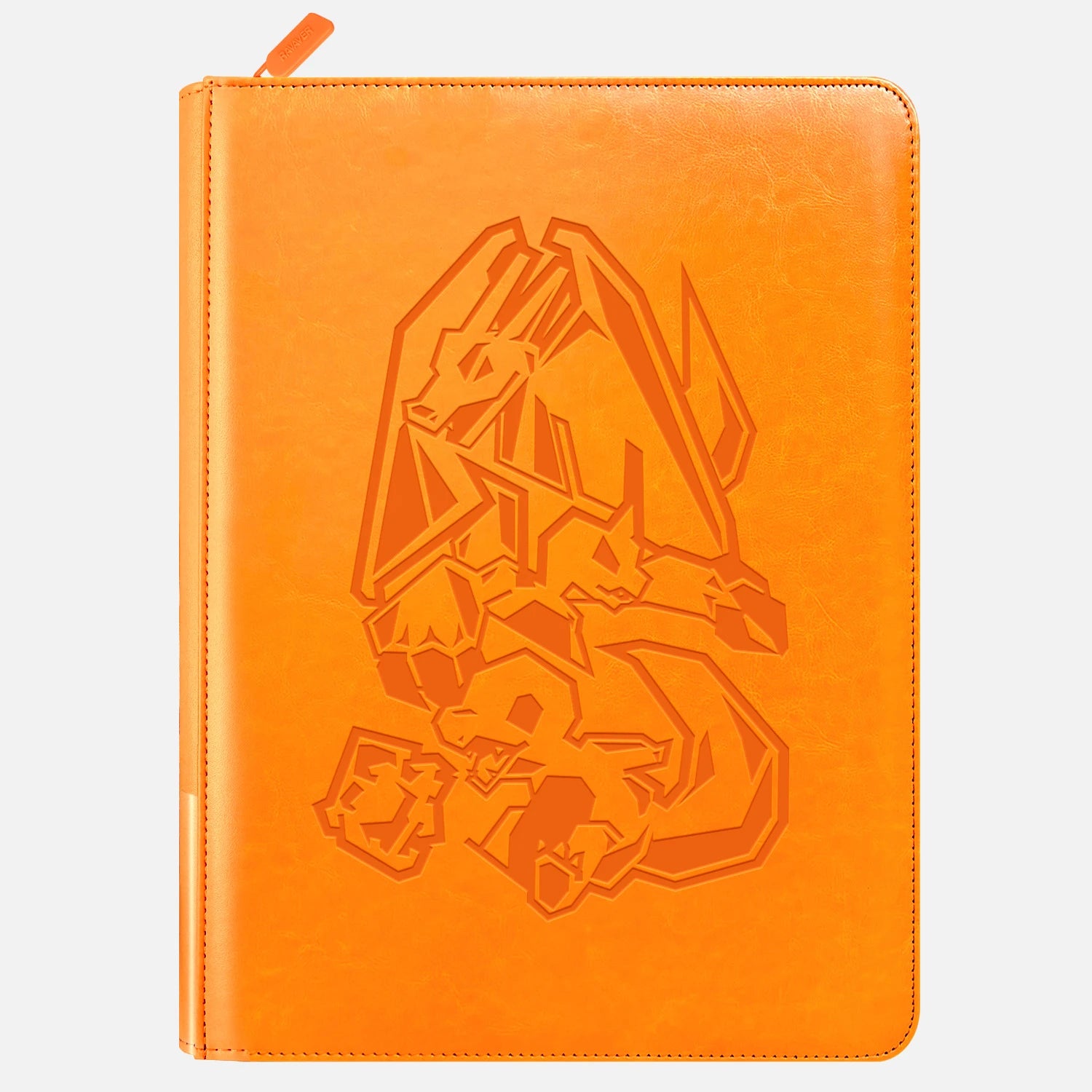
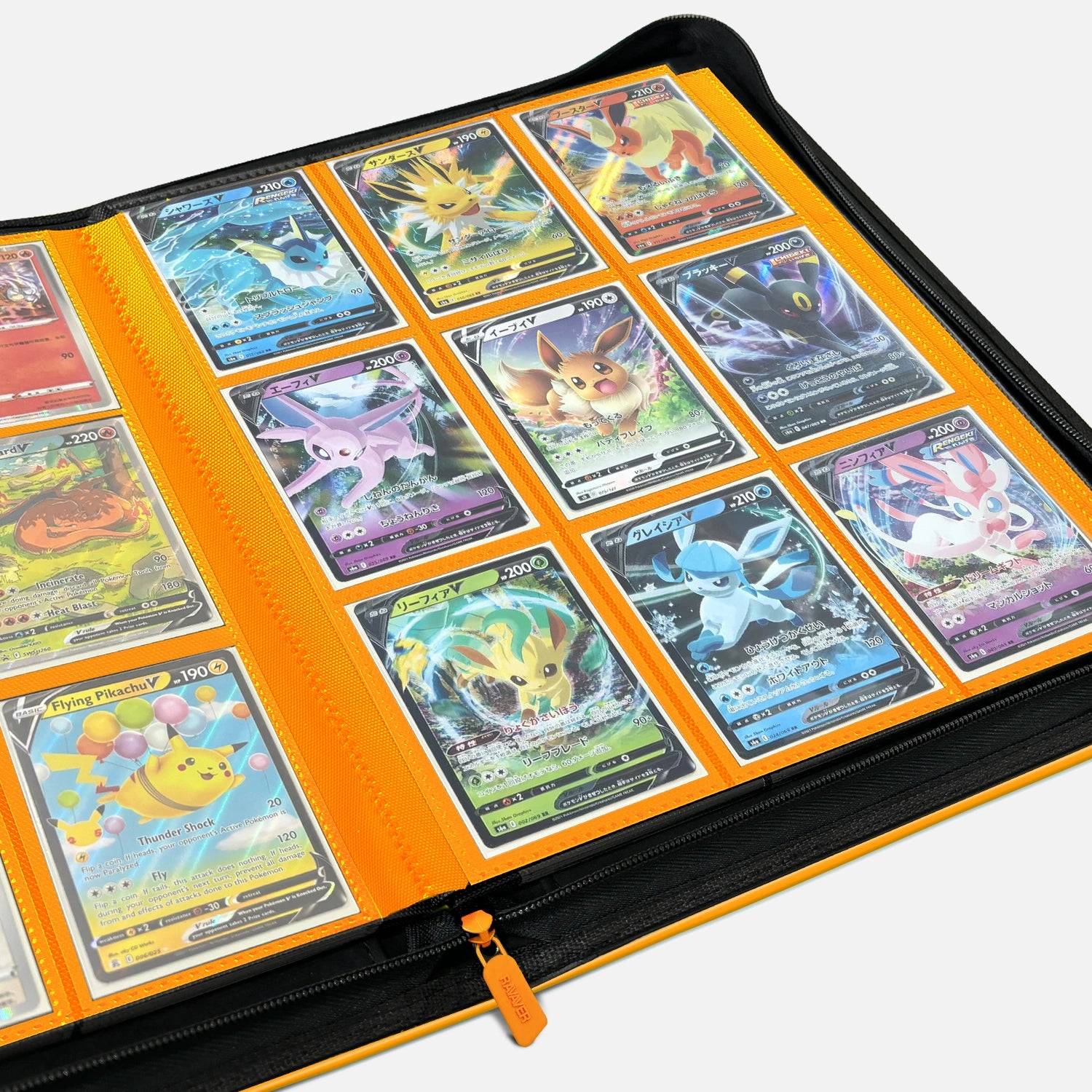
Every premium Pokemon binder product page lists 12 to 15 features. PU leather exterior, archival pages, full zipper, side-loading pockets, gift box, warranty, microfiber lining, anti-static treatment, embossed logo, ribbon bookmark. The list looks impressive. Most of it doesn't actually affect your collection.
Of the 13 features that show up most often in binder marketing copy, only 9 actually matter for protecting and presenting Pokemon cards. The other 4 are filler, and paying for them costs anywhere from $20 to $40 per binder. This piece is what to look for and what to ignore.

Key Takeaways
- Five features are non-negotiable for any binder holding cards worth grading: sewn-in pages, full zipper, archival-safe materials, side-loading pockets, and double-sleeve compatibility.
- Four more features are real upgrades worth paying for: PU leather exterior, gift packaging, multi-year warranty, and toploader compatibility.
- Four features are marketing filler that don't materially affect card protection or longevity: microfiber lining, anti-static treatment, embossed logos, and ribbon bookmarks.
- The price-to-feature ratio breaks down around $90. Above that, you're paying for prestige, not protection.
The 9 Features That Actually Matter
1. Sewn-in pages (not 3-ring loose pages)
The single most important binder feature, and the one that ring binders fail. Sewn-in pages are fixed to the spine, can't shift under storage weight, and don't have metal rings that press into card edges over time. Any binder with sewn-in pages clears the bar that 3-ring binders fail. If a binder product page doesn't mention sewn-in pages, it's almost certainly a 3-ring binder.
2. Full zipper closure
A perimeter zipper that seals the binder on three sides. Cards can't fall out if dropped, flipped, or stored vertically. Dust, humidity, and accidental spills are blocked. This is the closure type recommended by every long-term storage source from PSA to PokeBeach for cards worth grading. Snap closures and strap closures are downgrades.
3. Side-loading pockets
Pocket openings on the outside edge of each page, not the top. Cards stay locked in even when the binder is flipped or shaken. Side-loading is the format collectors converge on after 12-18 months in the hobby, and the format that almost never causes pocket-eject damage.
4. Archival-safe materials (PVC-free, acid-free)
The page material has to be inert. PVC reacts with card surfaces over years and causes yellowing that's almost impossible to reverse. Any binder product description that doesn't explicitly say PVC-free or archival-safe should be treated as short-term-only storage. PSA's storage guidance calls out PVC as a contamination source by name.
5. Double-sleeve compatibility
Pockets cut wide enough to fit a card in a penny sleeve plus a perfect-fit sleeve over the top. Double-sleeving is the standard for cards over $20, and a binder that can't fit double-sleeved cards is a binder that's the wrong format for the cards that matter most. Check the product description for explicit double-sleeve language; standard pockets often won't fit.
6. Toploader-compatible pockets (for trade or showcase binders)
Wider, deeper pockets that fit a card loaded in a hard toploader sleeve. This is a separate product category from standard binders. If your collection includes chase cards worth $50+ or graded raws, you need a binder labeled "toploader binder" or "toploader-compatible." Standard binders won't fit a toploader-loaded card.
7. PU leather or premium fabric exterior
Most premium binders use PU leather (polyurethane synthetic), which is actually a better choice for binders than real leather because it doesn't crack at the spine under repeated opening. The word that matters isn't "leather"; it's "PU." Premium fabric covers (textured nylon, canvas) also work, but pure plastic covers are the bottom tier and tend to peel at the corners within a year.
8. Reinforced spine
The binder spine carries most of the weight when the binder is closed. A reinforced spine (usually a hidden rigid insert) keeps the binder from sagging into a banana shape over years of storage. Premium binders all have this; budget binders skip it, which is why budget binders develop a permanent curve after a year on the shelf.
9. Capacity matched to your collection size
The right capacity is the smallest one that fits your collection with room to grow. Oversize binders create spine stress, browsability problems, and weight issues. A 360-card binder for a 250-card collection is right. A 720-card binder for a 250-card collection is wrong; the unused pages add wear without serving a purpose.
The 4 Features That Don't Actually Matter
1. Microfiber lining on the inside cover
Sold as a feature that protects cards from contact with the inside cover. In practice, the inside cover never touches the cards directly because the pages sit between them. Microfiber lining adds $5-$10 to the binder's manufacturing cost and zero protection value. The closest it comes to mattering is reducing static on dry days, which leads into the next non-feature.
2. "Anti-static" treatment
The claim is that the binder's pages or interior are treated to reduce static buildup, which protects the cards from dust attraction. Real anti-static treatments exist in industrial settings, but the consumer-grade application in binder pages has no measurable effect on card surfaces. A penny sleeve provides more anti-static protection than any binder coating. If the price difference between two binders is the anti-static claim, skip it.
3. Embossed brand logos on the exterior
Aesthetic preference, not a feature. An embossed brand logo doesn't change how the binder performs. The argument for embossing is that it signals quality, which is true in the same way a stitched logo on a backpack signals quality. The argument against is that you're paying for someone else's brand presence on your binder. Personal preference; not a buying decision.
4. Ribbon bookmarks
A small ribbon attached to the spine that's meant to mark your current page. Sold as a convenience feature. In practice, almost no Pokemon collector uses the bookmark, because the way collectors browse a binder is by flipping through, not by holding a saved spot. The ribbon is a holdover from notebook design that doesn't translate to a card binder. Manufacturers include it because it looks premium in product photos, not because anyone uses it.
How These Stack Up at Different Price Tiers
| Feature | $15-$25 Tier | $30-$50 Tier | $55-$85 Tier |
|---|---|---|---|
| Sewn-in pages | Sometimes | Usually | Always |
| Full zipper | Rare | Usually | Always |
| Side-loading pockets | Rare | Sometimes | Usually |
| Archival-safe materials | Sometimes | Usually | Always |
| Double-sleeve compatible | Rare | Sometimes | Usually |
| Toploader compatible | Never | Rare | Sometimes |
| PU leather exterior | Rare | Sometimes | Usually |
| Reinforced spine | Rare | Usually | Always |
The pattern is clear. The $30-$50 tier covers most of the must-have features, with some gaps on side-loading, double-sleeve, and toploader compatibility. The $55-$85 tier closes those gaps and adds the exterior quality. Above $85, the additional spend is mostly on cover design, gift packaging, and warranty length, not on protection.
How to Read a Binder Product Page Quickly
The way to evaluate a binder product page in under 60 seconds: scan for the 9 features that matter, ignore the 4 that don't, and treat anything that doesn't appear in the product description as absent. If sewn-in pages aren't mentioned, the binder is probably 3-ring. If archival-safe isn't mentioned, the pages probably contain PVC. If double-sleeve compatible isn't mentioned, the pockets are probably standard width. Marketing copy lists what the product has; what's missing matters as much as what's there.
What Reddit Says (And Why It Lines Up)
The hobby-wide consensus from r/PokemonTCG threads about binder buying matches this list almost exactly. The features that show up in nearly every "best binder for [use case]" answer are sewn-in pages, full zipper, side-loading pockets, and toploader compatibility for chase cards. The features that almost never come up in collector discussions, even when they appear prominently in product marketing, are microfiber lining and anti-static treatment. The collector market has already filtered out the filler features; the manufacturers haven't fully caught up.
Frequently Asked Questions
Is a $20 binder good enough for casual collecting?
For bulk and casual collecting with no cards worth grading, a $20 binder with sewn-in pages and an elastic strap closure is acceptable. The compromise is on transport security (no zipper), toploader compatibility (no), and long-term spine integrity. Fine for cards under $5 each, wrong for anything you'd be upset to damage.
What's the lowest price point where I get all 9 must-have features?
Around $55-$70 for a binder with all 9 must-have features including toploader compatibility. Below that, you can hit 8 of 9 (skip toploader compatibility and stay around $40-$50), which is fine if your collection doesn't include toploader-loaded cards.
Is real leather better than PU leather for binders?
No. PU leather is better for binders because it doesn't crack at the spine under repeated opening. Real leather develops crease patterns within 12-18 months in high-use binders. PU leather looks identical, costs less to manufacture, and lasts longer in this specific application.
Why do some binders advertise anti-static when sleeves already block static?
Mostly because anti-static is an easy claim to make and a difficult one to disprove in product marketing. Penny sleeves on the cards already block any static that matters; binder-level anti-static treatment adds nothing measurable. Treat it as marketing copy.
Does warranty length matter when choosing a binder?
It does, but not in the way most binder marketing implies. A 2-year warranty signals the manufacturer's confidence in spine durability and zipper longevity. Binders without warranties at the premium tier are unusual and probably a signal of cost-cutting. A multi-year warranty is worth a small price premium.
Your Next Step
Pull up a binder you're considering buying and scan the product description for the 9 features that matter. If it hits all 9, the binder is a real option at whatever price point. If it hits 7-8 and skips one of the non-critical ones for your use case, it's still fine. If it's missing 3+ of the 9, the binder is the wrong tier for cards over $20 each. The 4 filler features can be present or absent; they don't change the decision either way.
For collectors choosing among premium options after the must-have feature check, our 2026 Pokemon binder buying guide covers the five core decision points in the wider buying framework. The features list above is the checklist; the buying guide is the decision tree.
Sources:
- PSA, Preserving TCG Cards: Storage Options, retrieved 2026-05-14, https://www.psacard.com/articles/articleview/14066/preserving-tcg-cards-storage-options
- r/PokemonTCG, Best Binder Discussion Threads, retrieved 2026-05-14, https://www.reddit.com/r/PokemonTCG
- TCGplayer Infinite, Card Sleeves and Toploaders Beginner's Guide, retrieved 2026-05-14, https://www.tcgplayer.com/content/article/Card-Sleeves-and-Toploaders-Beginner-s-Guide/