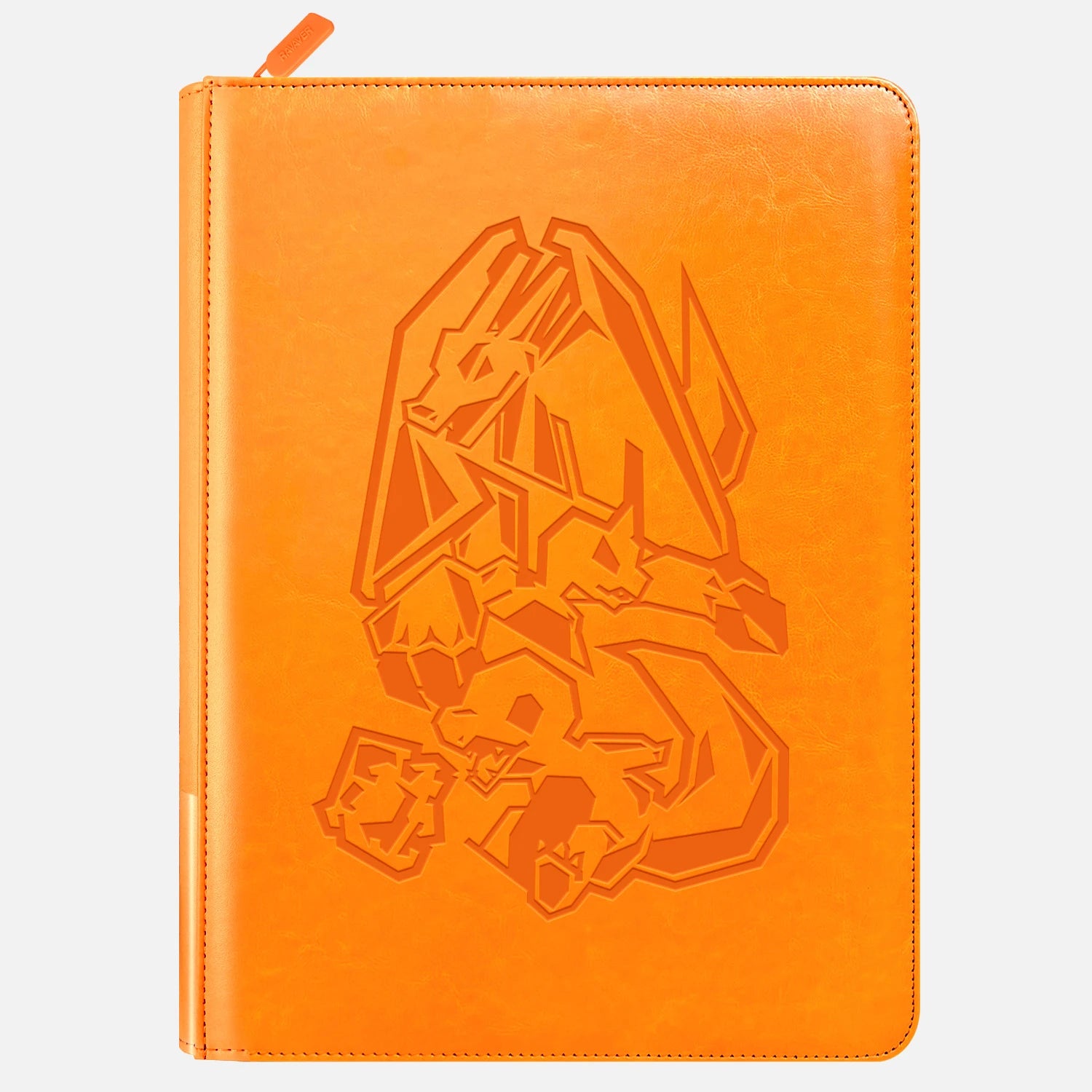
The cheapest Pokemon binder on Amazon costs about $12. A premium toploader binder runs $75 to $95. The gap is six times the price, and most buying guides handle it the same way every time: list features, hand you a top-10 list, call it done. That approach assumes every collector wants the same binder. They don't.
There are two collector types this guide is built for, and they need different binders. A set completer wants every card from a set laid out in order, browsable, and replaceable when a better copy comes through. A flex collector wants a binder they're not embarrassed to pull out at a trade table or a card show. The decision tree splits at that first question, and the rest of the buying choices fall out from it.

Key Takeaways
- Set completers prioritize layout and capacity (9-pocket, 360-720 card range, refillable pages). Flex collectors prioritize exterior, closure, and pocket integrity.
- Ring binders are the #1 cause of "binder dings" on Pokemon cards. Sewn-in pages with side-loading or top-loading pockets are the only safe option for cards worth more than the binder itself.
- A 9-pocket binder holds 360 cards at standard depth, up to 540 in zippered designs that allow page expansion. Going beyond 720 cards in one binder makes it harder to browse, not easier.
- The price-to-protection curve flattens around $50. Spending more buys you exterior quality, closure, and cover design, not better card protection.
- Most collectors end up owning at least three binders within their first two years: a daily browser, a trade-night binder, and a chase-card showcase.
Two Collector Types, Two Different Binders
The set completer is the collector who wants every card from Scarlet & Violet 151, or every base set first edition, or every Eeveelution full art across every set. Their binder is a working tool. They open it weekly to slot in new pulls, swap upgraded copies, and check what's missing. For this collector, the binder has to be browsable, refillable, and the pages have to lay flat.
The flex collector is the collector who shows up to a trade table at a card show and wants their setup to do half the talking before they say a word. Their binder is a social signal. They might only carry their top 40 chase cards in it, not a full set. For this collector, the binder has to look like it cost what it actually cost. Exterior matters, closure matters, the way it sits on the table matters.
Most collectors are 80% one type, 20% the other. Knowing your split before you shop saves you from buying the wrong binder twice.
The Five Decision Points That Decide Your Binder
Five buying choices control 95% of the binder's quality. Get these five right and the rest is preference.
| Decision Point | Set Completer Priority | Flex Collector Priority |
|---|---|---|
| Pocket layout | 9-pocket standard, sewn-in pages | 9-pocket toploader-compatible |
| Closure system | Zipper or elastic strap | Full zipper, no exceptions |
| Card compatibility | Sleeved (single-sleeve minimum) | Double-sleeved or toploader-loaded |
| Exterior | Durable, neutral | Premium PU, character art or distinctive look |
| Capacity | 360-720 cards (set size) | 180-360 cards (curated selection) |
If you find yourself shopping for a binder that compromises on more than one of these five points to hit a lower price, you're buying the wrong binder. The savings disappear the first time you have to replace it.
What Pocket Layout Actually Means for Pokemon Cards
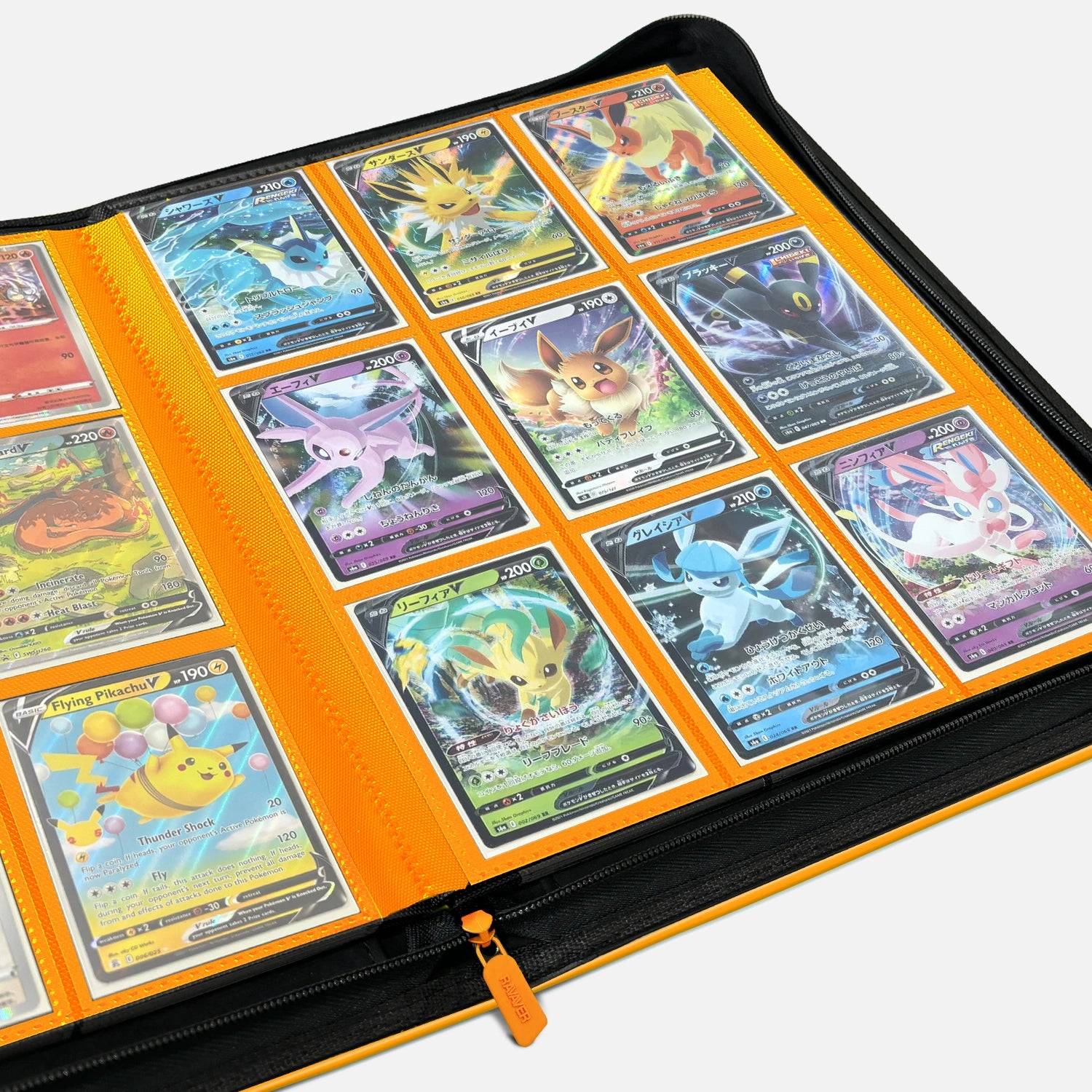
A 9-pocket page is the universal Pokemon binder standard, and there's a reason. Pokemon cards are 2.5 by 3.5 inches, which means a 9-pocket page fits exactly nine cards in a 3x3 grid on a US-letter-sized page with enough margin for the binder mechanism. Cards stay visible, the page stays readable, and you can browse a full row at a glance.
4-pocket pages exist for slabs and oversize cards (jumbos, promo cards in larger formats). 12-pocket pages exist for high-capacity collectors who don't mind tighter pocket margins. Outside of those use cases, 9-pocket is the answer.
The pocket loading direction matters as much as the count. Top-loading pockets (cards slide in from the top of the page) are cheaper to manufacture but leave a small gap at the top of every pocket. If the binder gets flipped sideways or upside down, cards slide. Side-loading pockets (cards slide in from the open side of the page, perpendicular to the spine) trap the card on all four sides once it's in. Side-loading is what serious collectors have been moving to since around 2022, and on r/PokemonTCG it's now the default recommendation for any card worth sleeving.
Toploader-compatible pockets are wider and taller than standard pockets so they can fit a card that's already inside a hard toploader sleeve. This is the format chase cards, graded raw cards, and high-value pulls live in. A standard binder will not fit toploader-loaded cards. If your collection includes any card worth more than the binder, you need toploader pockets.
Closure: The Single Most Underrated Binder Feature
The closure system is the difference between a binder that protects your collection and a piece of office stationery dressed up as one. There are four common closures, and only one of them is right for Pokemon cards above casual value.
Full zipper. The zipper runs along three sides of the binder and seals it shut when closed. Cards cannot fall out even if the binder is dropped, flipped, or stored vertically. Dust, humidity, and accidental spills are blocked. This is the only closure type recommended for cards worth grading or chase cards.
Elastic strap. A wide elastic band wraps around the closed binder. Holds pages flat but doesn't seal the binder. Works for sleeved cards in standard pockets, fails for double-sleeved or toploader-loaded cards because the spine bulges and the strap tension fights the pages.
Magnetic flap. A leather or fabric flap closes with hidden magnets. Looks premium, seals reasonably well, but the magnets can drift over time and stop holding. Better than nothing, worse than a zipper.
No closure (open binder). The 3-ring binder format with no cover lock. Treat this as a desktop-only option, not portable. Three-ring binders also bring a second problem documented across collector forums for over a decade.
From PokeBeach and r/PokemonTCG, the consensus is that 3-ring binders are the leading cause of "binder dings" on Pokemon cards. The damage pattern is consistent: pages near the rings shift slightly under their own weight, and the metal rings press through the page material into the card edge over months of storage. Cards stored in 3-ring binders for a year often come out with edge whitening that drops their grade by one or two PSA points. For valuable cards, this is the most expensive binder mistake in the hobby.

Card Compatibility: Sleeved, Double-Sleeved, or Toploader-Loaded?
Pokemon collectors typically run cards through one of three protection layers before the binder. The binder you buy has to match the protection layer your most valuable cards use, not the one your cheapest cards use.
Raw cards (no sleeve): any binder with sewn-in pages works. Avoid 3-ring binders. This is bulk territory.
Single-sleeved (penny sleeve only): standard 9-pocket pages, sewn-in, zipper or strap closure. The vast majority of binders sold for Pokemon cards target this format.
Double-sleeved (penny sleeve + perfect-fit, the standard for cards over $20): requires pockets cut wider than standard. Most premium binders specify "fits double-sleeved cards" in their product copy. If yours doesn't, your double-sleeved cards will bend the page or stick out.
Toploader-loaded (the standard for cards over $50 or anything you might grade): requires a dedicated toploader binder. Pockets are roughly 25% wider and deeper. This is a separate product category, not a feature you can add to a standard binder.
The mistake most collectors make is buying one binder for their whole collection, then discovering halfway through that their chase cards don't fit. The fix is either upgrading the binder or splitting the collection across two binders, which is why most serious collectors end up with both a standard binder and a toploader binder within their first year.
Capacity: How Many Cards Should One Binder Hold?
A 9-pocket binder with sewn-in pages typically holds one of three capacity tiers, set by the page count: 20 pages (360 cards), 30 pages (540 cards), or 40 pages (720 cards). All three numbers assume you're filling both sides of every page. If you only fill the front of each page (which some collectors do to avoid card-on-card contact through the page), divide those numbers in half.
The right capacity depends on what you're storing. A modern Pokemon set like Scarlet & Violet 151 has 165 cards in the base set, which fits comfortably in a 360-card binder with room for variants. A master set (every card including secret rares and special illustration rares) of the same set is closer to 200-250 cards. A multi-set collection or a long-running master set project needs the 540 or 720 tier.
Beyond 720 cards, the binder gets heavy enough that the spine starts to suffer and browsing becomes annoying. The hobby's working consensus, repeated across collector forums for years, is that multiple smaller binders beat one oversized binder every time. Splitting by set, by era (vintage vs modern), or by Pokemon type makes the collection easier to navigate and reduces stress on every individual binder's binding.
Material and Build: Where the $20-to-$90 Gap Lives
Once you've locked in the functional decisions (pocket layout, closure, compatibility, capacity), the remaining price difference between a $20 binder and a $90 binder comes down to material quality. The functional differences flatten after about $50. Beyond that, you're paying for exterior.
| Price Tier | What You Get | What You Don't Get |
|---|---|---|
| $10-$20 | Basic 9-pocket pages, strap or no closure, thin fabric/poly cover | Toploader pockets, premium exterior, durable zipper, double-sleeve fit |
| $25-$45 | Side-loading pockets, full zipper, reinforced pages, sleeved card fit | Toploader-loaded card fit, premium materials, character art |
| $50-$75 | Toploader-compatible pockets, PU leather exterior, archival-safe pages, full zipper | Distinctive cover design, gift packaging, extended warranty |
| $75-$95 | All of the above plus premium PU exterior, character-themed cover, gift box, multi-year warranty | Diminishing returns past this tier for most collectors |
Archival-safe materials (PVC-free pages, acid-free interior) matter more than most buying guides admit. PVC reacts with card surfaces over years and causes a yellowing pattern that's almost impossible to reverse. PSA's storage guidance calls out PVC explicitly as a long-term contamination source. Any binder that doesn't say "PVC-free" or "archival-safe" in its product description should be treated as a short-term option, not a long-term home.
The Show-Off Test: A Different Standard for Trade-Night Binders
The flex collector buys a binder by a different standard than the set completer. The question isn't "will this protect my cards." It's "will this look right when I pull it out next to another collector's binder at a trade table." This is closer to how people shop for wallets, watches, or backpacks than how people shop for storage.
Think of a binder like a wallet. Yeah, it holds stuff. But the one you actually carry around says something about you. A collector who's spent $4,000 building their collection and carries it to shows in a $14 plastic binder is sending a specific signal, whether they mean to or not. The collectors on the other side of the table notice.
The flex binder is usually smaller (180-360 cards, not 720), filled with the top end of the collection, and built around a closure and exterior that hold up to repeated handling. Premium PU leather, distinctive cover design (character art works well in the Pokemon hobby because everyone reads it instantly), full zipper, toploader compatibility. The cost premium versus a standard binder is usually $30-$50, and it pays off the first time a stranger at a card show asks where you got it.
When to Buy a Second Binder (And a Third)
Most collectors don't end up with one binder. They end up with a set: a working binder for daily browsing, a trade binder for shows and meetups, and a showcase binder for the highest-end cards. The progression usually plays out over the first 18-24 months in the hobby.
The working binder is the daily-use binder. Bulk-to-mid-value cards (under $20 each), single-sleeved, set-completion focus. The criteria is browsable, refillable, durable enough for weekly use. Mid-tier pricing ($25-$45) is the sweet spot.
The trade binder comes second, usually within six months of the working binder. This is the binder that goes to shows and Trade Nights. Cards over $20 each, double-sleeved or toploader-loaded, capacity 180-360. Premium tier ($50-$75) makes sense here because this binder gets handled by other people.
The showcase binder comes third, often as a chase-card-only binder or a one-set master binder for a set the collector cares about deeply. Capacity is small, the criteria is exterior and presentation, and this is where character-themed premium binders earn their price.
For Gift Buyers: A Simpler Decision Tree
If you're buying a binder as a gift for someone who collects Pokemon cards (a partner, a kid, a sibling, a friend), the decision tree is simpler. You're not optimizing for the recipient's exact collection. You're optimizing for the gift moment plus enough quality that the binder isn't immediately replaced.
Three rules cover most gift-buying scenarios. First, stay in the $40-$80 range. Below $40 the binder looks cheap when it gets opened. Above $80 it starts feeling like an over-spend for a gift unless you know the recipient is deep in the hobby. Second, choose a character-themed exterior over a neutral one. Recipients respond more strongly to a Charizard or Pikachu cover than to a plain leather binder. Third, prioritize binders that ship in gift packaging. A binder that arrives in a printed box with the logo on the lid frames the gift moment correctly.
What the Marketing Copy Doesn't Tell You
Three claims show up in almost every binder product page, and three of them are weaker than they sound.
"Premium leather." In the binder category, this almost always means PU leather (polyurethane synthetic), not real leather. PU is actually a better choice for binders because it doesn't develop cracks at the spine the way real leather does under repeated opening. The word "premium" is doing the heavy lifting, not the word "leather." Don't pay a premium for real leather in this category.
"Acid-free pages." Standard at this point. Any binder priced over $25 should have acid-free pages. It's a baseline, not a feature.
"Holds 720 cards." Yes, technically, if you fill both sides of every page. Browsability drops sharply past 540 cards, and the spine carries more weight than any binder under $100 is engineered for over a multi-year storage horizon. Treat 720 as the upper limit of what's reasonable in one binder, not the target.
Putting the Decision Together
The right binder is the one that matches your collection's value tier and the way you use it. A casual set-completer building a Scarlet & Violet 151 binder for personal browsing is in a different decision than a collector packing chase cards for a regional card show. Same hobby, different binder.
The good news is the decision tree is shorter than most buying guides make it. Lock in the five core decisions (pocket layout, closure, compatibility, capacity, material), pick the binder type that matches your collector profile (set completer, flex collector, or gift recipient), set your budget tier, and the choice usually narrows to one or two options. The rest is preference, color, and which Pokemon you want on the front.
If your collection includes any card you'd be upset to damage, the protection floor is non-negotiable: sewn-in pages, zippered closure, side-loading or toploader pockets, archival-safe materials. Below that floor, you're not buying a binder, you're buying a slow-acting risk. Above it, the rest is comfort and presentation.
Frequently Asked Questions
What's the best Pokemon binder for beginners in 2026?
For beginners with casual collections worth under $300 total, a mid-tier 9-pocket zippered binder in the $35-$50 range covers all five core protection criteria without overspending. Look for sewn-in pages, full zipper closure, side-loading pockets, archival-safe materials, and 360-card capacity. Avoid 3-ring binders entirely, since they're the leading cause of binder dings on Pokemon cards.
Do I really need a toploader binder?
Only if your collection includes cards already loaded in toploader sleeves, which usually means cards worth $50 or more, anything you might grade through PSA or CGC, or chase cards from current sets. Standard binders cannot fit a toploader-loaded card. If your collection is entirely sleeved (penny sleeve or double-sleeved) without toploaders, a standard 9-pocket zippered binder is enough.
How many cards does a 9-pocket binder hold?
A standard 9-pocket binder with sewn-in pages holds 360 cards in 20 pages, 540 cards in 30 pages, or 720 cards in 40 pages, assuming both sides of every page are filled. Browsability drops past 540 cards, so the working sweet spot for most collectors is the 360-540 range. Beyond 720, splitting into two binders works better than one oversize binder.
Can I put double-sleeved cards in any binder?
No. Standard binder pockets are sized for single-sleeved cards. Double-sleeved cards (penny sleeve plus perfect-fit, the protection layer most collectors use for cards over $20) need binders specifically labeled as double-sleeve compatible. The pockets are cut wider to fit the extra thickness. Forcing double-sleeved cards into standard pockets bends the page over time and can damage the cards.
Why are some Pokemon binders $20 and others $90?
The functional differences flatten around $50. Below that, you're paying for basic protection. Between $25 and $50, you upgrade to side-loading pockets, full zipper closure, and double-sleeve compatibility. Between $50 and $75 you add toploader compatibility and PU leather exterior. Above $75, the additional spend buys exterior design, character art, gift packaging, and extended warranty, not better card protection.
Are zippered binders worth the extra cost over strap binders?
For any collection with cards worth more than $20 each, yes. The zipper seals the binder on all sides, so cards can't fall out if the binder is dropped, flipped, or stored vertically. It also blocks dust, humidity, and accidental spills. Strap binders work for bulk and casual collections but don't seal the binder, which leaves cards exposed during transport.
How many binders should a Pokemon collector own?
Most serious collectors end up with three binders within the first two years: a working binder for daily browsing and set completion, a trade binder for shows and meetups, and a showcase binder for chase cards and master sets. The capacity, exterior, and price tier differ across all three because each binder is used differently.
Your Next Step
Pick your collector type first (set completer, flex collector, or gift buyer), then lock in the five core decisions. If you're buying your first binder and want one that works for all three use cases at the mid-tier price point, look for a 9-pocket zippered binder with side-loading pockets, double-sleeve compatibility, and archival-safe materials in the $40-$60 range. If you already have a working binder and need an upgrade for trade nights, move up to a toploader binder in the $60-$85 range with a closure and exterior that hold up to repeated handling.
For collectors who want to compare specific binder formats in more depth, our companion piece on how binders fit into the broader storage stack covers where each protection layer earns its keep. The decision matrix above is meant as a starting point, not a final answer. Your collection's specific value distribution will shift which decision points matter most.
Sources:
- PSA, Preserving TCG Cards: Storage Options, retrieved 2026-05-14, https://www.psacard.com/articles/articleview/14066/preserving-tcg-cards-storage-options
- TCGplayer Infinite, Card Sleeves and Toploaders Beginner's Guide, retrieved 2026-05-14, https://www.tcgplayer.com/content/article/Card-Sleeves-and-Toploaders-Beginner-s-Guide/
- PokeBeach Forum, Binder Comparison Threads, retrieved 2026-05-14, https://www.pokebeach.com/forums
- r/PokemonTCG, Best Binder Discussion Threads, retrieved 2026-05-14, https://www.reddit.com/r/PokemonTCG
- Bulbapedia, Trading Card Game Sets and Set Sizes, retrieved 2026-05-14, https://bulbapedia.bulbagarden.net/wiki/List_of_Pokémon_Trading_Card_Game_expansions