Ask twenty collectors how many booster boxes you need to complete a master set, and you'll get twenty different versions of "about six" with no math behind it. Six boxes works for one specific kind of set under one specific kind of collector behavior. For everything else, that number is somewhere between badly wrong and catastrophically wrong. The actual answer comes from a four-step formula that any collector can run in 10 minutes — and it almost never lands on six boxes.
This guide is the upstream calculation for any master set project. If you haven't picked a set yet, our 5-factor framework for choosing a Pokemon set is the decision you should make first.
Key Takeaways
- The right number of boxes is determined by set size, rarity distribution, and what percentage of the set you want from sealed product.
- For most modern sets, 4–6 boxes captures roughly 75% of the master set's card count and 50% of its value.
- Trying to pull every Hyper Rare or SIR from packs is mathematically irrational — expect to buy singles for the final 20–30% regardless.
- Prismatic Evolutions breaks the formula: 32 SIRs at 1-in-1,440 odds per specific card means singles-first is the only sane strategy.
- The formula gives you a budget anchor, not a prediction — luck swings the actual outcome significantly.

Why "six boxes" is a bad answer
The folk wisdom of "six boxes covers it" assumes a set with predictable rarity distribution and a collector who's content to fill the remaining gaps through singles. That assumption breaks for any set built around concentrated chase cards. Prismatic Evolutions is the obvious example. So is any Surging Sparks-style set where the bulk of value lives in a single SIR. "Six boxes" treats every master set like SV151 — a broad, even pool with manageable chase concentration. For sets that don't fit that profile, the number is meaningfully different.
Pull rates compound the problem. The Cardshoplive Scarlet & Violet data shows Special Illustration Rares at roughly 3% per pack based on tracked openings, which sounds achievable until you do the math on "any specific SIR." Pulling any SIR is 1 in 33 packs. Pulling the specific one you want is 1 in 33 × (number of SIRs in the set), which for a 14-SIR set lands at 1 in 462 packs. For Prismatic's 32 SIRs at improved 1-in-45 rates, the math becomes 1 in 1,440 per specific SIR per PokéBeach's published analysis.
The four-step formula
Step through these four calculations in order. Each one builds on the prior step. The output is a realistic box count for the percentage of the set you actually want from sealed product, not a magical number that completes the entire master set from packs alone.
- Determine your sealed-pull target percentage. What percentage of the master set do you want to pull from packs versus fill in with singles? For most collectors, 70–80% from packs is a reasonable target. The remaining 20–30% — always including the top SIRs and Hyper Rares — fills from singles.
- Map the rarity stack of the target set. List the number of cards at each rarity tier: commons, uncommons, holo rares, Pokemon ex, Double Rares, Illustration Rares, SIRs, Hyper Rares. Use the set's official count or a community tracker.
- Apply pull rates to each tier. Using published pull rate data, calculate expected pulls per box (36 packs per box) at each tier. A 6.48% Ultra Rare rate yields 2.3 Ultra Rares per box. A 3.01% SIR rate yields 1.08 SIRs per box.
- Apply the duplicate inflation factor. The pulls you actually need are unique pulls, not total pulls. After the first 3–4 boxes of any set, duplicate rates climb fast. As a working rule, multiply your raw box estimate by 1.4–1.6x to account for duplicates of the cards you already have.
Worked example: Surging Sparks
Surging Sparks has roughly 252 master set cards including secret rares, with 14 SIRs and 9 Hyper Rares. Pull rate data from TCGplayer's published analysis aligns roughly with SV-era baselines: SIR at ~3%, Hyper Rare at ~1.85%, Double Rare at ~13%, Illustration Rare at ~7.5%.
Running the formula for a 75% sealed-pull target:
| Tier | Cards in tier | Per-box pull expected | Boxes for ~75% unique pulls |
|---|---|---|---|
| Commons / uncommons | ~160 | ~25 per box | 2–3 boxes |
| Holo / Reverse Holo | ~50 | ~12 per box | 3–4 boxes |
| Pokemon ex / Double Rare | ~12 | ~5 per box | 4–5 boxes |
| Illustration Rare | ~9 | ~2.7 per box | 5–6 boxes |
| SIR | 14 | ~1.08 per box | 15–20+ boxes |
| Hyper Rare | 9 | ~0.67 per box | 20+ boxes |
The binding constraint is the rarest tier. Hitting 75% of unique SIRs from packs requires 15–20 boxes; hitting 75% of unique Hyper Rares requires 20+ boxes. At $130–$160 per box, that's $2,000–$3,200 in sealed product to hit your 75% target. Surging Sparks SIR singles run $20–$400 depending on which one, with most landing in the $40–$120 range. Buying 14 SIRs as singles outright costs roughly $700–$1,500. Pack-ripping costs 2–3x more for the SIR tier specifically, even after accounting for the cards you'd pull at lower rarity tiers as a side benefit.
The honest answer for Surging Sparks: 5–6 boxes captures the lower and middle rarity tiers efficiently, then buy SIRs and Hyper Rares as singles. Total project cost lands around $1,500–$2,200 versus $3,500+ for pure pack-ripping. Our 6-step master set budget worksheet formalizes this trade-off across multiple sets.
Worked example: Prismatic Evolutions (the formula breaks)
Prismatic Evolutions has 32 SIRs at 1-in-45 generic pull rate but 1-in-1,440 per specific SIR. For a 75% sealed-pull target on SIRs alone, the math becomes punishing: pulling 24 of 32 unique SIRs from packs requires statistical expected pack counts in the range of 30,000+ packs. That's $4,200+ in product just to hit the SIR portion of the target. The single market for Prismatic SIRs averages roughly $90–$200 per card (with Umbreon and Sylveon higher), so buying all 32 as singles runs $3,500–$5,000.
For Prismatic Evolutions, the formula's conclusion is: buy 2–3 boxes for the experience and the lower-tier completion, then buy 100% of SIRs as singles. Pure pack strategy isn't worse, it's actively irrational.
When ripping more boxes makes sense
Three scenarios justify ripping past the math-optimal box count.
First, you enjoy ripping for its own sake. The dopamine of breaking sealed product has real value to many collectors. If the answer is genuinely yes, rip 8–10 boxes and accept that you're paying a premium for entertainment. That's a valid choice as long as you're honest about what it is.
Second, you have access to discounted sealed product. If your local card shop runs case deals at meaningful discounts off retail, the math shifts in favor of ripping more. A 20% discount on a $130 box makes pack-ripping competitive with singles for several additional rarity tiers.
Third, you're collecting in volume across multiple projects. If you're doing master sets for three sets simultaneously and casing one of them makes sense for trade leverage with other collectors, the box count for that specific set becomes irrelevant to the strict completion math.
Frequently Asked Questions
How many boxes do I need to pull every SIR in a set?
Statistically impossible from a reasonable budget. For Prismatic Evolutions specifically, the expected number of packs to pull every specific SIR is over 30,000 packs. For SV-era sets with 14 SIRs and 3% pull rates, expect 20–30+ boxes for 75% SIR coverage, with the last 25% of unique SIRs becoming exponentially harder.
What's the average cost of a Pokemon booster box in 2026?
In-print Mega Evolution era boxes run $130–$160 at retail MSRP as of May 2026. Out-of-print SV-era boxes trade at premiums of 20–80% above MSRP depending on the set, with Prismatic Evolutions and Surging Sparks boxes carrying the highest premiums. Special set ETBs and premium collections carry their own markup tiers.
Is buying a case cheaper than buying individual boxes?
For in-print sets at MSRP, yes — cases typically run 5–10% below per-box pricing when bought from authorized retailers. For out-of-print sets, case premiums tend to scale with box premiums, so the discount isn't as meaningful. The bigger benefit of cases is trade leverage with other collectors.
How many boxes does the average master set collector buy?
Based on Reddit collector survey discussions over the past year, the typical answer for in-print sets is 4–6 boxes per master set project, with the remainder filled through singles. Collectors who rip more than 8 boxes for a single set are usually doing so for the experience rather than for efficient completion.
Should I buy ETBs and premium collections too?
Generally not for master set completion efficiency. ETBs include promos and exclusive cards that some master set definitions require, but per-pack cost is meaningfully higher than booster boxes. Premium collections are best treated as singles-purchase decisions for the specific exclusive cards they contain, not as bulk pack sources.
What to do this week
Pick the set you're targeting and run the four-step formula with that set's specific rarity distribution. The output will tell you how many boxes are worth ripping and where the line is between pack-ripping and singles. Most collectors are surprised by how much lower the box count comes out compared to their initial gut estimate.
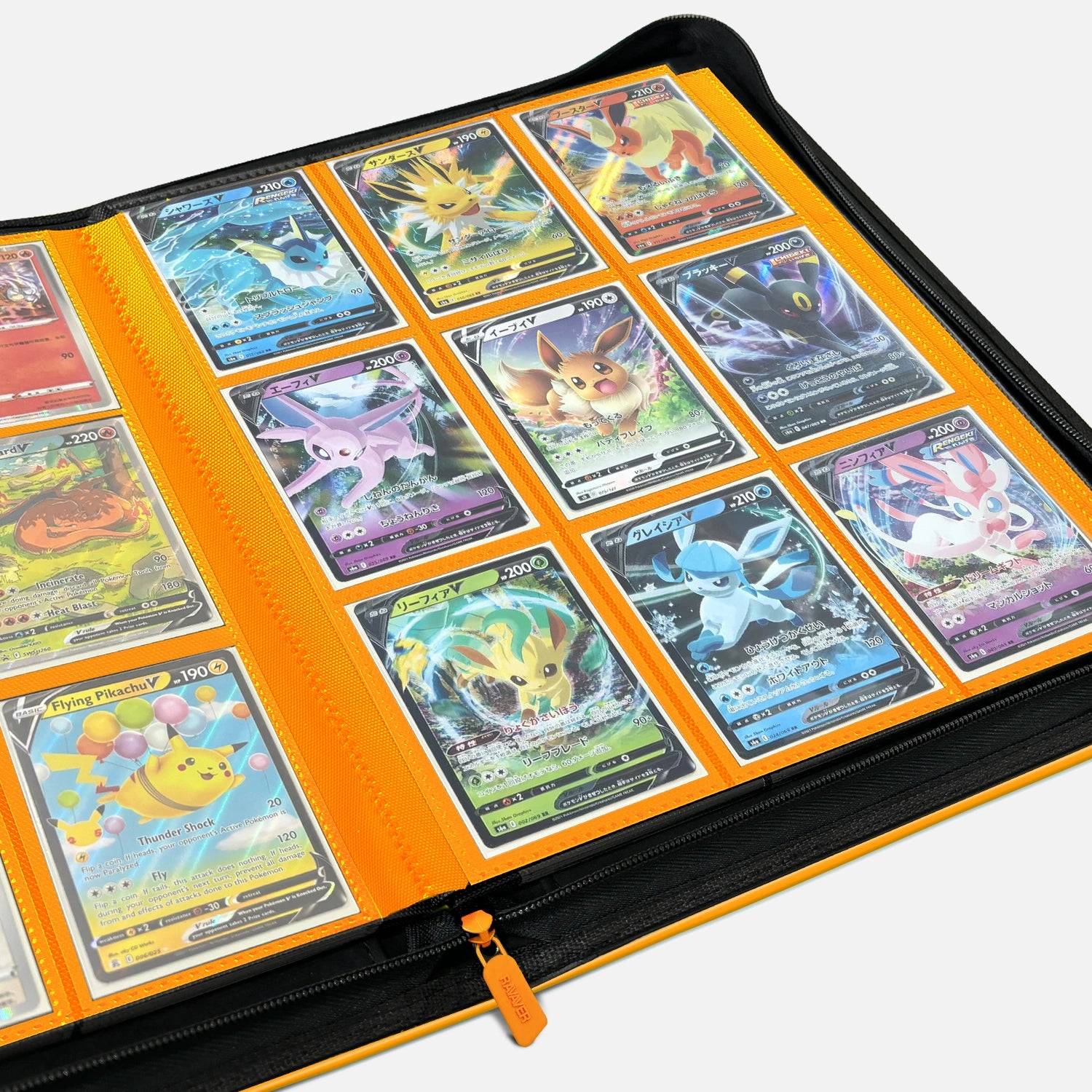
However many boxes you commit to, the cards you pull need to land in storage that protects them through the rest of your master set project. Ravaver's premium Pokemon-themed binders are sized for the realistic 200–300 card volumes that master set projects generate.
Sources:
- Cardshoplive, "Hit Rates for Pokemon TCG Scarlet & Violet," retrieved 2026-05-19, https://cardshoplive.com/pages/hit-rates-for-pokemon-tcg-scarlet-and-violet
- TCGplayer, "Pokemon TCG Surging Sparks Pull Rates," retrieved 2026-05-19, https://www.tcgplayer.com/content/article/Pok%C3%A9mon-TCG-Surging-Sparks-Pull-Rates/6ccfb6ab-f26a-4ce8-bab5-5f91c85ec70e/
- PokéBeach, "Prismatic Evolutions Pull Rates Revealed," retrieved 2026-05-19, https://www.pokebeach.com/2025/01/prismatic-evolutions-pull-rates-revealed-special-illustration-rares-twice-as-easy-to-pull