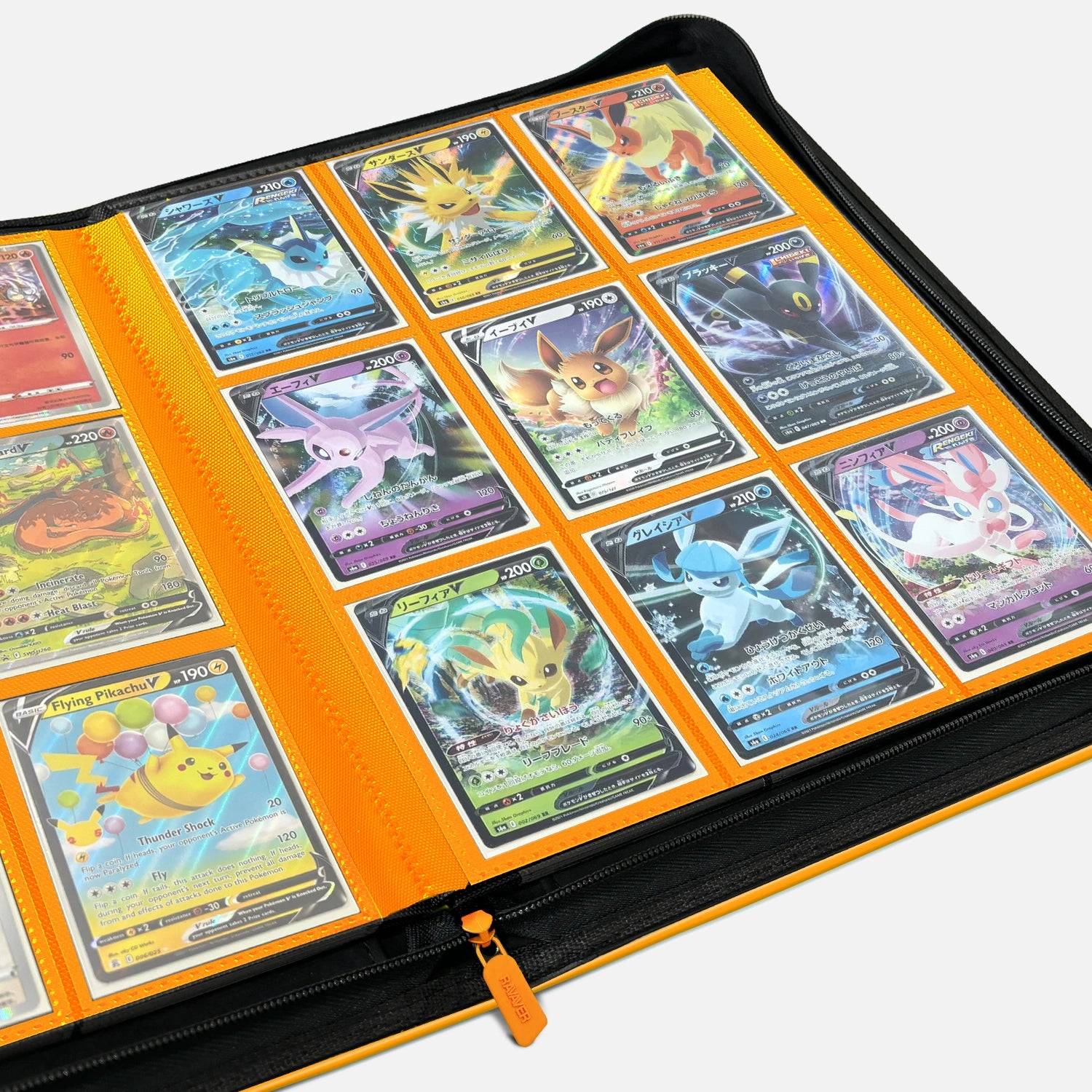
Ask ten different Pokemon collectors what a Master Set costs and you'll get ten answers between $300 and $15,000. Both ends can be right. The number depends entirely on which set you pick, how strict your definition is, and which costs you choose to count.
This breakdown comes from 15 years of building Master Sets (and abandoning a few). What follows is real math: current 2026 market prices, the hidden costs almost every blog ignores, and three actual budget tiers so you can pick the one that fits your wallet before you commit.

Key Takeaways
- A Master Set is the complete printing of every card in a set, including all rarities, reverse holos, and special illustration rares, not just "all the chase cards"
- The real 2026 range for a modern Scarlet & Violet Master Set sits between $1,200 (cheaper Standard sets) and $1,800 (chase-heavy sets like Surging Sparks at $1,470.73 total)
- Vintage Master Sets (Base, Jungle, Fossil) start at $8,000+ and climb past $50,000 for sealed-condition copies
- Hidden costs (sleeves, toploaders, binders, grading, shipping, sales tax) add 15-30% to the headline number, most calculators ignore this
- The cheapest path is not always sealed product. Singles win on cost-to-completion 7 out of 10 times for modern sets
What does a Pokemon Master Set actually include?
A Master Set is the complete set of every card printed within a single expansion, including the standard numbered cards, every reverse holofoil version, every secret rare numbered above the set total, every illustration rare, special illustration rare, hyper rare, gold card, and (depending on how strict you go) the alternate-language reprints. For a modern Scarlet & Violet set like Surging Sparks, that's 252 cards in the base count plus everything that comes after #252 in the numbering hierarchy, bringing the total to 430 distinct cards once reverse holos and chase rarities are included.
This is where most beginners trip. They count the 191 base cards, see a $300 price tag, and start collecting. Then they discover the reverse holo set adds another $500-800 on top. Then the special illustration rares push the total past four figures. By the time they figure out what a Master Set really means, they're $400 deep into a project they didn't price correctly.
The cleanest reference for what counts in a Master Set is the official numbering: anything that appears in the expansion's printed pool counts, including hidden numbers above the base set total. Promotional cards from the same era are a separate debate (a "Plus" or "Custom Master Set"), but for the purposes of this cost analysis, we'll stick to the strict in-set definition.
How much does a modern Pokemon Master Set cost in 2026?
For a current-era Scarlet & Violet block set, the realistic range is $1,200 to $1,800 for a complete near-mint Master Set bought through singles. Sealed-product routes cost more (and often deliver less). Here are the actual numbers for five popular modern sets, pulled from current PriceCharting and TCGplayer market data:
| Set | Card Count | Master Set Total (Singles) | Sealed Booster Box | Top Chase Card |
|---|---|---|---|---|
| Surging Sparks | 430 | ~$1,470 | ~$249 | Pikachu ex SIR $240-300 |
| Stellar Crown | ~250 | ~$1,200 | ~$308 | Terapagos ex SIR $180-220 |
| Twilight Masquerade | ~270 | ~$1,350 | ~$220 | Greninja ex SIR $160-200 |
| Paradox Rift | ~265 | ~$1,300 | ~$200 | Iron Valiant ex SIR $130-170 |
| Crown Zenith | 230 | ~$1,800+ | ~$320 (ETB) | Giratina V Alt Art $400+ |
What these numbers don't show you is the variance inside each set. Surging Sparks looks "average" at $1,470 total, but $700 of that is concentrated in just three cards (Pikachu ex SIR, Latias ex SIR, Latios ex SIR). If those chase cards reprint or correct downward, your Master Set value can drop $300 in a week. The risk is real, and it scales with how chase-heavy the set is.
The three Master Set budget tiers (and which one you actually want)
Most blogs give you one number. That number is usually wrong because it doesn't reflect what kind of collector you are. Here's how seasoned collectors actually split the budget question into three tiers, pick the one that matches your goal before you start.
Tier 1: Casual Master Set ($800-$1,100)
Near-mint condition acceptable. No grading. Reverse holos sourced from bulk lots ($0.50-$2 each) instead of singles markets. Chase cards bought ungraded from trusted sellers with photos. You skip the alternate-language reprints and limit yourself to the in-set numbered cards. This is the realistic path for a working collector who wants a finished display binder without funding a second mortgage.
Tier 2: Standard Master Set ($1,200-$1,800)
The "official" Master Set most people mean. Near-mint or better, all chase rarities included at current market rates, reverse holos sourced as singles when bulk lots aren't available. No grading required for completion, though many collectors grade their top 3-5 chase cards separately. This is what the table above reflects.
Tier 3: Strict Master Set ($2,500-$8,000+)
Every card PSA 10 or BGS 9.5+. This is where the math goes vertical. A $250 raw Pikachu ex SIR becomes a $600-900 PSA 10 (and only 30-40% of submissions hit that grade). You're paying $24.99/card minimum to PSA at the Value Bulk tier, plus shipping and insurance, plus the cost of resubmitting cards that come back as 9s. For a 430-card set, even bulk grading at $25/card adds $10,750 to the project before you count failed grades.
The honest truth: 95% of collectors building their first Master Set should be aiming at Tier 2. Tier 1 leaves money on the table when you decide to sell or upgrade later. Tier 3 only makes financial sense if you're treating cards as long-hold investment assets and have the capital to absorb a five-figure grading bill that won't pay back for 5-10 years.

The hidden costs almost every Master Set calculator ignores
Here's where the published cost guides fall apart. They quote you a singles total and call it done. Real collectors know there's a 15-30% surcharge on top that nobody warns you about until you've already started.
| Hidden Cost Category | Typical Range (Standard Tier) | Why It Matters |
|---|---|---|
| Sleeves (penny + premium outer) | $40-80 | 430 cards x 2 sleeves each = at least $25 in supplies. Premium outers add another $20-40. |
| Toploaders or card savers | $30-60 | All chase cards (typically 20-40 per set) need rigid protection during transit and storage. |
| Master Set binder | $50-120 | A 430-card set needs 24+ binder pages. Cheap binders bend cards. Premium toploader-friendly binders run $80+. |
| Shipping fees on singles | $80-200 | If you buy 50 separate eBay/TCGplayer orders, that's $4-5 each in shipping costs alone. |
| Sales tax (US average) | $80-150 | Most online card sales now charge state sales tax. On a $1,400 total, that's $100+ depending on your state. |
| Lost/damaged cards in transit | $30-100 | Cards arrive damaged. Returns take weeks. Some sellers ghost. Budget for 2-5% loss. |
| Storage and display upgrades | $50-200 | Once the set is done you'll want a real display setup. Magnetic holders, slab cases, or a premium binder for showing it off. |
Add those up and the Standard Tier $1,400 Master Set actually costs $1,700-$1,900 by the time you finish. That 15-30% surcharge is the difference between budgeting accurately and constantly wondering why your "completed" project keeps draining money.
Should you build a Master Set from singles or sealed booster boxes?
The short answer for modern Scarlet & Violet sets: singles win on cost-to-completion 7 out of 10 times. Here's the math using Surging Sparks as the example. A booster box has 36 packs at ~$249 market price. Average yield is 4-5 Secret Rares per box, with Special Illustration Rares pulling at roughly 1 in 91 packs. To pull every chase card by sealed product alone, you'd need to open 8-12 booster boxes on average, costing $2,000-$3,000 just to get the top cards, and you'd still need to fill in the gaps from singles markets.
Sealed wins in three specific scenarios. First, when the set is brand new and singles haven't stabilized yet (first 60 days post-release). Second, when you genuinely enjoy the act of opening packs and don't mind paying a premium for the experience. Third, when sealed product appreciation is part of your strategy, booster boxes from older sets like Hidden Fates and Crown Zenith doubled in value over 18 months, so the unopened boxes themselves became the investment.
For a beginner trying to budget realistically, single cards are the disciplined path. You know what you're paying, you know what you're getting, and you don't have to factor in gambling expectation into your spreadsheet.
Why does English vs Japanese pricing matter for your budget?
Japanese Pokemon TCG sets often run 30-50% cheaper than their English counterparts at the per-pack level. The Japanese pack MSRP of ¥200 (after the May 2026 increase from ¥180) converts to roughly $1.40 USD per pack, compared to the $4 US retail price. Japanese booster boxes for current sets typically run $80-130 versus $144 MSRP / $200+ market for English equivalents. And Japanese boxes guarantee at least one Secret Rare per box, English boxes guarantee nothing.
The trade-off is two-fold. First, Japanese chase cards have smaller collector demand outside Japan, which makes individual Japanese cards cheaper on the resale market but also reduces your set's long-term liquidity if you ever sell. Second, you're shipping product internationally, which adds $30-80 per order plus import fees in some states. For a Master Set project, the savings only show up if you're committing fully to a Japanese-language set, not mixing.
How long does it take to complete a Master Set?
Realistic timeline for a Standard Tier modern Master Set: 90-180 days if you're actively working it. The first 70% comes fast (commons, uncommons, regular holos all available in cheap bulk lots). The next 20% slows down (rare holos, ultra rares from singles markets). The last 10%, the chase Special Illustration Rares and Hyper Rares, can take 2-6 weeks alone because you're hunting for specific listings at acceptable prices, and the best deals get snagged within hours.
The collectors who fail at Master Set completion typically fail in the same place: month 3, when only 5-8 chase cards remain and each one costs $150-300. Motivation drops, other sets release, and the project sits at 95% complete for two years until they finally decide to sell what they have. Budget mentally for the long tail before you start, not just the headline number.

What about vintage Pokemon Master Sets?
Vintage WOTC-era Master Sets (Base, Jungle, Fossil, Team Rocket through Skyridge) operate on completely different economics. A Base Set Unlimited Master Set starts around $4,000-$6,000 for a near-mint complete collection. Shadowless or 1st Edition variants push the number into five-figure territory ($25,000-$80,000 depending on grades). And Base Set 1st Edition in PSA 10 condition for the full set has crossed $400,000 in confirmed sales according to PSA's auction tracking data.
The reason vintage is its own universe: the cards are 25+ years old, supply is fixed, condition sensitivity is extreme (white edges, centering, surface scratches all matter), and demand keeps rising because the players who opened these cards in 1999 are now 35-45 year-old adults with disposable income and nostalgia. If you're asking "how much does a Master Set cost" with vintage in mind, you're looking at a different conversation entirely, and probably need a specialized vintage broker, not a Google search.
Frequently Asked Questions
Is a Master Set worth the cost compared to just collecting chase cards?
Depends on your goal. If you want a complete, displayable, sellable collection that holds value as a unit, a Master Set is worth the premium because complete sets sell for 10-15% above the sum of their parts on the resale market. If you only want the visual highlights and don't care about completionism, building a chase-card-only collection costs about 60% of a full Master Set and gives you 90% of the visual appeal.
What's the cheapest modern Pokemon Master Set I can build right now?
As of 2026, the cheapest modern Scarlet & Violet Master Sets in the Standard Tier are Paradox Rift (~$1,300) and Twilight Masquerade (~$1,350). Both have manageable chase card values, complete reverse holo sets available in bulk lots, and stable enough pricing that you won't see massive month-to-month variance during your build.
Do I need to grade my Master Set cards?
No. Grading is a separate financial decision from completing a Master Set. The Standard Tier doesn't require grading at all. Most collectors grade their top 3-5 chase cards individually for display or investment purposes, then leave the bulk of the set raw in a binder. PSA 10 grading only makes financial sense on cards worth $80+ raw, because grading fees of $25-50 per card plus shipping plus grading failure rates eat into thinner margins.
Why do some Pokemon sets cost 5x more than others?
Two factors: print run size and chase card demand. Crown Zenith and Hidden Fates had artificially limited print runs as "special" sub-sets, which immediately compressed supply. Sets with universally loved Pokemon on the chase cards (Charizard, Pikachu, Eevee) sustain premium pricing because demand stays elevated long after release. A standard Scarlet & Violet expansion with no Charizard chase and a normal print run will cost half what a "special" set with a Charizard alt art costs, even if the card counts are identical.
Can I sell my Master Set later for what I paid?
Modern Master Sets typically sell for 70-85% of build cost when liquidated within 1-2 years of completion. Selling individual cards back to TCGplayer or eBay is slower but recovers more money than dumping the set to a single buyer. Sets from "favorite" eras (anything with Charizard chase cards, anything with English-only exclusive cards) hold value better. Sealed-product collectors recover differently, boxes from limited print runs can appreciate, but most modern boxes lose 20-30% of MSRP over 5 years once mass print runs flood the market.
How much should I spend on storage and protection for a Master Set?
Budget 10-15% of your card spend on protection. For a $1,400 Master Set, that's $140-210 across sleeves, toploaders, binder, and display. Skimping here is the most expensive mistake collectors make, a $300 card that develops edge whitening from a bad binder drops to $180 instantly, which means a $40 binder upgrade pays for itself within one damaged card. Toploader-friendly binders that don't compress sleeved cards run $60-100 and are non-negotiable for chase cards. Browse Ravaver's full Pokemon binder collection if you want options that handle toploader-thickness cards without ring damage.
What's the realistic monthly budget for someone building a Master Set?
A disciplined collector finishing a Standard Tier Master Set in 6 months should plan on $200-300 per month for cards, plus a one-time $150-250 upfront for sleeves/toploaders/binder. That cadence keeps you buying actively enough to hit price drops, but slow enough that you're not flooding the chase-card market with your own demand and bidding prices up against yourself. Speed-running a Master Set in 30 days typically costs 15-25% more because you're forced to pay current ask prices instead of waiting for deals.
Where to go from here
Pick your tier before you pick your set. A Casual Tier collector chasing a Crown Zenith Master Set is going to fail because the chase cards alone exceed the entire budget. A Strict Tier collector trying to build Paradox Rift will overgrade common cards and lose money on grading fees that exceed card values.
Start with one set, set a hard total budget that includes the hidden cost stack, and treat the project like a 6-month commitment instead of a weekend project. The collectors who finish their first Master Set are the ones who do the math before they buy their first card, not after.
Once you've picked the set, the next decisions are how to source cards efficiently, which sealed-vs-singles ratio fits your budget, and how to organize the build so you're not losing track of what you already own. We cover those next in the Master Set beginner playbook and the 5-factor set selection framework.
Sources:
- PriceCharting, Pokemon Surging Sparks Card Prices, retrieved 2026-05-26, pricecharting.com/console/pokemon-surging-sparks
- PriceCharting, Stellar Crown Booster Box, retrieved 2026-05-26, pricecharting.com/game/pokemon-stellar-crown
- PSA, 2026 Grading Service Tiers and Bulk Submission Pricing, retrieved 2026-05-26, psacard.com/services
- TCGplayer, Pokemon SV08: Surging Sparks Price Guide, retrieved 2026-05-26, tcgplayer.com/sv08-surging-sparks
- Cardrake, Scarlet & Violet Surging Sparks Master Set Guide, retrieved 2026-05-26, cardrake.com/expansions/sv8