Most Pokemon collectors think about display the same way they think about insurance — they'll figure it out later. Then a humidity spike pulls a Charizard from PSA 10 to PSA 8 territory, and "later" gets expensive fast. According to PSA grading data, a Surging Sparks Pikachu ex Special Illustration Rare drops from roughly $420 at PSA 10 to about $180 at PSA 8. That's a $240 hit for two grade points, and most of the time the damage came from how the card was stored or displayed, not how it was pulled.
This guide compares five display methods Pokemon TCG collectors actually use in 2026, with real cost ranges, the kind of cards each method suits, and what each one does (or doesn't do) to long-term value. We're calling out something nobody else does: the trade-off matrix between display visibility, PSA value preservation, and theft risk. Skip to the comparison table if you just want the verdict.
Key Takeaways
- UV exposure is cumulative and irreversible — a card exposed to direct sunlight for 6 months can lose 50% of its graded value, according to multiple PSA and archival sources
- PSA, BGS, and CGC slabs are not hermetically sealed, so humidity above 65% will still warp cards inside the holder
- Binders win for master sets and frequent browsing; toploader walls and frames win for chase cards and showpiece displays
- The right archival environment is 65-70°F and 45-55% relative humidity — same as a museum, not your average gaming room
- Display visibility and value preservation pull in opposite directions, so most serious collectors split their collection across two methods

What's the Best Way to Display a Pokemon Card Collection in 2026?
The best display method depends on the card's value tier and how often you want to see it. For master sets and bulk holo collections, a premium binder gives you the best blend of organization, protection, and viewability. For chase cards worth $50 or more, a sealed toploader wall or archival frame protects value while letting you flex the showpieces. Mixing two methods — binder for the 90%, wall display for the 10% — is what most experienced TCG collectors land on after a few years of trial and error.
Anyone who's been collecting since the WOTC days knows what "figured out" looks like the hard way. Friends with thousand-card binders stacked in garages. Slabs displayed on south-facing windows. Wall frames hung above a kitchen stove. Most damage to graded cards happens at home, not in transit. The display choice is the storage choice. Get it right once and your collection compounds. Get it wrong and you're funding someone else's eBay arbitrage.
The Five Display Methods Compared
Here's the full matrix of what TCG collectors actually use, ranked by what each method does well and where it costs you.
| Method | Best For | Cost Range | PSA Value Risk | Visibility | Theft Risk |
|---|---|---|---|---|---|
| Premium binder | Master sets, bulk holos, 9-pocket display | $30-90 per binder | Low (if archival pages) | High (browsable) | Low (portable, hideable) |
| Toploader wall display | Chase cards, alt arts, SIRs | $50-200 per wall | Medium (UV exposure) | Very high (showpiece) | High (visible from outside) |
| Archival frame (UV glass) | Vintage WOTC, graded holos, gifts | $80-300 per frame | Low (if archival glass) | High (showpiece) | High (visible from outside) |
| Slab display case | PSA 10 chase cards, set runs | $40-250 per case | Low (if UV-rated case) | Medium (case-by-case) | Medium (locks available) |
| Shadow box / themed display | Themed sets, trophy cards, gifts | $60-400 per box | Medium-high (humidity trap) | Very high (showpiece) | High (visible from outside) |
The pattern hidden in that table: visibility and theft risk track together. The more impressive the display, the more it advertises to anyone walking past your window. That's why a lot of serious collectors keep their PSA 10 Charizards in safes and put their PSA 7 Charizards on the wall.
Why Binders Still Win for Most of Your Collection
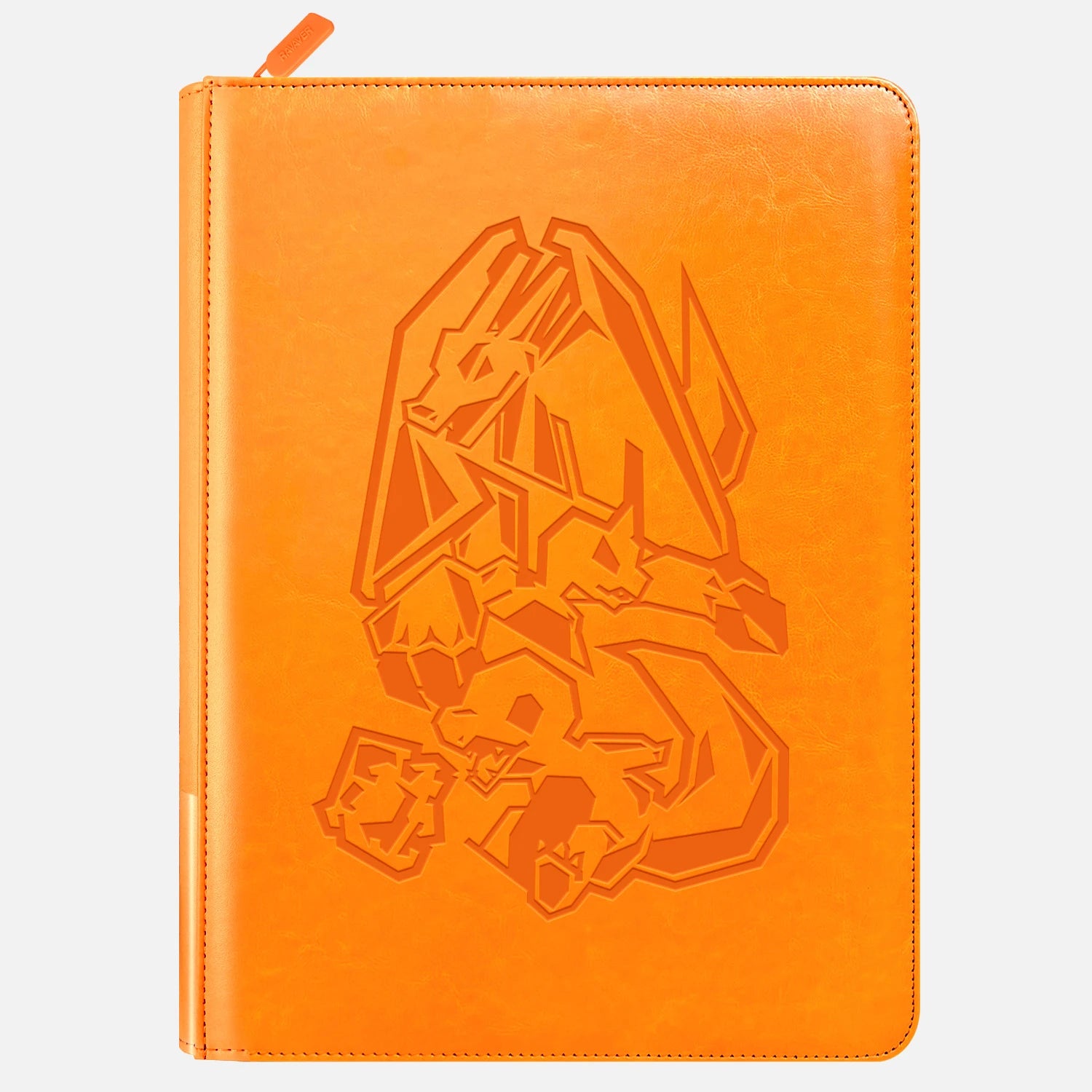
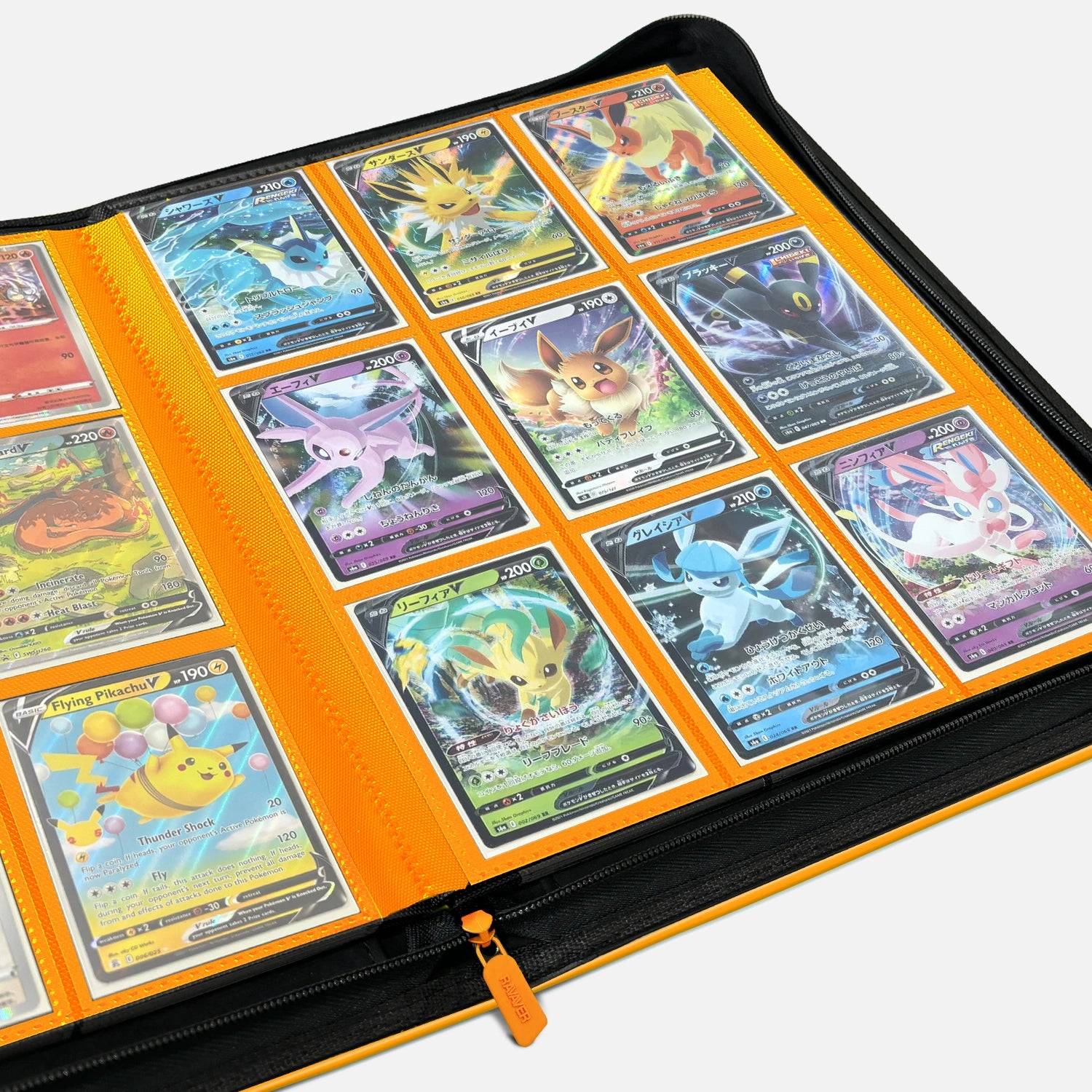
A 9-pocket binder is the workhorse of Pokemon collecting for a reason. It lets you organize by set, by evolution line, by personal favorites. You can flip through it. You can take it to a card show. You can hand it to a friend without worrying about a slab cracking on the floor.
The catch — and this is where most beginners get burned — is that not all binders are archival-safe. Polypropylene pages are inert and won't yellow or off-gas. PVC pages contain plasticizers that migrate over time, which is exactly how cards from the early 2000s ended up cloudy and stuck to the page. PSA's storage guidance is clear: acid-free, PVC-free, polypropylene-only.
Toploader-friendly binders solve the binder vs toploader debate for the 80% case. Your card sits in a toploader sleeve, the toploader sits in a side-loading pocket designed for it, and the binder zips shut around the whole thing. No bending. No edge whitening from page rub. No "crap, the binder slipped off the shelf and a corner dinged."
For a master set build like Surging Sparks (252 base cards, 445 master set), you want the binder. According to Bulbapedia, that set alone has 23 illustration rares plus 11 special illustration rares — far too many cards to wall-mount individually. A 480-card or 720-card toploader-friendly binder gets you the full set in one place, organized by national dex order, ready to flip when someone asks "what'd you pull this year?"

When Toploader Walls and Wall Frames Are the Right Call
Chase cards have a different job. They're not for browsing. They're for being seen. A binder full of bulk holos doesn't get pulled out every day, but a Charizard ex SIR on the wall above your desk gets seen every time someone walks in the room.
The trade-off is exposure. UV light is the silent killer of Pokemon cards. UV damage is cumulative and irreversible. Once color molecules break down, they don't come back. A card displayed in direct sunlight for six months can lose 50% or more of its graded value, even inside a PSA slab. Conservation sources consistently note that the clear plastic in PSA slabs prioritizes visibility, which means it has to let visible light through, and visible light includes the UV-adjacent wavelengths that fade ink.
This is why "toploader on the wall in any old frame" is a mistake. The right setup uses one of three approaches:
- UV-resistant archival glass ($30-80 extra per frame). The same glass museums use. Cuts 95%+ of UV without making the card look tinted.
- UV-filtering toploaders or slab cases. These cost more than standard toploaders ($3-8 each vs $0.50) but block UV directly at the card surface.
- Indirect light positioning. Hang the wall on a north-facing wall, or one shielded from windows. Free, and the difference in fade rate is dramatic.
For a Pokebeach forum thread on framing card collections, the consistent collector consensus is: if you frame cards, use archival glass only, or don't do it. Standard picture-frame glass is the most common cause of "why is my Charizard yellower than I remember?" stories.
Slab Cases and Shadow Boxes: When They're Worth It
Slab display cases sit in a middle zone. They're built for graded cards (PSA, BGS, CGC dimensions), they usually have locking options, and the better ones include UV-resistant acrylic. A good slab case in a den or office gives you the showpiece feel of a wall display with better protection.
Where slab cases fall short: humidity. PSA, BGS, and CGC slabs are not hermetically sealed. Air still circulates. If your room runs above 65% relative humidity for weeks at a time, the slab's plastic can warp slightly and the card inside can pull moisture from the air. Mold isn't unheard of in slabs stored in basements or garages.
Shadow boxes have the same problem with extra geometry. A deep shadow box with themed elements (a Charizard slab over painted flames, a Pikachu over a yellow background) looks incredible but creates pockets where humid air gets trapped against the card. Unless you control humidity in the room (45-55% RH is the standard archival range, according to the Image Permanence Institute), a sealed shadow box can be worse than no display at all.
If you want themed display, the safest version is a shadow box mounted on a controlled-climate wall (not a basement, not an attic, not a south-facing window) with archival glass and silica gel packets refreshed twice a year. Most collectors don't do this. Most collectors find out two years later why they should have.
How Display Method Affects Long-Term Card Value
This is the part most display guides skip, because the math gets uncomfortable. A card's graded value is a function of its centering, edges, surface, and corners at the moment of grading. Once graded, the slab protects against handling, but not against environmental damage that accumulates inside.
| Display Condition | Annual Value Impact | Why |
|---|---|---|
| Archival binder, climate controlled (65-70°F, 45-55% RH) | ~0% loss | Conditions match museum archival standards |
| Frame with archival UV glass, indirect light | ~0-2% loss | UV blocked, minimal humidity exposure |
| Slab case in controlled room, no direct sun | ~1-3% loss | Some humidity exchange but UV protected |
| Toploader wall, indirect light, archival sleeve | ~3-8% loss | Some UV bleed, surface dust accumulation |
| Standard frame, direct or filtered sunlight | ~10-25% loss | UV degrades ink colors progressively |
| Shadow box in humid room, no climate control | ~15-40% loss | Humidity trap accelerates paper aging |
The numbers add up over decades. A card displayed badly for 10 years can drop two full PSA grade tiers. For a card that was a PSA 9 worth $200 going in, that's a $130 loss in 2026 dollars, not counting reprint or market movement. For a PSA 10 chase card, it can be a four-figure loss.
Conversely, cards displayed in archival conditions can hold or even gain value over the same period if the underlying card appreciates. The 2003 Charizard that lived in a binder for 15 years grades better than the 2003 Charizard that lived on someone's bedroom wall, every single time.

The Two-Method Strategy Most Serious Collectors Use
Here's the pattern that emerges across years of TCG collector discussions and card show conversations: collectors who've been at this five-plus years almost always split their collection across two methods. The bulk lives in binders. The 10-20 showpiece cards live in frames, slab cases, or curated wall displays.
The reasoning is practical. Browsing 500 cards on a wall is impossible. Showcasing one card in a binder is anticlimactic. The two methods do different jobs, so they coexist instead of competing.
For a player building toward their first card show appearance, the build order usually looks like:
- Master set binder for whatever set you're currently chasing. Toploader-friendly, archival pages, sized for the set you're targeting (480 or 720 cards covers most modern sets including master sets).
- One "hero binder" for cross-set favorites and PR cards. The book you actually bring to trade nights.
- Wall or frame setup for the 3-5 chase cards you'd save first if there was a fire. UV glass, indirect light, mounted in a controlled-climate room.
You're going to walk into a card show or a Pokemon League one day. The binder you bring tells everyone how seriously you take this. The display on your wall tells them what you've actually pulled. Both matter, and they don't need to be the same piece of gear.
What About Custom Display Setups and Themed Displays?
Themed displays — Charizard wall over a fire-toned background, full Eeveelution shadow box, Gengar setup with dark accents — are some of the most rewarding parts of collecting for many TCG players. The Pokemon IP gives you nine generations of color palettes to work with. The display becomes part of the room, not just storage.
The risks are the same as any other wall display, plus one: themed setups encourage overcommitting cards. A nine-card Eeveelution display with PSA 10 alt arts pulls roughly $4,000-$8,000 worth of cards onto one wall. That's a single point of failure for environmental damage and theft. If that's your call, the protections need to match the value: archival UV glass, controlled-climate room, anchored mounting, ideally a wall not visible from any window.
For custom Pokemon-themed binders, the calculation is different. A custom binder with a chosen character cover travels with you, doesn't sit in sunlight 24/7, and protects cards as long as the binder itself is built archival. The binder is the showpiece, not the wall. Many of our collectors use a custom-cover binder as their hero binder for that exact reason — it's the binder that comes out at trade night, not the binder that lives on display.
Frequently Asked Questions
Does direct sunlight damage cards inside PSA slabs?
Yes. PSA slabs are designed to be visually clear, which means they transmit UV-adjacent wavelengths along with visible light. Direct sun exposure for as little as 6 months can produce measurable fading, and the damage is cumulative and irreversible. PSA's own storage guidance recommends keeping graded cards away from windows and fluorescent lighting.
What humidity level is safe for Pokemon card display?
The archival standard is 45-55% relative humidity. The Image Permanence Institute uses this range for paper preservation, and PSA, BGS, and CGC slabs all benefit from it. Above 65% RH for extended periods, you risk warping the plastic and accelerating paper degradation inside the slab.
Are PVC card sleeves safe for long-term display?
No. PVC contains plasticizers that migrate over years, causing yellowing, surface haze, and sticking. Use only acid-free, PVC-free polypropylene sleeves for any card you're storing or displaying long-term. Most major sleeve brands now produce polypropylene by default, but the dollar-store sleeves and older binder pages frequently still contain PVC.
How much does an archival display setup actually cost?
A solid two-method setup runs $150-400. A 480-card archival binder is $40-90, a UV-resistant frame for 3-5 chase cards is $60-150, and proper toploaders or sleeves add $30-80. The math gets favorable fast when you consider that a single grade drop on a chase card can erase the full cost of the setup.
Can I use IKEA or hobby store frames for Pokemon cards?
Only if you upgrade the glass to archival UV-resistant glass. Standard frame glass blocks almost no UV. The frame itself is fine. The glass swap costs $30-80 at any framing shop and is the single biggest preservation upgrade you can make to a wall display setup.
Do I need to worry about display if my cards aren't graded?
If you plan to grade them later, absolutely. Centering, edges, surface, and corners are the four grading factors, and three of those are vulnerable to display damage (only centering is set at the printing stage). A future PSA submission can swing $100-1000+ on a single chase card based on display history.
What's the most underrated display method?
A toploader-friendly binder used as a tabletop display, opened to a favorite page. You get the protection of a binder, the visibility of a wall display, and zero UV exposure when the binder's closed. For collectors who actually use their cards (not just store them), this is the best of both worlds.
Pick the Right Method, Then Build the Habit
The mistake most collectors make is choosing one display method and forcing the whole collection into it. The collection grows, the method strains, and damage starts compounding. The collectors who get this right pick the right method for each tier of the collection, then build a habit around it: archival binder for the master set, controlled frame for the chase cards, climate-controlled room for everything.
If you're starting out, the practical first step is a single archival binder sized for your current set, with toploader-friendly pockets. Build the chase wall when you have a card that earns it. Sooner or later your collection's going to be worth pulling out for friends and trade partners. Have the gear ready before that day comes.
Sources:
- PSA, Card Storage and Protection Guidelines, retrieved 2026-05-29, https://www.psacard.com/sportscardstorage
- Bulbapedia, Surging Sparks (TCG) Set Page, retrieved 2026-05-29, https://bulbapedia.bulbagarden.net/wiki/Surging_Sparks_(TCG)
- Image Permanence Institute, Environmental Standards for Archival Storage, referenced via Conserv.io archival recommendations, retrieved 2026-05-29
- Pokebeach Forums, Framing Card Collections discussion, retrieved 2026-05-29, https://www.pokebeach.com/forums/threads/framing-card-collections.86276/
- TCG Collector, Surging Sparks Visual Set List (international TCG), retrieved 2026-05-29, https://www.tcgcollector.com/sets/11636/surging-sparks