Most Pokemon card display advice is the same five tips dressed up differently: use UV glass, control humidity, archival sleeves, don't store in the garage, climate control. Useful but vague. The thing nobody puts a dollar number on is what each mistake actually costs when you ignore it. This article does that math.
Each mistake below comes with a real value impact range based on PSA grading data and observed collector cases. The cards don't lie. The display choices either compound your collection or quietly drain it. Skip to whichever mistake you suspect you're making right now.
Key Takeaways
- Standard frame glass is the single most common display mistake, costing collectors $50-1,500 per displayed card over 3-5 years
- South-facing display windows can drop a PSA 10 Charizard to PSA 7 territory in under 18 months
- Humid bathroom or basement display rooms warp slabs and yellow cards 3-5x faster than climate-controlled spaces
- Stacking toploaders in display boxes traps moisture against the card surface and causes edge whitening
- Open shadow boxes with themed elements create the worst humidity traps in collector displays

What Are the Most Damaging Pokemon Card Display Mistakes?
The five most damaging display mistakes are: framing cards behind standard glass instead of UV-resistant archival glass, displaying near sunlit windows, displaying in high-humidity rooms like bathrooms or basements, stacking toploaders horizontally in display boxes, and using shadow boxes without humidity control. Each mistake costs $50-1,500 per displayed card in PSA value loss over typical exposure periods, and the cumulative impact across a collection can erase the cost of any storage upgrade many times over.
Mistake #1: Framing Behind Standard Glass
Estimated cost: $80-1,500 per card over 3-5 years
This is the single most common display mistake, and the easiest to fix. Standard picture-frame glass blocks essentially zero UV. The card sits behind a clear window that may as well not be there for protection purposes. The clear plastic of a PSA slab has the same problem — it has to be visually clear, which means it transmits UV-adjacent wavelengths.
The damage pattern is uniform fading across the whole card face, with lighter colors fading first. Whites turn cream. Yellows and oranges shift toward beige. Holographic foils develop a slight haze. On a Surging Sparks Charizard ex SIR worth around $400-600 raw, this kind of fading drops the PSA grade from a 10 candidate to PSA 7 or 8 territory. The value loss is $150-450.
The fix costs $30-80 at any framing shop: swap the standard glass for UV-resistant archival glass. The same glass museums use. Cuts 95%+ of UV without tinting the card. The math is decisive — a $50 glass upgrade prevents $150-450 of value loss on a single mid-tier chase card.
For vintage WOTC cards or modern hyper rares above $500 raw value, the loss math gets worse. A 1999 1st Edition Charizard displayed behind standard glass for five years can drop from PSA 8 to PSA 5 territory, which on a 2026 market means $1,500+ in lost value. The archival glass upgrade for a vintage display is one of the highest-ROI moves in the entire hobby.
Mistake #2: Displaying Near Sunlit Windows
Estimated cost: $200-2,000 per card over 12-18 months
Even with archival glass on the frame, direct sunlight is brutal on Pokemon cards. The UV that gets through any glass treatment is amplified by the heat and intensity of direct exposure. According to industry sources on UV damage to trading cards, direct sunlight exposure for even 6 months can produce measurable fading.
The damage on a south-facing window display is faster and more severe than indirect daylight. Cards develop visible color shift within a year. After 18 months, the fading is obvious to anyone who knew the card before. PSA grades drop accordingly.
For a Pokemon trainer who walked into a card show with a PSA 10 Pikachu ex SIR that lived on their sunny windowsill for 18 months, the grade is now likely a PSA 8 at best. The value swing on that card from PSA 10 to PSA 8 is around $350. For a higher-tier card like a Charizard ex hyper rare, the same exposure can cost $1,000+.
The fix is positioning. Display walls go on the north side of a room, or any wall not directly hit by window light. Indirect daylight from across the room is acceptable. Direct sunlight at any angle is never acceptable for display.
Mistake #3: Displaying in High-Humidity Rooms
Estimated cost: $100-800 per card over 6-24 months
Bathrooms, basements, kitchens, and any room without active humidity control are display traps. According to archival standards, the safe humidity range for paper preservation is 45-55% relative humidity. Bathrooms after showers can hit 80-90% RH for 30+ minutes daily. Basements without dehumidifiers often run 65-75% RH year-round. Kitchens spike during cooking.
The damage pattern: edge whitening on cards inside toploaders, slight warping on PSA slabs (the plastic responds to humidity), and accelerated yellowing across the card face. PSA grading penalizes all three. A card that was a PSA 9 going into the display can drop to a PSA 7 after 12-24 months in high-humidity exposure.
The fix: move the display, or control the humidity. A $40 dehumidifier and a $20 hygrometer solve most rooms. Target 45-55% RH year-round. If the room can't be controlled (active steam from showers, no AC, basement seepage), the cards belong in a different room. Display value isn't worth the slow grading damage.
Mistake #4: Stacking Toploaders Horizontally in Display Boxes
Estimated cost: $30-380 per card over 6-18 months
Toploader display boxes are a classic intermediate option — better than wall display, easier than building a frame setup, organized for browsing. The mistake collectors make is stacking the toploaders horizontally and forgetting about airflow.
Horizontal-stacked toploaders create two problems. First, the cards on the bottom take pressure from the cards above, slight but constant. Over months, this can cause micro-shifts in the card position inside the toploader and edge stress at the contact points. Second, and more damaging, horizontal stacks trap humid air between layers. In a humid room, this accelerates the edge whitening that PSA grading penalizes.
The visual signature on the affected cards is whitening at the edges where the cards contacted other toploaders. PSA 10 candidates drop to PSA 8 or 9. The dollar impact varies by card value but for mid-tier chase cards runs $30-380 per affected card.
The fix is vertical storage. Toploaders stand upright in storage boxes with archival foam spacers between them. Same protection without the pressure or moisture problems. PSA's own storage recommendations call out vertical orientation for ungraded cards awaiting grading.
Mistake #5: Themed Shadow Boxes Without Humidity Control
Estimated cost: $150-2,000+ per card over 12-36 months
Themed shadow boxes are some of the most rewarding-looking displays in the hobby. A Charizard slab over painted flames. A full Eeveelution lineup behind a themed background. A Gengar setup with dark accents and purple lighting. The Pokemon IP gives you the visual material to make a wall installation that feels like part of the room.
The problem is geometry. Shadow boxes are deeper than standard frames, with internal volume that creates pockets of trapped air. Themed elements (fabric backgrounds, painted matte boards, foam shapes) often absorb and hold moisture from the room. The card sits in a small sealed environment that responds to room conditions but can't equilibrate quickly.
In any room above 50% RH, the shadow box becomes a slow humidity trap. The card experiences higher local humidity than the room average, often by 5-10 percentage points. Over 12-36 months, this is enough to drop a PSA 10 to a PSA 7 or 8.For a 9-card Eeveelution shadow box of PSA 10 alt arts, the total card value can run $4,000-8,000. Letting the entire display drop two grade tiers from environmental damage costs $1,000-2,500. For a single Charizard shadow box with a PSA 10 alt art, the loss can be $1,000-2,000 alone.
The fix is a controlled room and silica gel packets. The display lives in a room at 45-55% RH year-round. Silica gel packets sit inside the shadow box at the back, refreshed every 6 months. Archival UV glass on the front. The display still looks like the original theme, but the environmental control prevents the slow damage.
How These Mistakes Compound Across a Collection
The worst part of display mistakes isn't any single mistake. It's the way they stack. A collector with a wall display on a sunlit window AND standard frame glass AND a humid room is making three mistakes at once on the same cards. The damage isn't additive, it's multiplicative.
For a collection of 20 displayed cards averaging $150 per card raw value, a single grade-tier drop across all of them costs around $1,500. A two-tier drop costs $3,500. Most collectors making multiple display mistakes find out about the cumulative damage when they try to grade or sell the cards five years later.
You're going to walk into a card show or grade a chase card one day. The condition of those cards depends on what you did with the display setup right now. Prevention is cheaper than restoration every time.
The Three Display Fixes That Solve 80% of These Mistakes
Most display mistakes share root causes. Three fixes address the majority of the damage:
- Archival UV glass on any frame, toploader display, or shadow box. $30-80 per display. Prevents UV yellowing entirely.
- Position any wall display on a north-facing or shielded wall. Free. Prevents direct sunlight exposure.
- Climate control the display room to 45-55% RH year-round. $60-100 total for hygrometer and dehumidifier. Prevents humidity-driven yellowing, warping, and edge whitening.
The total cost of these three fixes for a typical home display setup is $100-200. The value preservation across a collection of even 10-20 displayed cards is well into four figures for most collectors. The ROI is rarely close.
Frequently Asked Questions
How can I tell if my display setup is already damaging my cards?
Look for the visual signatures of each damage type. Uniform fading across the whole card face suggests UV exposure. Yellowing concentrated at the edges suggests humidity. A slight haze on the holographic surface can indicate either UV or PVC. Compare a displayed card to an identical card from the same set kept in storage. The differences become obvious side by side.
Are LED display lights safe for Pokemon cards?
Most modern LEDs are safe. The exceptions are older LED bulbs without UV filtering and any LED that runs hot. Cool-color LEDs in the 3000-4000K range with UV filtering produce essentially no UV emission. Avoid halogen bulbs and standard fluorescent tubes near displays, both of which emit significant UV.
What if I can only display in a humid room?
A $40 dehumidifier and a $20 hygrometer can bring most rooms into the 45-55% RH range. If the room has structural humidity issues (basement seepage, no AC, frequent steam), the display belongs elsewhere. Cards in a humid room lose value continuously regardless of other protections.
How much does archival UV glass actually cost?
$30-80 for a standard 8x10 or 11x14 frame. Custom framing shops carry it routinely. Order online from frame supply companies if your local shop doesn't stock it. The glass swap on an existing frame is the cheapest upgrade with the highest preservation ROI.Does this advice apply to graded PSA slabs?
Yes, fully. PSA slabs protect against handling damage but not against UV, humidity, or temperature. A graded card displayed badly still loses value over time. PSA's own storage recommendations apply to slabs as well as raw cards.
Can I display my cards without making any of these mistakes?
Yes, with three layers of protection. Archival UV glass on the display, indirect or controlled lighting in a controlled-climate room. That's the museum standard, and it's the standard for any card you want to preserve indefinitely. The setup costs $100-300 total and protects cards for decades.
Fix the Setup, Stop the Slow Drain
Display damage is the slowest, quietest form of value loss in Pokemon collecting. It doesn't announce itself the way a dropped card or a torn corner does. It just shows up years later when you go to grade or sell, and the card isn't what you remembered. The collectors who avoid this aren't lucky — they made the right display decisions before the damage started.
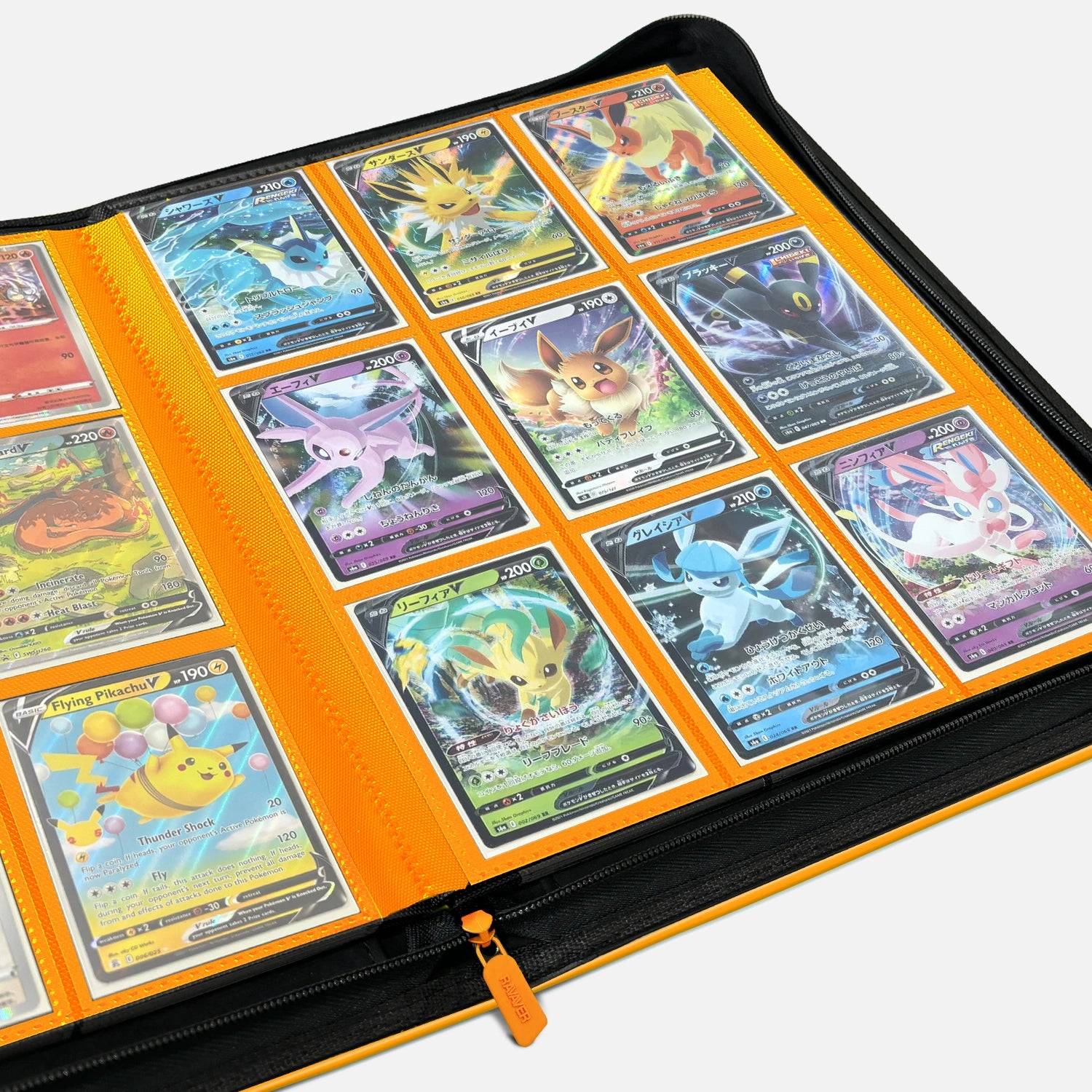
For the bigger picture on display vs storage, see our pillar on how to display your Pokemon card collection in 2026. For the chemistry behind yellowing damage, check the Pokemon card yellowing prevention guide. For the underlying toploader vs binder decision that affects display setups too, the toploader vs binder comparison walks through the protection math. And for an archival binder that handles the 90% of your collection that shouldn't be on a wall, the Ravaver binder collection uses archival polypropylene pages by default.
Sources:
- PSA, Card Storage and Protection Guidelines, retrieved 2026-05-29, https://www.psacard.com/sportscardstorage
- Phantom Display, UV Protection for Trading Cards: Prevent Fading, retrieved 2026-05-29, https://phantomdisplay.com/blogs/blog/protect-pokemon-cards-from-uv-damage
- Pokebeach Forums, Framing Card Collections discussion, retrieved 2026-05-29, https://www.pokebeach.com/forums/threads/framing-card-collections.86276/