The collector who pulled a Charizard in 2010 and stored it on a desk by a window doesn't have a Charizard anymore. The card's still there, but the colors are wrong. The yellow is slightly muddier. The orange is half a tone off. PSA's grading scale doesn't have a category called "used to be a 10," but if it did, that's the card.
Yellowing comes from three different sources, and they don't all do the same damage. UV bleaching, PVC migration, and humidity-driven paper aging each have different speeds, different thresholds, and different reversibility. This guide breaks down what's happening at the chemistry level, which yellowing you can fix, and the exact storage conditions that prevent the kind you can't.
Key Takeaways
- There are three distinct causes of Pokemon card yellowing: UV exposure (irreversible), PVC plasticizer migration (irreversible), and humidity-driven paper aging (partially reversible if caught early)
- UV yellowing happens at any wavelength under 400 nanometers, including indirect sunlight through windows and fluorescent lighting
- PVC migration yellowing develops over 6-24 months in cards stored in PVC sleeves or pages — the only fix is to remove the PVC source immediately
- Humidity-driven yellowing accelerates above 65% RH and can show measurable damage in 30-90 days of exposure
- Safe long-term storage is 65-70°F, 45-55% relative humidity, away from any direct or strong indirect light

What Causes Pokemon Cards to Yellow Over Time?
Pokemon cards yellow from three separate processes: ultraviolet light breaking down the pigments in the printed inks, plasticizers from PVC sleeves migrating into the card surface, and humidity-driven chemical breakdown of the cardstock fibers themselves. Each cause produces a slightly different look, and they can stack. A card that yellowed from both UV and PVC will look worse than either alone, and that combined damage is the most common reason vintage cards from the early 2000s don't grade well today.
In 5 years, your collection's going to be worth pulling out for friends or selling or grading. Whichever direction you go, the cards have to still look the same as the day you got them. Yellowing is the silent failure that ruins that future.
UV Yellowing: The Damage You Can't Reverse
UV light is the most aggressive yellowing cause and the one with the worst long-term math. UV wavelengths under 400 nanometers carry enough energy to break the molecular bonds in printed pigments. Once those bonds break, the color is gone. There's no chemical or physical process that puts it back.
The frustrating part: UV doesn't have to be direct sunlight. The UV-A and UV-B that fades Pokemon cards comes from:
- Direct sunlight (highest UV intensity, fastest damage)
- Indirect daylight through any window (lower intensity but cumulative over years)
- Standard fluorescent tubes (significant UV-A emission)
- Older LED bulbs without UV filtering (some emit measurable UV)
- Halogen bulbs in display cases (UV-rich and hot)
Industry sources note that UV damage is cumulative and irreversible — once color molecules are broken, they're broken forever. A card displayed in indirect sunlight for two years can show measurable fading even if it never received a direct sun ray. PSA's storage recommendations specifically call out windows and fluorescent lighting as risks for graded cards.
The visual signature of UV yellowing: the lighter colors fade fastest. White borders take on a cream tint. Yellow and orange shift slightly toward beige. Blues lose intensity. The shift is uniform across the card face because the UV hits the whole surface.
PVC Migration Yellowing: The Slow Chemistry Failure
The second cause of yellowing has nothing to do with light. PVC (polyvinyl chloride) plastic contains plasticizers, chemical additives that keep the plastic flexible. Over time, these plasticizers migrate out of the plastic and into anything in contact with it.
For Pokemon cards stored in PVC sleeves or PVC binder pages, this means the plasticizers transfer to the card surface. The chemistry produces three visible effects: a yellowing of the card surface, a slight haze or cloudiness, and (in severe cases) the card sticking to the sleeve.
The timeline varies. Industry guides note that PVC sheet protectors can damage photos over time by transferring plasticizers that cause sticking, yellowing, and surface deterioration. For Pokemon cards in PVC sleeves, visible yellowing typically appears between 6 and 24 months, depending on temperature and how tightly the sleeve fits the card.
The visual signature: a yellowish tint that's strongest at the card surface and uniform across the whole face. Often paired with a slight clouding of the protective coating on holos.
The fix: remove the card from the PVC source immediately. The yellowing already in place can't be reversed, but the process stops. The card moves to acid-free, PVC-free polypropylene sleeves and lives the rest of its life away from PVC. Industry sleeve guides consistently recommend polypropylene as the archival standard. Polypropylene won't off-gas, react with ink, or yellow over time.

Humidity Yellowing: Partially Reversible If Caught Early
The third cause is the most subtle and the only one you can fix. Pokemon card stock is paper-based with a printed coating. When ambient humidity rises above 65% relative humidity, the paper fibers absorb moisture. This swells the fibers slightly, breaks down some of the cellulose bonds in the paper, and accelerates the yellowing process that paper goes through naturally over decades.
For Pokemon cards specifically, humidity yellowing shows up first at the edges (which are most exposed) and gradually moves toward the center. The signature is a soft yellow tinge starting from the perimeter, sometimes with subtle warping if the humidity has been extreme.
What makes humidity yellowing different: caught early, the process slows or stops when the card returns to a stable 45-55% RH environment. The fibers don't "un-yellow," but they stop progressing. For cards that haven't been severely damaged yet, restoring proper environmental conditions can preserve them at their current state for decades.
The threshold matters. According to Society of American Archivists and Image Permanence Institute standards referenced across archival sources, the recommended archive temperature is 60-70°F and 45-55% relative humidity. Below 40% RH causes paper brittleness over years. Above 65% RH accelerates aging and creates mold risk. The 45-55% band is the safe zone.
Temperature, Light, and Humidity Thresholds
| Factor | Safe Range | Damage Threshold | Time to Visible Damage |
|---|---|---|---|
| Temperature | 65-70°F | Above 80°F sustained | 1-3 years |
| Relative humidity | 45-55% | Above 65% RH sustained | 30-90 days |
| UV exposure (direct sunlight) | None | Any direct exposure | 3-12 months for measurable fade |
| UV exposure (indirect daylight) | Minimal | Constant indirect for years | 2-5 years |
| PVC contact | None | Any contact | 6-24 months |
The pattern: humidity above 65% does damage fastest. UV does the most permanent damage. PVC does the most insidious damage because it works invisibly until visible failure.
How to Tell Which Type of Yellowing You're Looking At
If you're trying to diagnose an already-yellowed card, the location and pattern of the yellowing tells you the cause.
- Uniform yellowing across the whole card face, lighter colors faded most. UV damage. The light hit the whole surface evenly. Most common on cards displayed by windows or under fluorescent lights.
- Uniform yellowing with slight surface haze or stickiness. PVC migration. The sleeve was the source. Check what sleeve or page the card was in.
- Yellowing concentrated at the edges, fading toward the center, sometimes with warping. Humidity damage. The room or storage location had high RH for an extended period.
- Yellowing on one side of the card only. Either localized UV (a beam of sunlight at certain hours) or localized humidity (a damp wall or window).
For mixed damage — a card that hit two or three of these causes — the visual signature stacks. This is what happens to most vintage cards from the late 1990s and early 2000s that lived in bedroom binders before the hobby treated storage seriously.
The Long-Term Storage Setup That Prevents All Three
Preventing yellowing isn't complicated. Most of it is making the same decisions a small archive or museum makes for paper-based materials. The setup looks like this:
- Acid-free, PVC-free polypropylene sleeves for every card. Standard for any card you care about for more than five years.
- Archival polypropylene binder pages or rigid toploaders. Same chemistry as the sleeves. No PVC in any storage layer.
- Climate-controlled room. 65-70°F, 45-55% RH. A $20 hygrometer and a $40 dehumidifier handle this for most rooms.
- Zero direct sunlight. Cards live in closed binders, drawers, or display setups behind UV-resistant archival glass. Never on a desk by a window.
- Indirect light only when displaying. Wall displays mount on north-facing walls or walls shielded from window light. The light hitting the card should never have come directly through a window.
- Cool, indirect LED for any display lighting. Modern LEDs without UV emission are safe. Avoid halogen, fluorescent, and incandescent bulbs near cards.
This setup costs $100-300 for the storage materials and the climate control, depending on room size and how many cards you're protecting. For a collection worth even a few thousand dollars in cards, the math is decisive in the storage's favor.
Can You Restore a Yellowed Pokemon Card?
For most yellowing, no. UV damage is permanent. PVC migration is permanent once it's happened (though stopping further damage is possible by removing the PVC source). Severe humidity damage that's progressed past the cellulose breakdown stage is also permanent.
The one case where partial recovery is possible: mild humidity yellowing on the card's edges, caught early. Moving the card to a stable 45-55% RH environment can slow or stop the progression. The yellowing already in place stays, but the card doesn't get worse.
Professional conservation services exist for high-value vintage cards. They handle de-acidification of the paper and controlled rehydration. For Pokemon cards specifically, this is rarely cost-effective. A WOTC Charizard with moderate yellowing might cost $200-500 to professionally conserve, and the resulting card still won't grade as well as one that was stored properly from day one.
The math says prevention is always cheaper. The cards you bought this year are the cards you'll be storing 30 years from now. Set up the right conditions once.
Frequently Asked Questions
How long does it take for a Pokemon card to yellow from UV exposure?
Direct sunlight produces measurable fade in 3-12 months. Indirect daylight through a window takes 2-5 years to cause visible yellowing. Fluorescent lighting takes 3-7 years for clear damage. The damage is cumulative, so partial exposures across years still add up to the same total damage as a single longer exposure.
Are PVC-free sleeves and pages widely available?
Yes. Most major sleeve and binder page brands now produce polypropylene by default. Ultra Pro, Dragon Shield, BCW archival, and similar brands all offer PVC-free options. The remaining PVC products are mostly the cheapest sleeves at dollar stores and older binder pages still on the market. Check the packaging for "acid-free," "PVC-free," or "archival polypropylene."
What's the safe humidity range for storing Pokemon cards?
45-55% relative humidity, the standard archival range used by the Image Permanence Institute. Above 65% RH for extended periods accelerates yellowing and risks mold. Below 40% RH causes paper brittleness over years. A $20 hygrometer in the storage room confirms the range.
Will a PSA slab protect my card from yellowing?
Partially. PSA slabs protect against handling and contact damage. They don't fully block UV (the plastic is designed to be visually clear) and they aren't hermetically sealed against humidity. Slabs in good environmental conditions hold value for decades. Slabs displayed in direct sunlight or stored in high-humidity rooms still yellow over time.
Does climate-controlled storage actually matter for cards under $50?
For frequent-handling commons, less so. For any card you plan to grade later or hold for five-plus years, yes. Even commons hold sentimental value, and yellowed commons look just as bad as yellowed rares. The cost of climate control is the same regardless of card value. A controlled-climate storage room protects everything in it.
What's the worst place to store Pokemon cards?
A garage. Garages combine humidity swings, temperature swings, and often UV from windows or open doors. Cards stored in garages can show damage within a year. The second-worst is an attic (high temperatures accelerate every damage type). Basements are sometimes acceptable if the humidity is actively controlled, but most basements run too humid without intervention.
Set Up the Storage Once, Stop Worrying About It
The best collectors don't think about yellowing because they've already solved it. The cards are in archival sleeves. The sleeves are in archival pages or toploaders. The pages and toploaders live in a room that's 67°F and 50% RH. The room has no south-facing windows and uses LED lighting without UV emission. The whole setup costs less than one PSA submission of a chase card and protects everything for decades.
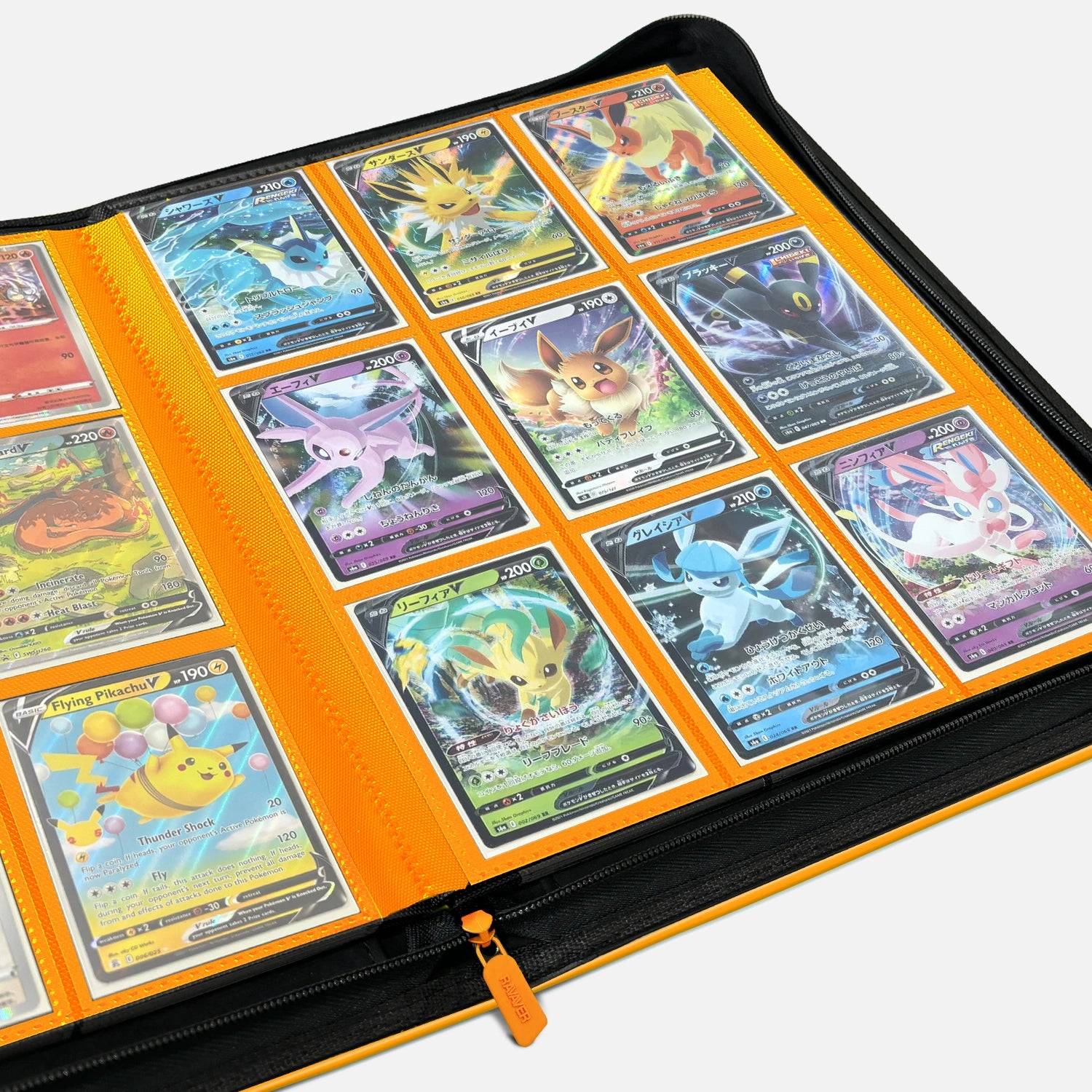
For the bigger picture on storage and display trade-offs, see our pillar on how to display your Pokemon card collection in 2026. For the toploader vs binder question that overlaps with humidity concerns, check the toploader vs binder storage comparison. And if you're looking for archival, PVC-free binder storage to start the right way, the Ravaver binder collection uses archival polypropylene pages by default.
Sources:
- PSA, Card Storage and Protection Guidelines, retrieved 2026-05-29, https://www.psacard.com/sportscardstorage
- Image Permanence Institute, Archival Storage Environment Standards, retrieved 2026-05-29
- TitanShield, Card Sleeves Explained: Archival-Safety Materials Guide, retrieved 2026-05-29, https://www.titanshield.com/blogs/blogs/card-sleeves-explained
- Phantom Display, UV Protection for Trading Cards: Prevent Fading, retrieved 2026-05-29, https://phantomdisplay.com/blogs/blog/protect-pokemon-cards-from-uv-damage