Every Master Set budget guide online quotes you a card cost and calls it done. Reality is messier. After 15 years and a dozen Master Sets, the surprises are never the card prices themselves, they're the costs nobody warned you about that show up between weeks 3 and 12 of the build and turn a $1,400 project into a $1,800 project.
These nine hidden costs add 15-30% to the typical Master Set budget. None of them are optional once you start. The collectors who finish projects on budget are the ones who price them in before card #1 lands in the binder.

Key Takeaways
- Hidden costs typically add 15-30% on top of the headline card spend for a Standard Tier Master Set
- The most underestimated expense is shipping fees on small singles orders ($80-200 cumulative over a project)
- Sales tax alone on a $1,400 project averages $80-150 depending on US state
- Storage and protection skimping is the most expensive false economy. Saving $40 on a binder can cost $300 in damaged cards
1. Sleeves (penny sleeves + premium outer sleeves)
Every card in a Master Set needs at least one sleeve. Most chase cards need two (penny inner + premium outer). For a 430-card set, that's 500+ penny sleeves and 100+ premium outer sleeves at minimum.
Realistic cost: $40-80 across the build. Penny sleeves run $5-8 per 500-pack. Premium outer sleeves (Ultra Pro Eclipse, Dragon Shield Mattes, KMC Hyper Mats) cost $8-18 per 100 depending on brand.
How to save: Buy in 1,000-pack bulk on Amazon or specialty card shops, you'll use them across multiple sets over time. Don't economize on the outer sleeve quality for chase cards. Cheap outer sleeves can develop static or yellowing over 2-3 years and transfer damage to the card.
2. Toploaders or card savers for chase cards
Sleeves protect against surface scratches. Toploaders protect against bending and corner damage. Every chase card over $20 in your Master Set should sit in a toploader once it arrives, especially during photography, transport to grading services, or any handling event.
Realistic cost: $30-60 across the build. Standard 35pt toploaders run $8-15 per 25-pack. Card savers (the flexible cousin of toploaders, preferred for PSA grading submissions) cost $10-20 per 50-pack.
How to save: Don't toploader bulk commons or low-value cards, that's wasted spend. Reserve toploaders for the top 20-40 cards in your set (typically anything over $20 raw value). For the rest, premium outer sleeves are sufficient protection.
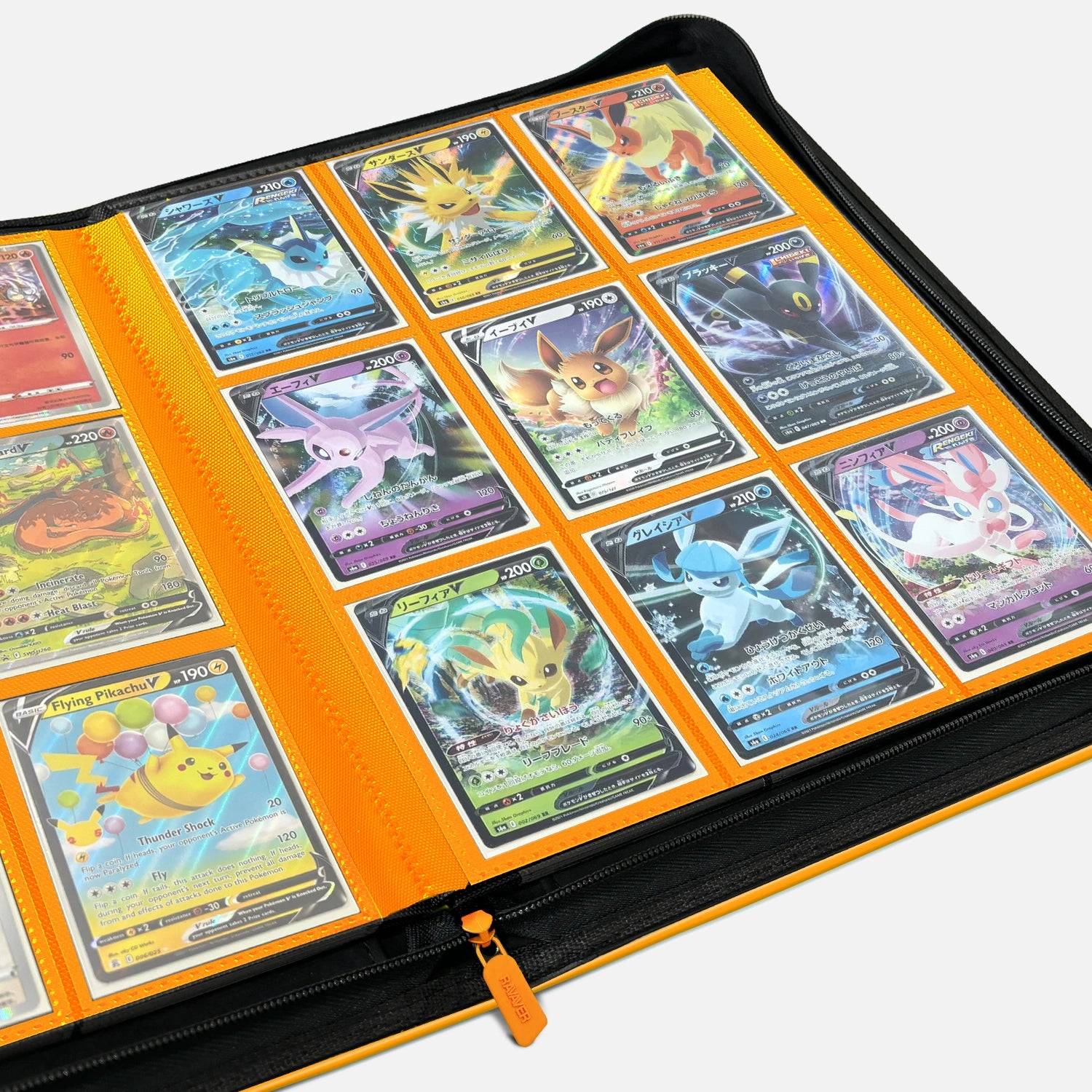
3. A binder that actually fits a Master Set
Most beginners buy a $20 9-pocket binder, fill 40 pages, and realize their set needs 70+ pages. Then they buy a second binder. Then a third. Then they realize the cheap binder's rings are bending the corners of cards near the spine. Eventually they swap to a single 480-720 card capacity zippered binder for $80-120, and the cheap binders sit unused.
Realistic cost: $50-120 for a proper Master Set binder. A 480-card capacity premium binder with toploader-friendly pockets and zippered closure runs $80-100 in the standard premium range.
How to save: Buy the right binder once at the start of the project instead of buying three wrong binders sequentially. A toploader-friendly binder eliminates the need to remove toploaders for storage, which saves friction and prevents handling damage. Browse premium Pokemon binders that handle full Master Sets without ring damage.

4. Shipping fees on dozens of small singles orders
This is the cost nobody plans for. A typical Master Set build involves 30-60 separate online orders to source missing singles. Each order has $3-5 in shipping. That's $90-300 in shipping fees alone, spread across the project where it's hardest to see in aggregate.
Realistic cost: $80-200 across a Master Set build. The variance depends entirely on how efficiently you batch orders.
How to save: Use TCGplayer's "Mass Entry" tool to consolidate multiple cards from the same seller into single orders. Set a minimum order value of $25-30 before purchasing. Below that, shipping cost is more than 15% of order value, which is bad math. For chase cards, accept slightly higher card price from sellers who include free shipping over $50+ orders.
5. Sales tax (and it adds up fast)
Most US states now charge sales tax on online card purchases. The Wayfair decision in 2018 effectively ended tax-free online shopping for collectibles. Average US state sales tax is 6-9%, with high-tax states like California, New York, and Washington exceeding 10% in some localities.
Realistic cost: $80-150 on a $1,400 Master Set spend at average US sales tax rates.
How to save: There's no legitimate way to avoid this, sales tax is mandatory by state law. Some collectors order from private sellers on Reddit's r/PokemonTCG_Marketplace where tax isn't collected (though you're technically responsible for use tax in most states). Build the tax cost into your headline budget from the start.
6. Lost or damaged cards in transit
Cards arrive damaged. Cards get lost in the mail. Sellers ghost on chargebacks. Refund processes drag for weeks. Across a typical Master Set build, expect 2-5% of orders to have problems requiring time and energy to resolve, with 0.5-1% of total card spend ending up unrecoverable.
Realistic cost: $30-100 in irrecoverable losses across a $1,400 project. Time cost of chasing refunds is real but harder to quantify.
How to save: Buy from sellers with 99%+ feedback scores and 1,000+ transactions for cards over $30. Always use trackable shipping for cards over $50 (most sellers include this. Verify before purchase). For chase cards, request photos before shipping when buying outside major marketplaces.
7. PSA Population Report submission fees (if you grade anything)
Grading is optional for completing a Master Set, but most collectors end up grading the top 3-5 chase cards. PSA's Value Bulk tier costs $24.99 per card with a PSA Collectors Club membership ($149-199/year), 20-card minimum submission. Without membership, the cheapest tier is $32.99/card. Add shipping to PSA ($25-40 for insured shipping), grading-failure costs (cards that come back as 9s when you wanted 10s), and the $20-40 wait time on cross-grade resubmissions.
Realistic cost: $200-600 for grading 5-10 chase cards, including failure costs and resubmissions. The bare minimum to grade 20 cards (PSA Value Bulk minimum) is $499.80 plus shipping plus membership cost.
How to save: Only grade cards worth $80+ raw, where the grading fee is a small percentage of the card's value. Use the PSA Collectors Club ($149/year) if you'll submit 30+ cards across a year, it pays for itself in fee discounts. For cards under $80 raw, leave them ungraded.
8. Display and storage upgrades after completion
You finished the Master Set. You're proud. You take photos. Then you realize the cards look bad sitting in a basic binder, so you upgrade to a premium showcase binder. Then you want to display the top 5 cards separately, so you buy magnetic card holders. Then you decide the slabs need their own display case. Each upgrade is small individually but they add up.
Realistic cost: $50-200 for post-completion display upgrades, depending on how showy you want the final display.
How to save: Plan the final display setup before you start the project, not after. Decide whether you want a binder-only display, a slab-only display, or a hybrid. Buy the display infrastructure during the Preserve allocation rather than as a surprise add-on.
9. Opportunity cost: the cards you wanted to buy instead
This is the hidden cost most collectors don't think about: the cards you didn't buy because Master Set spending tied up your collecting budget. When a chase card from another set you love drops 30% during a market dip, you can't pounce because your $1,400 is committed to the current Master Set project.
Realistic cost: Hard to quantify, but real. The collectors who manage this best treat Master Set projects as 25-50% of their annual collecting budget, leaving 50-75% for opportunistic purchases on cards they love but aren't actively pursuing.
How to save: Set a clear annual collecting budget before starting a Master Set. Allocate the Master Set as one budget line, and protect the rest of the year's discretionary collecting funds from being consumed by it.
The total hidden cost stack on a Standard Tier Master Set
| Hidden Cost Category | Low End | High End |
|---|---|---|
| Sleeves | $40 | $80 |
| Toploaders | $30 | $60 |
| Master Set binder | $50 | $120 |
| Shipping on singles orders | $80 | $200 |
| Sales tax | $80 | $150 |
| Lost/damaged cards | $30 | $100 |
| Grading (optional) | $0 (skip) | $600 |
| Display upgrades | $50 | $200 |
| Total hidden costs | $360 | $1,510 |
On a $1,400 Standard Tier card spend, hidden costs add $360-1,510 depending on whether you grade and how aggressive your display setup is. The realistic mid-range without grading is $300-500 in hidden costs, meaning the project's true cost is $1,700-1,900, not the $1,400 you originally calculated.
How to budget hidden costs properly
Three steps before you start any Master Set project:
- Add 25% to your card spend estimate. If you think the set will cost $1,400, plan for $1,750. The 25% is your hidden cost buffer.
- Pre-purchase the major Preserve items. Buy the binder, sleeves, and toploaders before card #1 arrives. This prevents the "I'll get to it later" trap that ends with damaged cards.
- Track hidden costs in a separate column. When you log a card purchase, log the shipping and tax separately. Watching the hidden cost column grow keeps you disciplined on order consolidation.
Frequently Asked Questions
Can I skip sales tax by buying from private sellers?
Some private marketplaces (Reddit, Discord, in-person trades) don't collect sales tax. Technically you're responsible for "use tax" in most states, though enforcement is essentially nonexistent for collector-scale purchases. Buying from private sellers can save 6-10% on tax but adds counterparty risk, chargebacks are harder, and you have no marketplace protection if a card arrives damaged.
Is grading really worth the cost on most Master Set cards?
No. The 80/20 rule applies: 80% of cards in a Master Set aren't worth grading because grading fees exceed the post-grade value lift. Reserve grading for cards worth $80+ raw (where the PSA 10 premium is meaningful) or cards with strong sentimental value. Grading all 430 cards is a financial mistake that adds $10,000+ to a project for minimal value lift on the bulk.
What's the smartest single investment in storage for a Master Set?
A premium toploader-friendly binder is the single best investment. It handles every card from the project (from $0.50 commons to $300 chase cards), eliminates the cost and friction of separate storage solutions, and prevents the ring-damage that destroys cheaper binders. Expect to spend $80-120 for a binder that lasts 5-10 years across multiple sets.
How do I track shipping costs without going crazy?
Create a Google Sheet with one row per order. Columns: date, seller name, card cost, shipping cost, tax. After 4-6 weeks you'll see your shipping-cost percentage clearly. If it's over 8% of card spend, you're ordering too small, consolidate into larger orders or change sellers. The goal is shipping under 5% of total card spend.
Should I get insurance on shipped cards over $100?
Yes. USPS adds $3-5 for insurance up to $200, and the additional cost is trivial compared to losing a $150 chase card to a sorting facility mistake. For cards over $500, use Registered Mail or signature-required delivery. Most sellers handle this automatically for high-value cards. Verify before purchase.
Where to apply this
Take your current Master Set budget. Multiply by 1.25. That's your honest total cost including hidden expenses. If that number is over your comfort level, downgrade tier or extend timeline before you start. Surprise costs at month 4 are the #1 reason Master Set projects stall.
For how these hidden costs fit into the overall Master Set economics, see our complete 2026 cost analysis. For the disciplined budget framework that accounts for hidden costs from day one, see the 4-phase cost allocation method.
Sources:
- PSA, 2026 Service Levels and Bulk Submission Pricing, retrieved 2026-05-26, psacard.com/services
- TCGplayer, Seller Shipping Fees Documentation, retrieved 2026-05-26, tcgplayer.com
- Streamline Sales Tax Project, US State Sales Tax Rates 2026 Reference, retrieved 2026-05-26, streamlinedsalestax.org