The cheapest path to a complete Pokemon Master Set might not be in English at all. Japanese-language booster boxes routinely cost 40-60% less than their English equivalents, pull rates are mathematically better, and the Japanese print quality is widely regarded as superior. So why doesn't every Master Set builder just collect Japanese?
The answer is more nuanced than the cost difference suggests. This breakdown compares the real 2026 cost of building a Master Set in each language, factors in shipping and import costs most calculators ignore, and gives you a clear decision on which path makes sense for which collector profile.

Key Takeaways
- Japanese Pokemon booster packs cost ~$1.40 at MSRP (¥200) versus $4 for English packs, roughly a 65% per-pack savings
- Japanese booster boxes guarantee at least one Secret Rare per box. English boxes guarantee nothing
- Once you factor in international shipping ($30-80 per order) and import duties, the savings drop to 20-35%
- Japanese Master Set resale liquidity in the US is roughly 40-50% of English equivalent, which offsets savings if you ever sell
- Japanese makes the most sense for collectors building for long-term display, not for buyers planning to flip
The headline cost comparison: English vs Japanese Master Set
Let's start with the per-pack and per-box economics, then build up to Master Set totals.
| Cost Component | English (US Market) | Japanese (Direct Import) | Effective Difference |
|---|---|---|---|
| Pack MSRP | $4.00 | ~$1.40 (¥200) | JP cheaper 65% |
| Booster box MSRP | $144 | ~$40-50 (¥6,000) | JP cheaper 65-70% |
| Booster box market (current sets) | $200-310 | $80-130 | JP cheaper 55-65% |
| Secret Rare pull rate (per box) | ~1.2 average (not guaranteed) | 1+ guaranteed | JP better odds |
| Chase card singles (top SIR) | $250-350 | $80-150 | JP cheaper 50-70% |
| Card count per "set" | 250-430 (modern SV era) | 80-150 per JP equivalent | Different structure |
The most important note in that table is the last row: Japanese sets are structurally different from English sets. Pokemon Japan releases smaller sets more frequently, typically 80-120 cards per release, compared to English sets that bundle 2-3 Japanese releases into a single 250-430 card expansion. To build a "Master Set" equivalent to one English set in Japanese, you'd typically need to complete 2-3 separate Japanese sets.
How much does a Japanese Pokemon Master Set actually cost?
Using Surging Sparks as the reference point. The English Surging Sparks Master Set has 430 cards at a total market value of approximately $1,470. The equivalent Japanese content was released across two sets: "Super Electric Breaker" (~110 cards) and "Battle Partners" (~70 cards), both released in late 2024.
Building both Japanese Master Sets to equivalent completion from singles markets currently runs $550-750 combined, meaning the Japanese path delivers the equivalent content at roughly 40-50% the English cost. That's the headline savings everyone quotes.
The catch: those numbers are before international shipping and any import duties. Add $30-80 per shipping order (and most Master Set builders need 3-6 orders to source efficiently), and the actual landed cost lands closer to $700-1,000 for the Japanese path. That's still cheaper than English at $1,400-1,500, but the savings dropped from "60% cheaper" to "30-40% cheaper" once you factor in delivery economics.
The pros and cons of building a Japanese Master Set
Why Japanese wins:
- Lower base cost. 30-40% cheaper after shipping is still meaningful, especially on larger projects ($500-800 in savings)
- Better pull rates. Japanese boxes guarantee at least one Secret Rare per box. English boxes average 1.2 Secret Rares with no guarantee, meaning some boxes pull zero
- Superior print quality. The Japanese print process has tighter centering, better foil quality, and fewer edge defects. PSA 10 rates on Japanese cards run 15-25% higher than English equivalents
- Smaller, more focused sets. Easier to track completion on an 80-card set than a 430-card set. Faster sense of achievement
- Unique artwork. Some Japanese-exclusive promo cards and SIRs never get English releases, adding collector value
Why English wins:
- Resale liquidity. US collector market is enormously deeper for English cards. Selling a Japanese set in the US recovers 50-60% of cost. Selling an English set recovers 70-85%
- No language barrier on TCG play. If you ever want to actually play with your cards (not just collect), Japanese is unplayable in US tournaments
- Faster shipping. Domestic US shipping is 2-5 days. Japanese imports take 7-21 days
- No customs risk. Some US states levy import duties on collectibles over certain thresholds. Tracking customs is tedious
- Cultural resonance. The Pokemon Master Set was originally an English concept. Many collector communities and grading conventions are English-centric

Which collector profile should choose Japanese?
Japanese Master Set building makes the most sense for these specific collector profiles:
The long-hold display collector
You're building this set to keep, display, and enjoy for 10+ years with no plans to sell. The 30-40% cost savings goes straight to your bottom line, and the superior print quality means your set looks better in a display binder. Resale liquidity doesn't matter to you because you're not selling.
The grading enthusiast
You plan to PSA-grade many cards from the set. Japanese cards' higher PSA 10 rate (15-25% better odds than English) means more of your grading submissions come back at the top grade, where the value premium justifies the grading cost. Combined with the cheaper raw card cost, the grading economics flip clearly in favor of Japanese.
The cost-conscious starter collector
You're new to Master Set building and want to learn the workflow at the lowest possible financial stakes. Building a Japanese set for $700-1,000 instead of an English set for $1,400-1,500 lets you make beginner mistakes at half the cost. If you decide Master Set building isn't for you, you've lost less.
Which collector profile should stick with English?
The investment-minded builder
You're treating cards as appreciable assets and care about resale liquidity. English sets sell faster, at higher percentages of cost, and have larger active buyer pools. The 30-40% cost savings on Japanese gets eaten by 30-40% worse resale percentages, net zero or worse on liquidation.
The first-time builder without import experience
If you've never ordered internationally before, the learning curve on Japanese sourcing is steep. You'll need to evaluate Japanese sellers, navigate customs forms, understand import duty thresholds in your state, and accept 2-3 week shipping windows. None of these are insurmountable, but they're real friction. Stick with English for your first project and revisit Japanese once you've built the workflow muscle.
The player-collector hybrid
If you ever want your cards to be playable in US sanctioned tournaments, you need English. Japanese cards are not legal in Pokemon Organized Play events in the US, period.
The hybrid strategy most experienced collectors actually use
Here's what most 5+ year collectors do in practice, regardless of what online guides recommend: they build English Master Sets for the sets they love most (where resale liquidity and cultural primacy matter), and they cherry-pick Japanese versions of specific chase cards where the savings are dramatic enough to ignore the liquidity penalty.
Example: A Pikachu ex SIR from Surging Sparks costs $250-300 raw in English. The Japanese equivalent costs $100-130 raw. If you want the visual centerpiece for your collection but don't need the English-language version for resale, the Japanese single is the better buy by $150+. The same logic applies to alternate art cards, promo cards, and any individual single where the price gap exceeds the resale penalty.
This hybrid approach delivers most of the cost savings of Japanese collecting while preserving most of the resale liquidity of English collecting. The downside: your Master Set isn't purely one language, which some completionists dislike.
Where to source Japanese Pokemon cards safely in 2026
Three trusted channels for US collectors:
- TCGplayer. Has a growing Japanese card marketplace. Sellers ship from Japan but rate per US delivery standards. Easier returns than international auction sites.
- eBay (Japan-shipped sellers). Filter by "Located in: Japan" and check feedback scores. Yahoo Auctions Japan listings often appear on eBay through proxy services.
- Specialized Japanese card importers. Sites like Samurai Sword Tokyo and similar Japanese-focused stores aggregate inventory and ship at flat international rates ($30-50 per box).
Avoid first-time-listing eBay sellers from Japan with under 100 feedback, counterfeit Japanese cards exist (lower volume than English fakes but they're out there). Always check the holo pattern under bright light and verify the back-of-card print quality before paying for ungraded singles.
Frequently Asked Questions
Are Japanese Pokemon cards considered "real" by US collectors?
Yes, Japanese Pokemon cards are produced by The Pokemon Company itself and are equally official to English cards. They're not legal for US tournament play (separate licensing region), but they're 100% genuine Pokemon TCG product. Collector communities respect both languages equally as part of the IP.
Do Japanese cards grade the same way as English at PSA?
PSA grades both English and Japanese cards using the same 1-10 numeric scale. Japanese cards historically grade higher on average due to superior print quality (tighter centering, fewer edge defects). PSA labels Japanese cards distinctly in their database, so resale buyers can clearly tell which language they're getting. CGC and BGS also grade Japanese cards.
What's the difference between Japanese set release schedules and English?
Japan releases new sets every 1-2 months in smaller 80-150 card batches. The US/EU markets bundle 2-3 of those Japanese sets into single 250-430 card English expansions, releasing every 3-4 months. So an English "Surging Sparks" combines content from two separate Japanese sets released months earlier. This means Japanese collectors see cards 4-8 months before English collectors do, with prices lower because the US collector demand hasn't fully kicked in yet.
Can I store Japanese and English cards in the same binder?
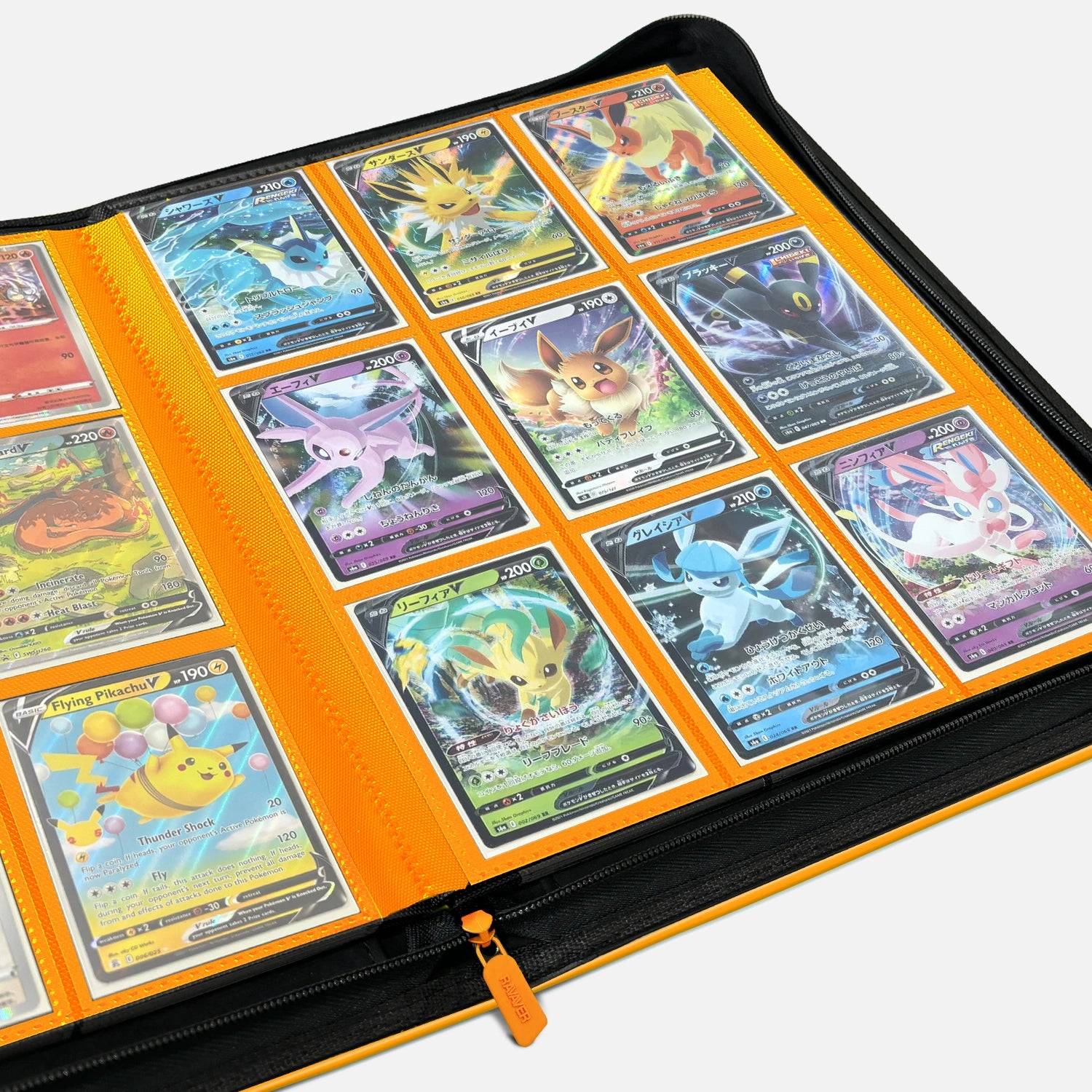
Yes, Japanese and English Pokemon cards are the standard 63x88mm size and fit any standard 9-pocket binder pages. The only physical difference is the Japanese cards are slightly thicker on average. For sleeved storage, standard 65x90mm penny sleeves and Ultra Pro/Dragon Shield outer sleeves fit both equally well. Check out premium binders that accommodate both languages if you're going the hybrid route.
Will Japanese Pokemon cards appreciate the same way English ones do?
The short answer: not as fast in USD terms, but yes in JPY terms. Japanese cards appreciate within the Japanese collector market according to local supply/demand dynamics. US-market appreciation of Japanese cards is slower and more selective, only the most iconic cards (Charizard, Pikachu, vintage Base equivalents) sustain US collector interest. For straightforward Master Set appreciation in USD, English remains the safer bet, but specific iconic Japanese chase cards have outperformed their English counterparts in select cases.
Where to decide from here
Make a 5-minute decision before you start: are you building this Master Set primarily to keep and enjoy, or primarily to hold as an appreciable asset? If keep-and-enjoy, Japanese saves you 30-40% with better print quality. If asset-grade, English preserves liquidity at higher upfront cost.
The hybrid approach, English base with selectively Japanese chase cards, is what most experienced collectors actually do once they've done the math both ways. Start there if you're unsure.
For how either choice plays out across the full Master Set cost structure, see the complete 2026 cost breakdown. For the disciplined budget framework that handles either path, see the 4-phase cost allocation method.
Sources:
- The Pokemon Company Japan, 2026 Pricing Announcement for ¥180 to ¥200 Pack MSRP Change, retrieved 2026-05-26, pokemon.co.jp
- TCGplayer, Japanese Pokemon TCG Marketplace, retrieved 2026-05-26, tcgplayer.com/pokemon-japan
- PriceCharting, Pokemon Surging Sparks Card Prices, retrieved 2026-05-26, pricecharting.com/console/pokemon-surging-sparks