The question collectors actually ask after grading their first batch of cards isn't "what's the difference between a binder and a slab box." They know the difference. The question is which one fits their specific situation, because every collector with more than 20 PSA slabs runs into the same wall. The cards are too valuable for a binder. The slab box hides them away. And the in-between options (mag holders in display drawers, mounted shadow boxes, custom display cases) cost more than the cards themselves for anyone outside the top 5% of the hobby.
This is a direct comparison from someone who runs both. The binder side holds 320 raw cards in a finished master set's Tier 2 archive. The slab box side holds 24 PSA-graded chase cards. Each system protects what it's good at protecting, fails at what the other one's for, and gets misused constantly on r/PokemonTCG when collectors try to make one do the other's job.
Key Takeaways
- Binders are for raw cards you handle weekly. Slab boxes are for graded cards you access twice a year.
- A PSA slab won't fit in any standard 9-pocket binder pocket. Special slab-fit binders exist (Ultra Pro, BCW) but trade off page count and price.
- BCW slab storage boxes hold 25 PSA cases for $15–$25. The same 25 slabs in a magnetic shadow-box display setup run $300+.
- The right answer for most master set collectors is both: a toploader binder for the raw tour-the-set spread and a slab box for the chase cards too valuable to flip past every week.

What a binder is actually built for
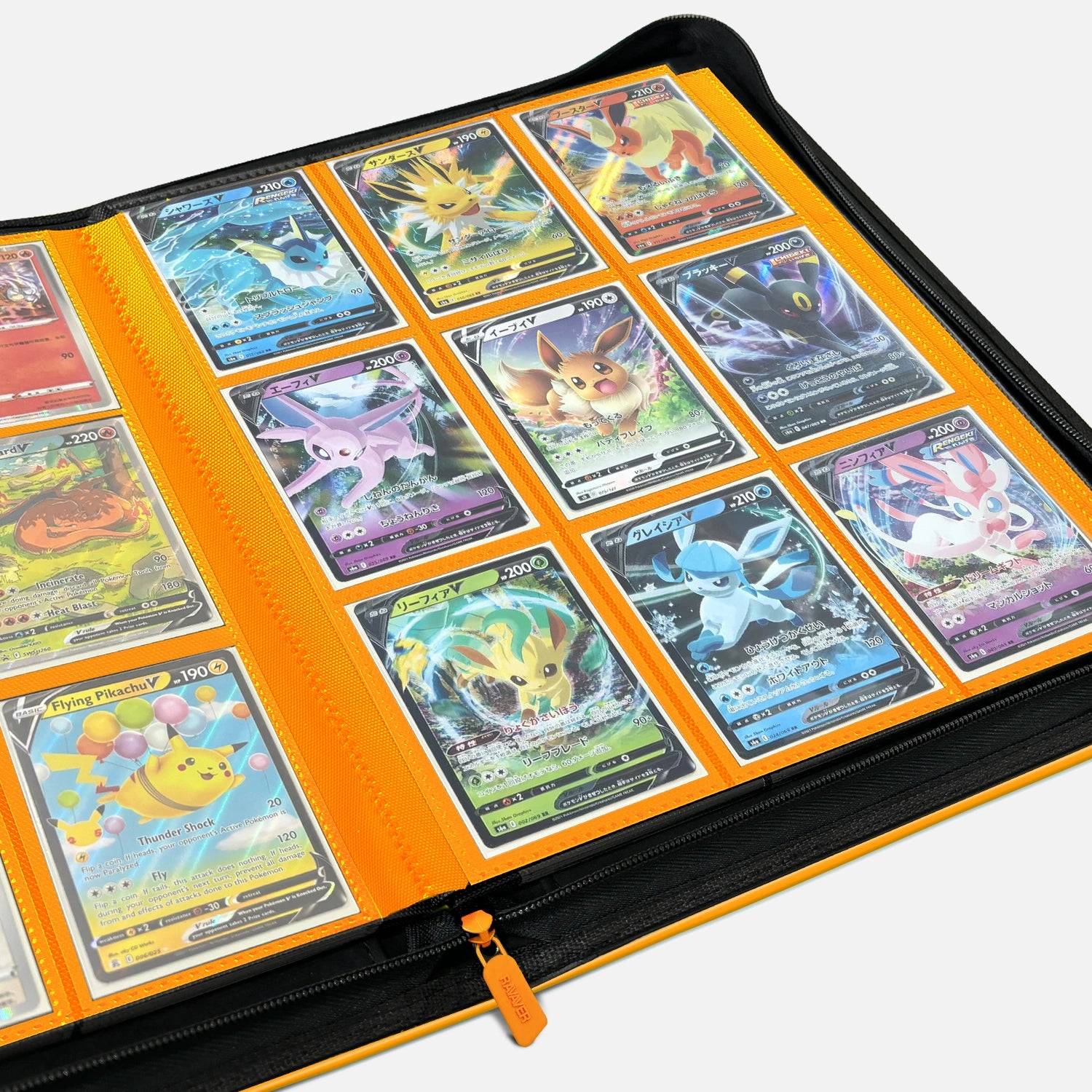
A binder solves the problem of accessing a hundred-plus raw cards without sleeving and unsleeving them every time you want to look. The whole product category exists because raw cards in a stack get fingered, edge-bumped, and re-stacked into damage. The binder removes that handling entirely. You flip a page, the card stays in its pocket, and the only thing that touches the card surface is the same archival-grade page that touched it last week.
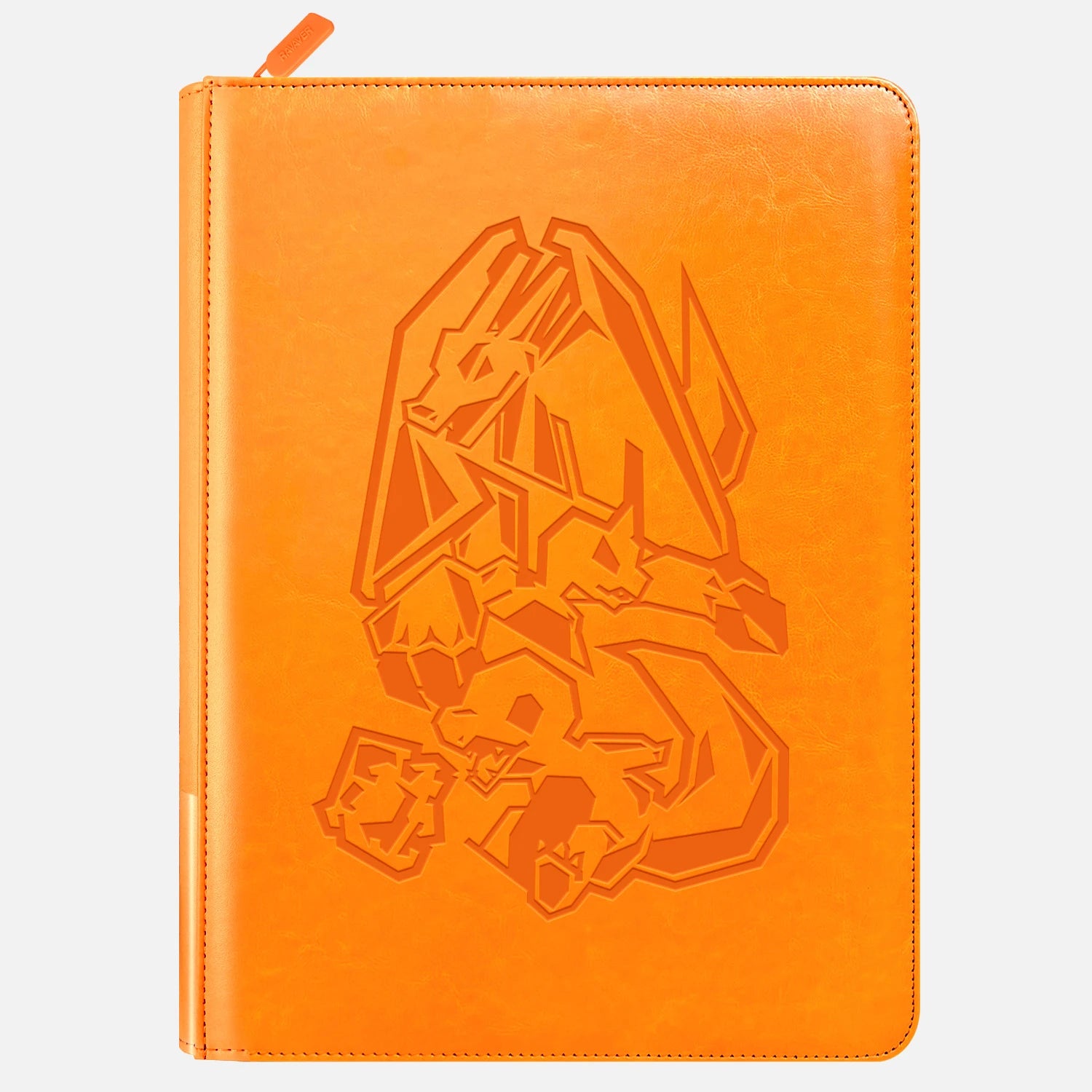
The trade-off is mechanical wear. Page turns put micro-stress on the corners of cards in their pockets. Most modern premium binders solve this with side-loading or top-loading pocket designs that minimize friction, full-zip closures that hold pages flat, and PU leather covers that resist warping. The high-end of the binder market (Vault X EXo-Tec, Ultimate Guard ZipFolio, Ravaver Toploader) costs $60–$120 because the engineering on those four pieces actually matters when you're putting $40,000 worth of raw cards in a single product.
Binders work best when:
- You're storing 100+ raw cards and want to access them weekly
- You want to show the collection to friends, customers at a card show, or trade partners without unsleeving anything
- You're building a master set and want to see the progress visually as pockets fill in
- You want a physical "version" of your collection that lives outside a spreadsheet
Binders fail when you try to store graded slabs in them (no standard pocket fits a PSA case), when you flip through them daily for years on end (mechanical wear adds up), or when you store them in conditions outside the 65–72°F and 40–55% humidity range every paper-based collectible needs.
What a slab box is actually built for
A slab box is the inverse of a binder. It's optimized for low-access, high-protection, dense storage of cards that are already encapsulated in PSA, BGS, or CGC cases. The BCW slab storage box is the de facto standard — a heavy cardboard box with a fitted lid that holds 25 standard slabs in vertical orientation, with foam dividers between cards. You can stack five of these on a shelf in a 14"-deep closet and store 125 slabs in less space than two binders take up.
The trade-off is access. To look at any card, you take the box down, lift the lid, slide out a slab, and put it back. There's no flipping through. There's no visual progress check. If you want to see what's in the box, you check your spreadsheet. The cards are protected against almost everything (UV, dust, abrasion, micro-handling) because they're inside their slabs and then inside an opaque storage container. That's the whole pitch.
Slab boxes work best when:
- You have graded cards and want them in a stable archival environment
- You don't need to look at the cards more than every few months
- You're storing the cards in a safe, safety deposit box, or closet you don't open often
- You want to maximize storage density per shelf inch
Slab boxes fail when you try to use them as a display (they're not — they're storage), when you mix raw and graded cards in the same box (foam dividers don't fit raw cards properly), or when you store them in a location you genuinely never check (because then a humidity problem inside the box goes undetected for a year).
Head-to-head comparison
| Factor | Binder | Slab box |
|---|---|---|
| What it holds | Raw or sleeved cards | Encapsulated graded slabs (PSA, BGS, CGC) |
| Capacity | 200–720 cards | 25 slabs per box; scales by stacking |
| Cost per card | $0.10–$0.40 | $0.60–$1.00 |
| Access frequency | Weekly to daily | Every 2–6 months |
| Display value | High when open on a stand | None — opaque storage |
| Protection against mechanical wear | Good for raws; poor for slabs | Excellent for slabs |
| UV protection | Closed: excellent; open: depends | Excellent |
| What insurance underwriters prefer | Itemized binder inventory acceptable | Slab box in fire-rated safe is gold standard |
The slab-in-binder problem nobody talks about
The question that comes up constantly in r/PokemonTCG and r/pkmntcgcollections is some version of "can I put my slabs in a binder?" The honest answer most veteran collectors give is: technically yes, practically no. Here's why.
A PSA standard slab is roughly 88mm wide, 117mm tall, and 7mm thick. A standard 9-pocket binder pocket is sized for a raw card, which is about 63mm by 88mm. Slabs don't fit. The workaround is a slab-fit binder, where each "pocket" is actually a sleeve sized to hold one slab. Ultra Pro and BCW both make these. They work, but they cut your page count down dramatically (typical slab binder holds 16–24 slabs) and the cost-per-slab-stored goes up to $5–$15, which is worse than a slab box on every metric except visual presentation.
The cases where a slab binder genuinely makes sense are narrow but real. Show-and-tell at card shows, where you want to flip through a curated set of 16 PSA 10 chase cards in one product. Display in a shop or trading environment. A "best of the set" portfolio for a specific master set. Anything that involves a graded collection you actually want to see regularly is the right use case. Anything else, including most home storage, is better served by a slab box.

What veteran collectors do (the hybrid system)
The setup I've watched most multi-year master set collectors converge on is roughly this:
- One premium toploader binder per active master set. Houses the raw "spread" — every card in the set, including reverse holos and supplementary cards. This is the tour-the-set object. It lives on a bookshelf, closed, in a climate-stable room. Open it when you want to show the set or check progress.
- One BCW 25-slab box per 20–25 graded cards. Houses the graded chase tier. Lives in a fire-rated safe at home or a bank deposit box, depending on total value. You open it maybe twice a year when you're adding a newly graded card or doing your annual inventory photo refresh.
- One acrylic display rotation on the desk. 3–5 cards in single-card stands, swapped every 30 days from either the binder or (carefully, briefly) the slab box. This is the daily-access display that solves the "but I want to see them" problem for graded cards.
The economics work out cleaner than any single-product solution. A finished Scarlet & Violet-era master set with 12 graded chase cards costs maybe $90 in storage hardware total: $65 for the binder, $20 for the slab box, $5 for a couple of acrylic stands. Add the bank box if your graded tier crosses $5,000, and the all-in is still under $200 a year for storage. Most master set collectors spend more than that on the last two SIR singles. For collectors who want the binder side handled by a single premium product, Ravaver's toploader binder collection is engineered around the use case described above.
When to skip the binder entirely
For collectors whose master set is mostly graded (vintage Base Set master sets, 1st Edition Jungle, anything pre-WOTC-modern where every meaningful card got slabbed), the binder is genuinely optional. The whole collection might live in three or four slab boxes. The display rotation happens directly from those boxes to the desk. The binder you have is for the raw bulk doubles, sealed packs, or memorabilia surrounding the set, not the set itself.
The mistake that wrecks the hybrid system
The single most common failure mode I see is treating the slab box as a display piece. Someone buys a "display slab box" with a clear acrylic lid, fills it with PSA 10 chase cards, and sets it on a shelf in a room with a window. Three months later, the cards facing the lid have started showing UV shift on the white borders, even through the acrylic. The clear-lid slab box is a marketing product, not a storage product, and the actual storage products from BCW or Ultra Pro have opaque or paper-covered lids for a reason.
If you want to display graded cards, you display them one at a time in a UV-filtered acrylic stand on a desk, or in a Riker mount with proper UV-filtering glass. The slab box is not the right tool for that job. Use it for the storage problem it's actually built for.
Frequently Asked Questions
Can a PSA slab fit in a regular 9-pocket binder?
No. PSA standard slabs measure roughly 88mm by 117mm by 7mm, which is significantly thicker and slightly larger than the pocket dimensions on a standard 9-pocket binder page. Forcing a slab into a binder pocket either won't fit at all or will deform the page and adjacent pockets. If you need binder-style storage for slabs, buy a dedicated slab binder from Ultra Pro or BCW. Otherwise, use a slab storage box.
Are slab boxes a good long-term archival solution?
Yes for the slabs themselves, with one caveat. BCW and similar slab boxes are acid-free cardboard, opaque, and snug-fit around the slabs, which gives excellent protection against UV, dust, and abrasion. The caveat is climate: if the box is stored in a closet that swings from 50% to 70% humidity seasonally, that swing affects what's inside the box too. Slab boxes buffer humidity slowly but don't eliminate it. Pair the box with a hygrometer in the same closet and silica packets inside the box for full archival-grade protection.
How many PSA slabs fit in a standard slab storage box?
Standard BCW slab storage boxes hold 25 slabs in vertical orientation, separated by foam dividers. They cost $15–$25 each and stack neatly on a shelf. For larger collections, BCW also makes 50-slab and 100-slab boxes, but the 25-slab unit is the most common because it fits cleanly in a fire-rated safe and stays light enough to carry to a bank deposit box. Most master set collectors I know own 2–4 slab boxes total.
Do I need a binder if my entire master set is graded?
Not for the set itself. A fully graded master set lives in slab boxes, with a display rotation on the desk for the cards you want to see. The binder becomes optional. Where you might still want one is for the raw doubles you accumulated chasing those grades, for sealed product associated with the set, or for memorabilia like signed promo cards or sealed Japanese variants. Most fully graded master set collectors keep one binder for "everything else" and the actual master set lives in slab boxes.
Should I display my slab box on a shelf or hide it in a safe?
Hide it in a safe, or a closet, or a bank box. Slab boxes are storage products, not display products. The acrylic-lid versions marketed as "display" are not safe for long-term UV exposure even with the lid down. If you want to display graded cards, use a single-slab acrylic stand or a UV-filtering Riker mount, and rotate cards into the display from the storage box every 30 days. The storage box itself stays out of sight.
What's the best binder for a graded card collection?
For graded cards specifically, the Ultra Pro Pro-Binder Slab Binder and the BCW Slab Binder are the two products designed for the use case. Both hold 16–24 slabs per binder. They're niche products that make sense for a curated showcase of chase cards you want to flip through. For a finished master set with mixed raw and graded cards, a regular premium toploader binder for the raws plus a slab box for the graded tier is a better solution than trying to put everything in a slab binder.
Can humidity damage cards inside a slab?
Yes, slowly. PSA, BGS, and CGC slabs are well-sealed but not hermetic. Over years of exposure to humidity above 65% or below 30%, moisture migrates in and out, and the card inside can develop the same warping or edge issues as a raw card in the same environment. The slab gives you about 5x more buffer than a raw card, but it's not infinite. Climate-controlled storage matters even for graded cards.
What to do this week
If your collection right now is 80% raw cards and 20% graded, the move is one premium toploader binder for the raws and one BCW 25-slab box for the slabs. Total cost $80–$110, total setup time one afternoon. If your collection is the inverse (mostly graded), skip the binder and buy two slab boxes plus a couple of acrylic display stands. Either way, the mistake to avoid is trying to make one product do both jobs. They're different problems and the products that try to solve both end up failing at one of them.
Sources:
- PSA, "Submission Updates and Pricing," retrieved 2026-05-21, https://www.psacard.com/services
- BCW Supplies product pages, retrieved 2026-05-21, https://www.bcwsupplies.com/
- r/PokemonTCG community discussions on binder vs slab storage, retrieved 2026-05-21, https://www.reddit.com/r/PokemonTCG/