This is the most common storage question collectors ask, and the most common answer online ("no, never") is missing important nuance. The honest answer is: usually no, sometimes yes, and the difference depends on three specific conditions in your specific space. Here's the actual math and how to decide whether your basement or garage can hold a Pokemon card collection or whether you need to move it inside.
Key Takeaways
- For most US homes, the answer is no. Basements average 60 to 70 percent relative humidity in summer in non-arid states, which is above the 55 percent mold threshold for paper-based collectibles.
- Garages have an additional condensation problem from cars: warm car interiors meet cool concrete floors and the moisture has to go somewhere.
- A finished, dehumidified basement with year-round monitored humidity below 50 percent can work. A bare concrete unfinished basement almost never can.
- The cheap fix for most collectors is an interior closet on the first or second floor. It's free, and it works better than any unconditioned outbuilding.

What Pokemon cards actually need from their environment
The numbers archivists use for paper-based collectibles are tight. The Library of Congress, Northeast Document Conservation Center, and most museum standards target the same range: relative humidity (RH) of 30 to 50 percent, temperature of 60 to 70 degrees Fahrenheit, and as little fluctuation in either as possible. Pokemon cards are paper-based collectibles, so the same numbers apply.
The fluctuation point matters more than the absolute number. A space that holds steady at 55 percent humidity does less damage than a space that swings from 30 percent in winter to 65 percent in summer. The latter is what most basements and garages do, even when the average looks fine.
Why most basements fail the test
The average US basement runs 10 to 20 percent more humid than the floors above it, year-round. In summer, that gap grows. Three reasons:
- Cool concrete surfaces below the dew point cause water vapor in the air to condense. This is why basements feel damp.
- Groundwater pressure pushes humidity through concrete walls even when there's no visible leak. This is constant in most regions east of the Rockies.
- Warm air from upstairs falls and gets trapped in the basement, where it cools and reaches dew point, depositing moisture.
Result: a typical unfinished basement in Ohio, Virginia, North Carolina, Georgia, or anywhere in the Gulf Coast region runs 60 to 75 percent humidity from May through September. Anything over 55 percent risks mold on paper, and anything over 65 percent guarantees it given enough time.
Why most garages fail twice
Garages have the basement problem plus a second one. The car parked inside generates condensation. A warm car interior (from a recent drive or a sunny day) meets the cold concrete floor and the cold garage walls. The temperature differential causes moisture to condense out of the air, often onto whatever is on the bottom shelf or against an exterior wall.
Garages also have the most extreme temperature swings of any home space. Summer afternoon temperatures inside an attached garage can hit 110 to 120 degrees Fahrenheit. Winter mornings in cold climates can drop to 20 to 30 degrees. Each thermal cycle stresses the foil layer on holographic cards and accelerates plastic aging on any nearby supplies.
When a basement can actually work
Three conditions, all required:
- Finished basement. Drywall, flooring, ceiling, and ideally an HVAC return that pulls air through the space. An unfinished basement with exposed concrete and rafters won't maintain stable conditions even with a dehumidifier.
- Year-round monitoring with a hygrometer. Place a digital hygrometer in the basement and check it at least monthly for a full year before committing to storing cards there. You need to see the summer numbers, not just the winter ones.
- Average humidity below 50 percent across all four seasons. Not just "sometimes below 50." If the summer peak is 60 percent, the cards spend several months in mold-risk territory.
Even with all three conditions met, the basement is still worse than an interior closet upstairs for marginal cost. The basement makes sense when you need the space and have already verified it works.
When a garage can actually work
Almost never, for valuable cards. The conditions for a garage to work are stricter than for a basement:
- Attached, insulated, climate-controlled garage with a wall-mounted HVAC unit
- No cars parked in it (or a sealed wall separating the parking area)
- Hygrometer-confirmed conditions matching the basement standard above
- No exterior wall storage (always interior walls or interior shelving)
If you meet all of these, the garage is functionally an extra interior room. For most US homes, it's not worth the upgrade just to store cards. PSA's recommendation aligns: store in temperature- and humidity-stable indoor spaces.
The actual fix: where to store cards instead
| Space | Typical RH | Temp stability | Card-safe? |
|---|---|---|---|
| Attic | 25 to 75% | Terrible | Never |
| Unfinished basement | 55 to 75% | Poor | Almost never |
| Attached garage | 35 to 70% | Terrible | Almost never |
| Finished basement (HVAC) | 40 to 55% | Good | Sometimes (verify) |
| Interior closet (1st/2nd floor) | 35 to 50% | Excellent | Yes |
| Climate-controlled vault | 40 to 45% | Excellent | Yes (expensive) |
The interior closet on the first or second floor wins by default. It's free, the conditions are the most stable in the home, and you can pair it with a $75 archival storage box build for complete protection.
If you absolutely have to use a basement or garage
The harm reduction version of this answer, for collectors with no other space:
- Buy a dehumidifier. Run it constantly in summer. Aim for 45 percent.
- Use the most archival box you can find (BCW 5000-count or CardboardGold equivalent), with a rechargeable silica canister inside.
- Store on a shelf at waist height or higher, never on the floor.
- Use an interior wall, never an exterior wall.
- Add a digital hygrometer and check it weekly.
- Move cards inside for the summer if you live somewhere humid (Florida, Gulf Coast).
This gets you most of the way to safe storage. It's still not as good as an interior closet, but it's much better than the average basement setup.

The cost-benefit of moving cards inside
For collectors weighing the move, here's the math. A $5,000 collection stored in an unconditioned basement or garage will typically lose 20 to 40 percent of its value over 5 years from cumulative humidity damage, mold spots on bulk, and surface waviness on holos. That's $1,000 to $2,000 in damage.
The cost of moving the collection inside is roughly $0 if you have a closet, plus $75 for a properly built storage box. The cost of a year-round dehumidifier in a basement is about $300 for the unit and $5 to $10 per month in electricity.
The economics almost always favor moving the cards. The collection appreciates faster than the dehumidifier saves.
Frequently Asked Questions
What if my basement is technically "finished" but doesn't have HVAC?
Finished without HVAC usually means drywall over concrete with no active air circulation. Humidity in these spaces still runs 5 to 10 percent higher than the floors above. You can use it, but you need a dedicated dehumidifier and verified hygrometer readings for a full year before committing.
Is a detached garage worse than an attached one for cards?
Yes. Detached garages have no thermal buffer from the home. Summer temperatures inside can match outdoor temperatures, which means 90+ degrees Fahrenheit for weeks at a time in most US states. Detached garages are effectively outdoor storage with a roof.
Can I use those big Coleman or Yeti coolers as makeshift card storage?
Briefly, but not long-term. Insulated coolers are sealed, which traps humidity at whatever level was inside when you closed them. They also don't allow moisture buffer with a silica canister to actively absorb anything new. Use them for transport, not storage.
How fast does humidity damage show up?
It depends on severity. At 70 percent RH continuously, visible warping on holos appears within 6 to 12 months. At 60 percent, the damage is much slower and might take 2 to 4 years to become noticeable. At 55 percent or below, properly stored cards are stable for decades.
What about a closet on the ground floor of a slab-foundation home?
Slab-foundation homes (common in the southern US) don't have basements, so the ground floor closet is the equivalent of a second-floor closet in a basement home. Conditions are typically excellent. The only caveat is to avoid closets sharing a wall with the outside of the house if you're in an extreme climate.
Move them this weekend if you can
If your cards are currently in a basement, garage, attic, or any unconditioned space, plan the move for the next weekend. The whole process takes a few hours. Find an interior closet, get a hygrometer, get a proper storage box, and don't think about it again.
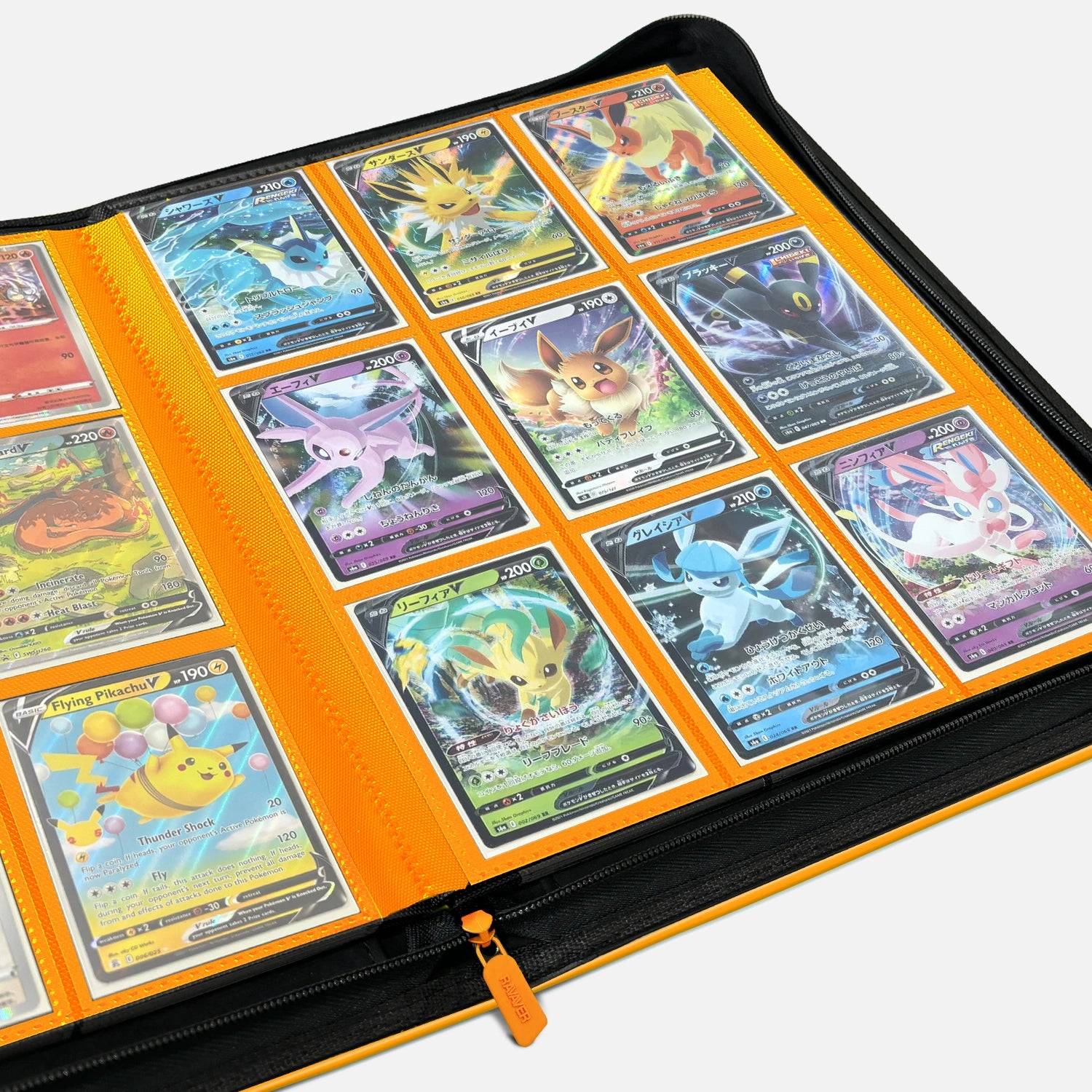
For the cards you actually bring out (binder cards, chase cards, anything you'd show a fellow collector), Ravaver's toploader binder line handles both the protection and the social side of storage. The boring bulk stays in an archival storage box in the closet. The cards you want to be seen with stay in a binder you actually use.
Sources:
- PSA Blog, "Keys to Trading Card Storage and Preservation," retrieved 2026-05-13, blog.psacard.com
- Northeast Document Conservation Center, "Preservation 101," retrieved 2026-05-13, nedcc.org
- Archival Methods, "Using Plastics in Archival Storage," retrieved 2026-05-13, archivalmethods.com