Walk into any card shop and you'll see three things sitting on the counter near the register: a brick of penny sleeves, a stack of perfect fit sleeves, and a tower of toploaders. The shop owner uses all three. Most collectors only use one or two and lose money because of it. The question isn't which one is best. The question is which combination makes sense for which card, and where the upgrade actually matters.
This is the layer-by-layer breakdown of penny sleeves, perfect fit sleeves, and toploaders, including the double-sleeve math that gets argued about in every collector group chat and the moment each one stops being worth the cost.
Key Takeaways
- Penny sleeves are first-line abrasion protection. They cost about $0.01 each and belong on anything you might trade or grade.
- Perfect fit sleeves wrap tighter than penny sleeves and are the standard inner sleeve in a double-sleeve setup for high-value cards.
- Toploaders add the rigid layer that stops bending. They are required for cards over $25 and for any card in transit.
- Double sleeving (perfect fit inside, premium outside) is correct for chase cards. It's overkill for bulk and overkill for graded slabs.

What each protection layer actually does
Before comparing them, name the job each one has. Confusion between the three usually comes from collectors who don't separate the functions, which leads to redundant protection on cheap cards and insufficient protection on expensive ones.
Penny sleeves protect against surface abrasion. They are thin, soft, and slightly oversized so the card slides in and out easily. They cost roughly a cent each in bulk. Their entire purpose is to wrap a card before it touches a toploader, a binder pocket, or anything else.
Perfect fit sleeves protect against the card sliding around inside its outer protection. They are stiffer than penny sleeves and sized to grip the card. They are too tight to use as standalone protection (the card is hard to insert) and they aren't designed to absorb impact. In a double-sleeve setup, they sit inside a premium outer sleeve, and the card sits inside them.
Toploaders protect against bending. They are rigid PVC-free plastic shells, typically 35-point thick for Pokemon, that hold a sleeved card flat. They don't protect against surface scratches (the card moves inside them) which is why sleeves go in first.
Penny sleeves vs perfect fit vs toploaders: spec comparison
| Spec | Penny sleeve | Perfect fit | Toploader |
|---|---|---|---|
| Material | Polypropylene | Polypropylene | Rigid PP or PETG |
| Thickness | Ultra-thin | Thin, snug | 35 to 75 point |
| Cost per unit | ~$0.01 | ~$0.05 | ~$0.15 to $0.40 |
| Main job | Surface abrasion | Stop card sliding | Prevent bending |
| Use alone? | Only for casual storage | Almost never | Only with a sleeve inside |
| Grading service prefers? | Yes (penny + semi-rigid) | Sometimes | No (use semi-rigids) |
The spec comparison clears up the most common mistake: trying to use any one of these alone. Penny sleeves alone don't stop bending. Perfect fits alone don't fit easily and don't protect from outside abrasion. Toploaders alone scratch the card every time it shifts inside. They are designed to work as a layered system.
When to use penny sleeves alone
Penny sleeves alone are fine for one specific use case: temporary protection on cards you're about to sort, trade, or move to a more permanent setup. Out of the pack, in a sort pile, in a stack of trade fodder. They are not long-term storage.
What they aren't good for: storing chase cards, going into a binder without a toploader for anything over $25, or any kind of mail or transit. The penny sleeve will let the card bend at the slightest pressure.
When to use perfect fit sleeves alone
This is the trick question. Perfect fit sleeves are almost never used alone. They are inner sleeves designed for the double-sleeve setup. The exception is when you're storing a card temporarily during grading prep and want the snug fit without an outer premium sleeve in the way. Even then, most collectors add an outer sleeve.
If someone tells you they store cards "in perfect fits" without anything else, ask whether they mean inside binder pages or inside semi-rigids. There's always something on the outside, otherwise the perfect fit isn't doing the job it was designed for.

When to use toploaders alone (and when not to)
Never use a toploader alone with a card directly inside it. The toploader edges are sharp on a microscopic level, and the card surface will scratch every time it moves. The "alone" trap is the most expensive mistake in this entire category: collectors put a $200 chase card into a toploader unsleeved, send it across the country, and end up with surface scratches that drop a grade.
Toploaders are designed to hold sleeved cards. The sleeve goes on first, then the sleeved card slides into the toploader. The combo is what protects the card.
The double-sleeve setup: when it's actually worth doing
Double sleeving means: perfect fit sleeve on the card, then a premium outer sleeve (Dragon Shield, KMC, or similar) on top. The double sleeve goes into a toploader for transit or sits in a binder pocket for storage.
The reason double sleeving exists is a specific failure mode. In a single-sleeve setup, the card can shift inside the sleeve as you handle it, and friction at the entry point causes micro-abrasion on the card edges over time. The perfect fit grips the card so it doesn't move. The outer sleeve provides the impact and abrasion buffer that the perfect fit alone doesn't.
Double sleeving makes sense for:
- Chase cards over $50 you're keeping long-term
- Cards you're prepping for PSA, BGS, or CGC grading (some submitters double-sleeve before semi-rigid)
- Vintage cards in display binders where they'll be flipped and looked at often
- Any card going to a card show in a binder you'll actively show people
Double sleeving is overkill for:
- Bulk commons and energies
- Modern holos under $5 that you'll probably trade away soon
- Cards already in PSA, BGS, or CGC slabs (the slab is the protection)
- Bulk PSA 9 or lower graded cards where the grade is already locked in
The math: a double sleeve costs about $0.06 per card. A penny sleeve is $0.01. On a $0.10 bulk card, the math doesn't work. On a $300 chase card, the math works thousands of times over.
Sleeve plus toploader vs the binder pocket question
A common point of confusion: if a card is in a sleeve and a toploader, does it still need a binder pocket designed for toploaders? Yes, for two reasons.
First, a sleeve plus toploader is wider than a sleeve alone. A standard binder pocket is sized for a sleeved card (about 67 mm wide). A toploader is around 70 mm wide. Forcing a toploader into a regular binder pocket bends the pocket edges and risks pushing the card edges into the corner of the page.
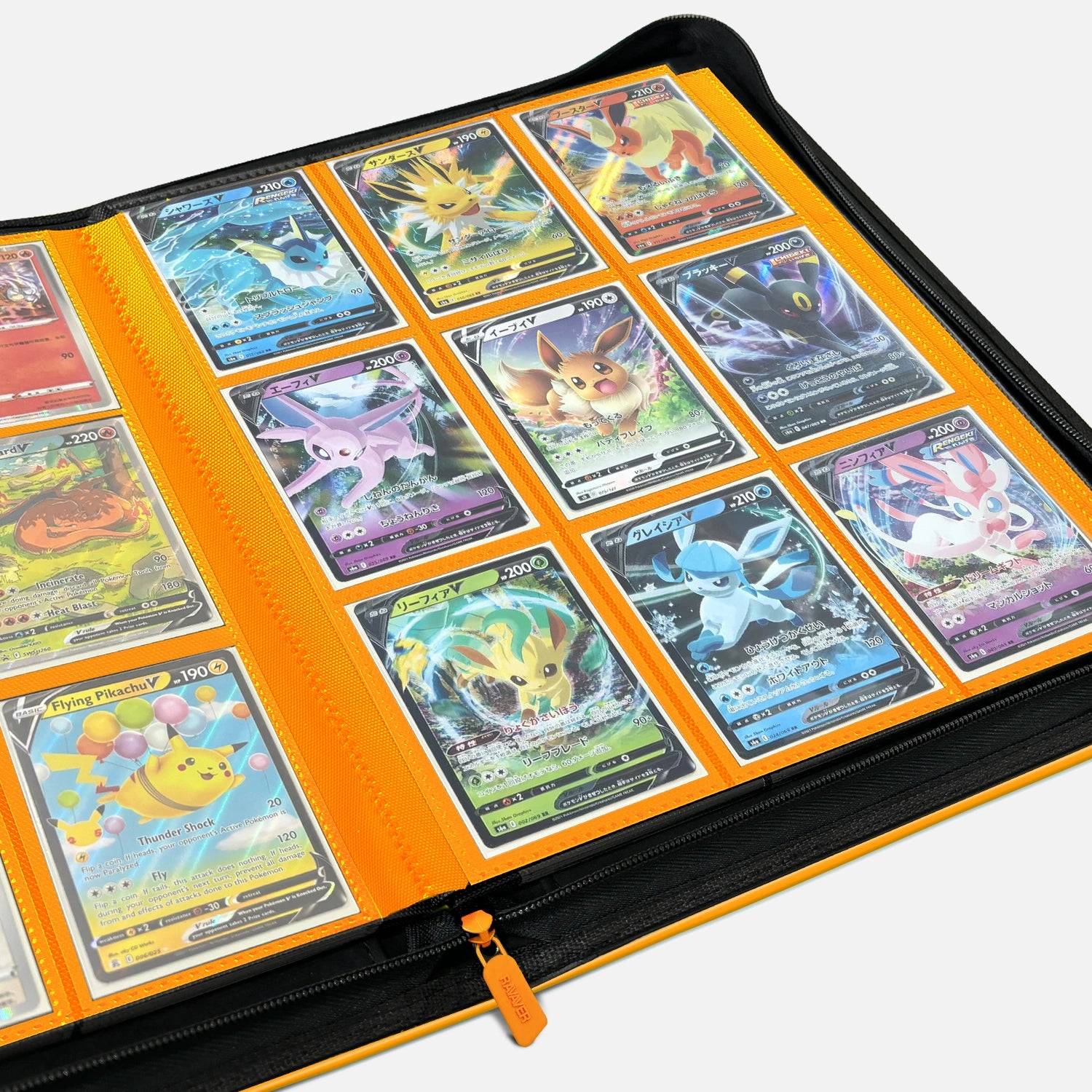
Second, the binder needs to close. A binder full of toploaders won't close in a ring binder built for paper. That's the entire reason toploader binders exist as a separate product category. Side-loading toploader binders like the ones in the Ravaver lineup are sized for toploaders specifically, so the protection and the storage layer work together.
What grading services actually prefer
Common confusion: collectors send cards in toploaders to PSA or BGS thinking it's the safest option, only to find out the grader either repackages or charges a small fee for opening. Grading services prefer:
- Card in a penny sleeve (not perfect fit, which is too snug to remove without bending)
- Sleeved card in a semi-rigid card holder (BCW or Card Saver brand)
- Semi-rigid in the submission box with a rubber band
The semi-rigid is the key. It's stiff enough to protect during transit, flexible enough that the grader can squeeze the sides and slide the card out without forcing it. A toploader requires prying, and prying causes damage. PSA, BGS, and CGC all publish this preference in their submission guides.
Frequently Asked Questions
Can you double sleeve and still fit in a standard toploader?
Yes, with most setups. A perfect fit plus a premium outer sleeve is still thinner than the inside of a standard 35-point toploader. The card slides in without forcing. If the toploader feels tight, the issue is usually the toploader being undersized rather than the sleeves being too thick.
Are KMC perfect fits better than Dragon Shield inner sleeves?
Both work. KMC perfect fits are slightly stiffer and have a reputation for tight fit. Dragon Shield inner sleeves are slightly cheaper per unit and easier to find in bulk. For long-term storage, either works. Most collectors pick one and stick with it for consistency across their collection.
How long do penny sleeves last before they degrade?
Polypropylene penny sleeves are chemically stable for decades when kept out of direct sunlight. The failure mode isn't degradation but loosening. After being inserted and removed several dozen times, the entry point widens and the sleeve becomes too loose to grip the card. Replace any sleeve that no longer holds its shape on a card.
Should I double sleeve graded slabs?
No. The slab is the protection. Adding sleeves around a PSA or CGC slab creates moisture pockets and makes the slab harder to handle. Slabs go directly into slab cases, slab binders, or display boxes.
What's the difference between a toploader and a card saver?
A toploader is rigid plastic, fully enclosed on three sides with an open top. A card saver (Card Saver I is the standard brand) is a semi-rigid, slightly bendable plastic holder with an open top. Card savers are the ones grading services prefer because the grader can flex them open without prying.
Pick the right layer for the card in front of you
The rule of thumb most experienced collectors use: penny sleeve for anything you might keep, perfect fit plus premium outer sleeve for anything over $50, toploader for anything over $25 or in transit. Card savers for anything going to grading.
The cost difference between protecting a $300 card properly and improperly is about $0.05. The cost difference in the resale value of that card if you mess up the protection is hundreds of dollars. This is the cheapest part of the hobby to get right, and the most expensive part to get wrong.
Once your sleeves and toploaders are sorted, the next decision is the binder or box that holds them. The full storage stack guide covers how the sleeve and toploader layers fit into binder and environment decisions.
Sources:
- PSA, "Trading Card Grading Service," retrieved 2026-05-13, psacard.com
- Dragon Shield, "Are Dragon Shield Sleeves Acid Free?", retrieved 2026-05-13, about.dragonshield.com
- Archival Methods, "Using Plastics in Archival Storage," retrieved 2026-05-13, archivalmethods.com