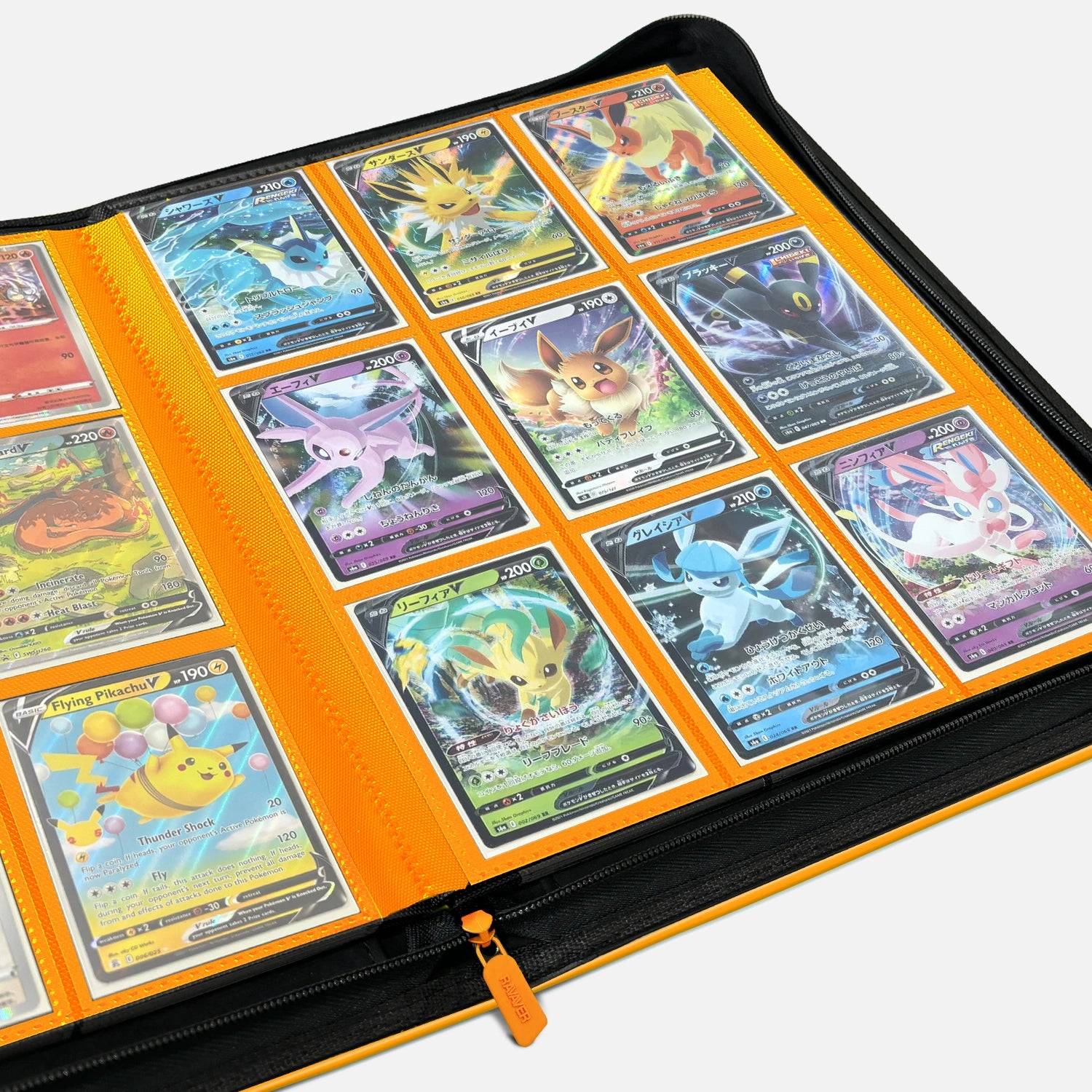
This is one of the most-debated questions in modern Pokemon collecting, and the honest answer depends on three things almost nobody asks before deciding: what the card is worth, what the room looks like, and whether the collector ever plans to sell. Most graded-vs-raw display advice skips all three and gives a blanket recommendation. The real answer is more situational. For the wider framework this question fits into, see the 2026 complete display guide and the PSA, BGS, CGC grading 101.
Key Takeaways
- Graded slabs are objectively safer for display because of the rigid case and standardized framing.
- Raw cards in magnetic one-touch holders are nearly as safe and dramatically cheaper, with one major caveat: condition isn't certified.
- For cards under ~$100 in value, display raw. For cards over ~$300, slab. The middle is judgment.
- The biggest hidden cost of display-raw-then-grade-later is that handling for display can drop a future grade by a half-point.
- Frames designed for slabs and frames designed for toploaders are not interchangeable.
What's the actual safety difference between displaying a slab and a raw card?
A PSA, CGC, or BGS slab is a sealed acrylic case. The card inside can't shift, can't catch dust, can't be touched without breaking the seal. Most slabs offer some baseline UV resistance, with PSA's newer cases marketed as UV-protective. Independent testing has confirmed measurable UV blocking across the three major grading companies' modern slab cases.
A raw card in a magnetic one-touch holder is also fully sealed, also UV-protective in most modern one-touches, and dust-tight. The functional protection is similar. The difference is what's not certified: nobody has verified the card's grade. If the card had a hairline edge whitening when it went into the holder, it still has that edge whitening. The display doesn't disclose it.
That difference matters most when the card is eventually sold. A buyer trusts a slab grade. A buyer of a raw card has to inspect, which usually means lower offers or refusal to buy sight-unseen.
Does the value of the card change the answer?
Yes, more than any other factor. Here's the practical breakdown:
| Card value (raw) | Grading cost worth it? | Display recommendation |
|---|---|---|
| Under $50 | Usually no | Display raw in magnetic one-touch |
| $50-150 | Sometimes (if PSA 10 likely) | Display raw unless grading is planned |
| $150-300 | Usually yes | Slab first, then display |
| $300-800 | Almost always yes | Slab first, then display in proper frame |
| Over $800 | Always yes | Slab and consider a shadowbox |
The math is simple at the extremes. A $30 card doesn't justify a $30 grading submission plus a $25 slab frame. A $500 card without a slab is sitting on a wall claiming to be a $500 card with no third-party validation, which depresses the resale value.
The middle is where collectors argue. The most common compromise for cards in the $100-300 range is display-raw-now-grade-later-if-I-decide-to-sell. That works in theory. In practice, every time the card comes out of the holder for cleaning, photographing, or repositioning, the grade potential drops slightly. PSA's submission guidance notes that micro-surface wear and edge whitening from handling are among the most common downgrades.
How does the room change the answer?
UV exposure is the variable most people underestimate. A slabbed card on a sunny south-facing wall is safer than a raw card in the same spot, but neither is truly safe long-term without an additional UV-filtering frame. A raw card in a magnetic one-touch in a dim corner of a study can outlast a slab on a sunlit shelf.
The other room factor is foot traffic. Slabs are heavier and more impact-resistant. A toddler, a cat, or a hurried adult knocking a slab off a shelf usually means a scratched case, not a damaged card. The same knock to a wall-mounted raw card in a thin acrylic frame can crack the frame or pop the card loose.
What about the prestige factor?
Worth saying out loud because it drives a lot of decisions even when collectors don't admit it: slabs read as more serious. A wall of slabs reads like a curated investment collection. A wall of raw cards reads like a personal collection. Neither is better. They communicate different things, and people choose based on what they want the wall to say about them.
Among r/PokemonTCG users who post collection room photos, the highest-engagement posts are almost always slab-heavy. That's social proof. But it's also a feedback loop, because people who slab tend to invest more in display, which means slab walls are the ones getting photographed and shared. Raw walls can be just as visually striking; they just don't get the same algorithm boost.
Should you ever grade a card just for display?
Sometimes, with a caveat. The case for grading a $80 card to display: the slab case adds physical protection, the grade adds confidence, the presentation gets cleaner. The case against: grading fees plus shipping plus the slab frame can total $50-80 in costs for a card worth $80 raw. If the card never sells, that's pure expense.
Where grading-for-display starts to make sense is sentimental cards. The first pull from a particular set, the card that started the collection, a holographic chase card with personal story. Slabbing those isn't an investment decision, it's a preservation decision. The cost is justified by the keepsake value, not the resale value.
What about cards being saved to grade later?
These are the cards that cause the most regret. A collector pulls a Charizard SIR, knows it's likely a PSA 10 candidate, decides to enjoy it raw for just-a-few-months before submitting. Six months later the card has been pulled out a dozen times, has a hairline edge whiten, and grades as a 9. The 9 is still valuable, but it's not the 10 it could have been.
The cleanest rule for grading candidates: put the card in a magnetic one-touch holder the moment it's pulled, leave it there, and either grade it within 60 days or commit to keeping it raw long-term. The middle path of display-while-undecided is where grade points get lost.
Frequently Asked Questions
Can I display a raw card on a wall safely for years?
Yes, with the right setup. Magnetic one-touch holder with UV protection, frame with additional UV-filtering acrylic, indirect light, rotated every 6-12 months. The card can stay in display condition indefinitely under those conditions. The risk increases the moment any of those layers is missing.
Are slab frames a good gift for a graded card someone already owns?
Excellent gift, low risk. A single-slab display frame is universal across PSA, BGS, CGC, SGC, and most other major graders, so the gift works regardless of which company graded the card. Standalone frames run $15-40, and recipients almost always appreciate the upgrade.
Does displaying a slab fade the card inside?
Slabs offer baseline UV resistance but not full UV blocking. A slab in direct sunlight over several years can still see card fade. The safe approach is treating the slab like an unprotected card for UV purposes: keep it out of direct sun or add a UV-filtering frame on top of the slab.
What if my best card is graded but lower than I'd like, like a PSA 8?
Display it anyway. The graded label is more important than the specific grade for display purposes. A PSA 8 in a slab frame still reads as a serious collector card. The slab grade matters most at resale, less at display.
Can I get a raw card grade-protected without paying for grading?
Sort of. A perfect-fit inner sleeve plus a magnetic one-touch holder gives a card most of the physical protection a slab provides, minus the certification and the rigid case. It's not equivalent to a slab for resale value, but for personal display, it's close enough that many collectors choose this path for everything below the grail tier.
Is it worth slabbing a card just to fit it in a slab frame?
Almost never. Slab frames are designed to fit existing slabs; the slab itself should be justified on its own grounds (value, certification, condition). If the only reason to grade is so-it-fits-the-frame, buy a magnetic one-touch and a one-touch-sized frame instead. Save the grading budget for cards where it actually adds value.
Where to take this next
If you have one card in mind right now, ask three questions about it: what's it worth raw, what room would it go in, and do you plan to sell. If the answer to question one is over $300, slab it. If it's under $50, display it raw. Everything else is judgment, and the best test is to put the card in a one-touch on a desk for a month before deciding what frame, if any, to commit to.
For the layer underneath the wall, where active cards live between display rotations, the toploader-compatible binders at Ravaver hold both raw cards (in slots) and slabs (in slab-compatible variants). Different binder, same job: keep the cards organized while you figure out which ones earn a frame.
Sources:
- PSA, Card Preservation Guidelines, retrieved 2026-05-12, https://www.psacard.com/articles
- Elite Fourum, UV protection of graded cards: PSA vs CGC vs BGS, retrieved 2026-05-12, https://www.elitefourum.com/t/uv-protection-of-graded-cards-psa-vs-cgc-vs-bgs/34202
- Phantom Display, Best Graded Card Display Cases for PSA and BGS, retrieved 2026-05-12, https://phantomdisplay.com/blogs/blog/psa-slab-case-101